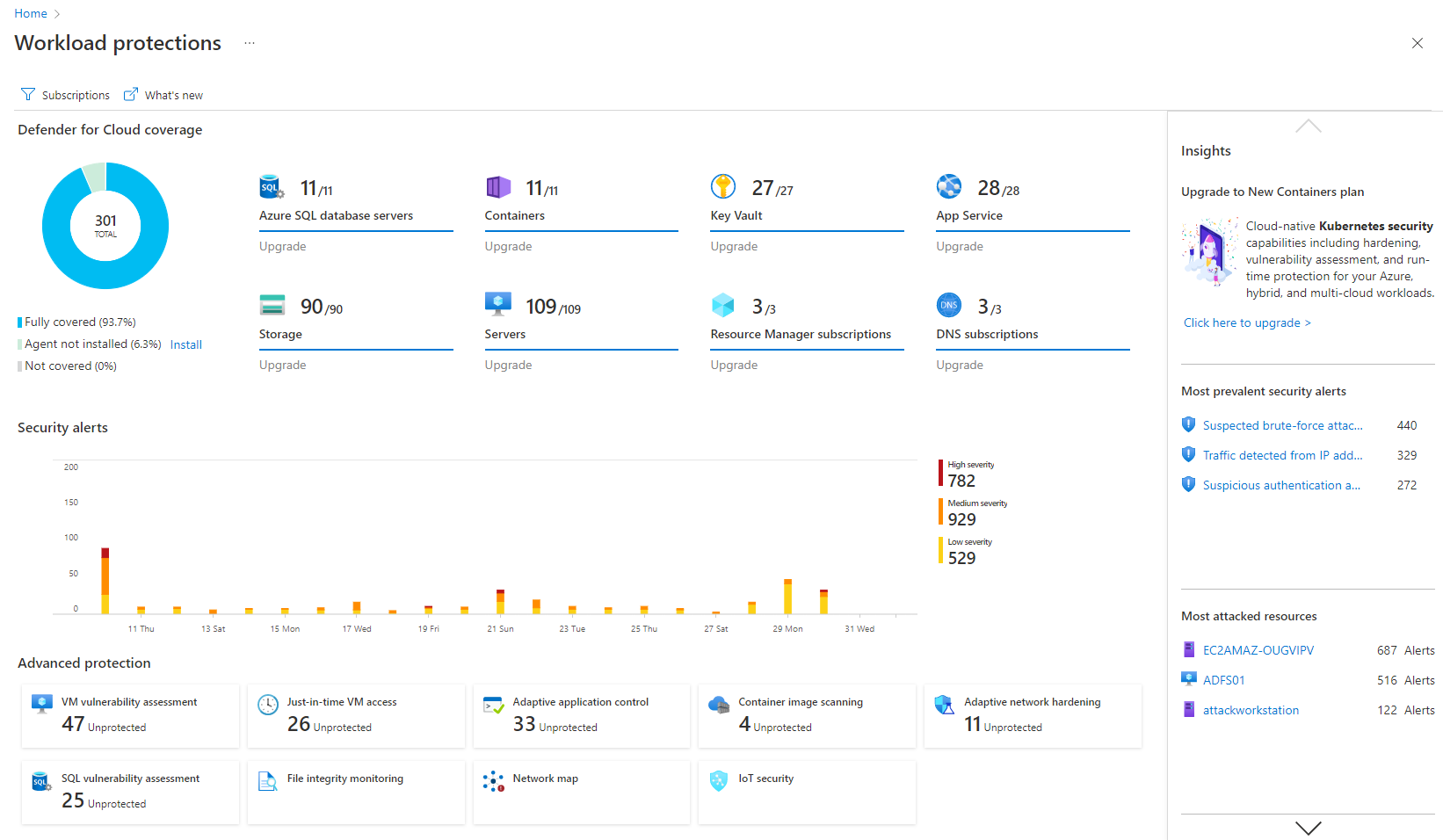
Microsoft Defender for Cloud is a Cloud Security Posture Management (CSPM) and Cloud Workload Protection Platform (CWPP) for Azure, on-premises, and multicloud (Amazon AWS and Google GCP) resources.
N/A
Portainer
Score9.8 out of 10
N/A
Portainer is a centralized container management platform for containerized apps and IoT device management. It helps accelerate container adoption and reduce time-to-value on Kubernetes, Docker, and Swarm with a management portal, allowing users to deliver and manage containerized applications from the data center to the edge. Portainer helps - Reduce the operational complexity associated with multi-cluster management Bridge the skills gap and facilitate feature…
I think it's good for cloud-native companies. A company that, from day zero, they're like, "We're going cloud, and this is how we're going to do it." They get it. It works well for them. Smaller organizations that are under X amount of resources- I don't know what that X might mean- but I feel like it plays well in smaller, more nimble organizations. If you're an older organization or if you're extremely large, it starts becoming a little difficult to manage at scale. And you have to sometimes throw bodies at the problem. Maybe not the most eloquent way of saying it, but that's what it feels like.
A de minimis incentive was given to thank the reviewer for their time. The incentive was not used to bias or drive a particular response, nor was the incentive contingent on a positive endorsement. More Info
Many developers, especially lesser experienced developers, don't have a really good background in setting up containers from the command line. Portainer is invaluable to them. Giving a UI to them gives them much more confidence and allows them to learn properties and capabilities of containers under far less stress. On the flip side of this, giving then a UI on a production system can lead to chaos...never give junior developers access to production servers.
A de minimis incentive was given to thank the reviewer for their time. The incentive was not used to bias or drive a particular response, nor was the incentive contingent on a positive endorsement. More Info
It's really well laid out, with an easy-to-use, accessible UI.
With Microsoft Defender for Cloud, it has everything you need with the Safelink attachment, the Safelink emails for URL, the way it scans those URLs and attachments within the product, and you're seeing the results. And that adds an extra layer of security for the user, so you feel comfortable knowing the product monitors those. That's something I really like about that product.
A de minimis incentive was given to thank the reviewer for their time. The incentive was not used to bias or drive a particular response, nor was the incentive contingent on a positive endorsement. More Info
Separating server maintenance with application development, providing a clear user interface for developers who don't want to worry about the underlying server.
RBAC for container deployment linked to a SAML IDP, not something particularly easy in a native Docker instance but point and shoot in Portainer, allowing the use of Azure / Okta etc to provide user access.
Image management with multiple repositories is super clear and reduces incidents
A de minimis incentive was given to thank the reviewer for their time. The incentive was not used to bias or drive a particular response, nor was the incentive contingent on a positive endorsement. More Info
Integrations with on-premise workloads can sometimes be challenging. Needs improvement and well standardised integration points
Vulnerability categories can be difficult to understand. It should allow teams to focus on critical findings and help them keep aside low-severity or suppressed vulnerabilities
Pricing can be improved as it can be over-priced for smaller businesses and would potentially affect their ROI due to the small scale
A de minimis incentive was given to thank the reviewer for their time. The incentive was not used to bias or drive a particular response, nor was the incentive contingent on a positive endorsement. More Info
When setting up static IPs for a new container, having the used ones for a specific network at hand would be cool or something like a mini IPAM of some sort...
Using the developertools to see "oh, it's a 40x or 500" when something doesn't seem to load because the ui just states "Didn't work" is kinda annoying. expandable toasts or something would be nice.
A de minimis incentive was given to thank the reviewer for their time. The incentive was not used to bias or drive a particular response, nor was the incentive contingent on a positive endorsement. More Info
It is a great product that integrates nicely when running an Azure platform and even multi-cloud environment. Not looking for point-solutions but a suite that answers most requirements. It is very comfortable being able to use KQL, workbooks and automation that is native to the azure platform
My visibility is limited because I'm only doing very small pieces of what the overall org does. And also, we have limitations on what we're allowed to use. It's not like we get a new product as users or leadership level users, and everything is on, and we can just do whatever we want. We're very restricted in what we can use any tooling within the org because of the different levels of regulatory constraints we have, because of just the nature of who we are inherently. So that's why. I don't think it's necessarily the product. I think it's more or less of what we're able to do with the product.
A de minimis incentive was given to thank the reviewer for their time. The incentive was not used to bias or drive a particular response, nor was the incentive contingent on a positive endorsement. More Info
Accessibility for Non-Experts: even with some people having a bit longer on-boarding it is still very simple Quick setup is insanely useful, we can get it running in 10 seconds after installing docker Portainer has once again super clean UI and is very user friendly. Deployment/monitoring and management are super easy. I can tell just from a glance if something is out of date (watching at you Watchtower not doing your job for some reason)
A de minimis incentive was given to thank the reviewer for their time. The incentive was not used to bias or drive a particular response, nor was the incentive contingent on a positive endorsement. More Info
One of their staff members jumped on a video call immediately with me and led me through the problem and solution during a quick session of screen sharing. In this day and age that is above and beyond, especially when it comes to software. It took approximately 5-10 minutes to diagnose and fix, including pleasantries!
A de minimis incentive was given to thank the reviewer for their time. The incentive was not used to bias or drive a particular response, nor was the incentive contingent on a positive endorsement. More Info
I believe Microsoft Defender for Cloud stacks up well against the other tools we looked at. It is native to the Azure platform and provides the same insights as the other tools. We selected Microsoft Defender for Cloud because it integrates well with the Azure resources and gives the needed insight, security alerts and recommendations.
A de minimis incentive was given to thank the reviewer for their time. The incentive was not used to bias or drive a particular response, nor was the incentive contingent on a positive endorsement. TR verified that a representative sample of customers was invited. More Info
Portainer takes the cup in terms of usability and features. It is also more useful for smaller deployments, whereas Kubernetes in our opinion and experience, could probably be more suited to certain other use cases. Portainer is also a fresh feel among all the preexisting container management solutions and brings positivity and a new breeze in the industry.
A de minimis incentive was given to thank the reviewer for their time. The incentive was not used to bias or drive a particular response, nor was the incentive contingent on a positive endorsement. More Info
Increased productivity: Portainer's user-friendly interface and streamlined container management can help increase the productivity of IT teams.
Cost savings: By simplifying container management, Portainer can help reduce the time and resources required to manage container environments, potentially leading to cost savings.
A de minimis incentive was given to thank the reviewer for their time. The incentive was not used to bias or drive a particular response, nor was the incentive contingent on a positive endorsement. More Info