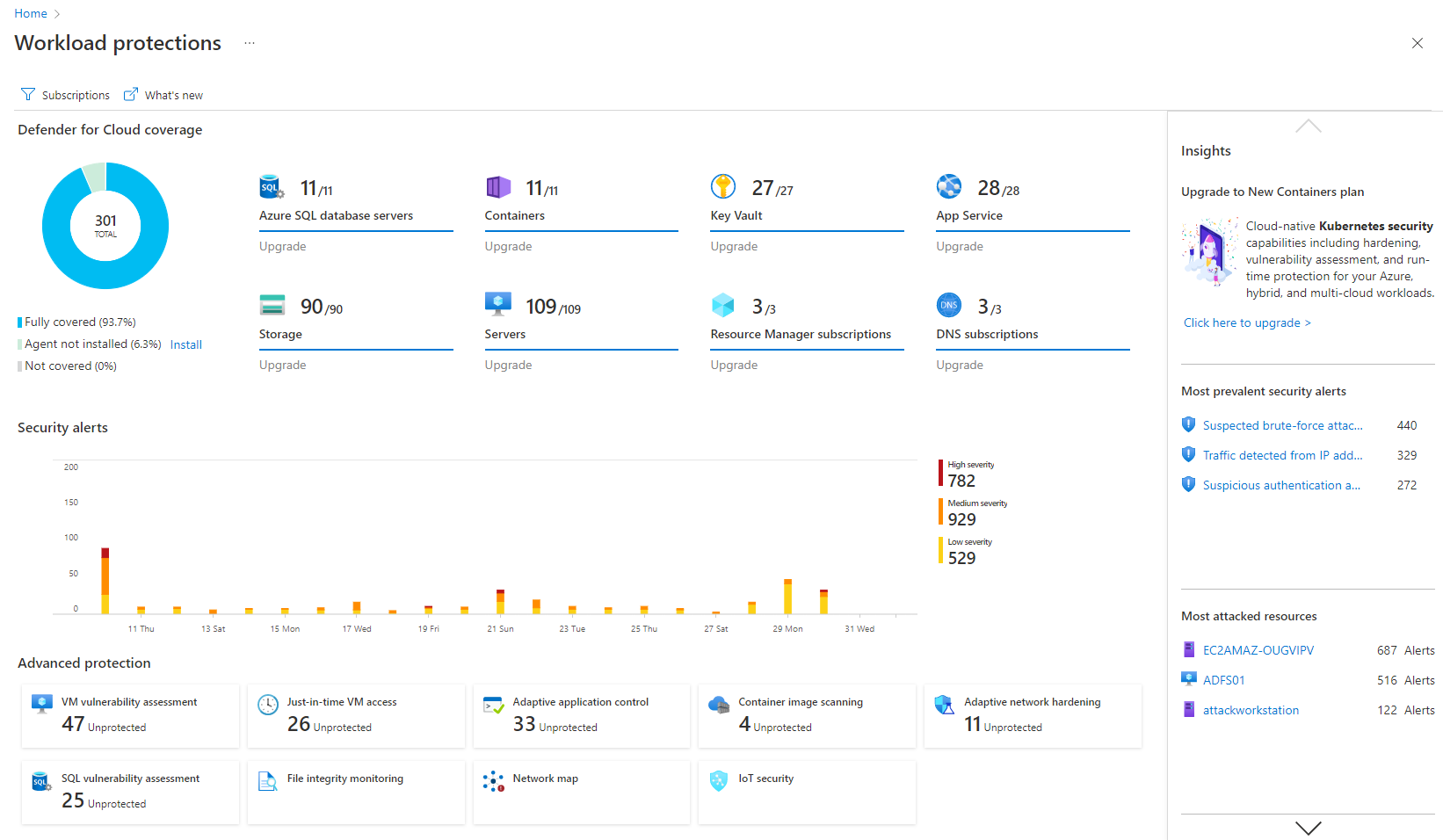
Microsoft Defender for Cloud is a Cloud Security Posture Management (CSPM) and Cloud Workload Protection Platform (CWPP) for Azure, on-premises, and multicloud (Amazon AWS and Google GCP) resources.
N/A
Tenable Cloud Security
Score 9.2 out of 10
N/A
Tenable Cloud Security (formerly Tenable.cs) enables security teams to continuously assess the security posture of their cloud environments by maintaining a current inventory of cloud assets for proactive analysis whenever a new vulnerability is published without a user having to take any actions. It includes technology from Accurics, acquired by Tenable in September 2021.
N/A
Wiz
Score 8.6 out of 10
N/A
Wiz is a Tel Aviv based, cloud risk visibility solution for enterprise security. It provides a 360° view of security risks across clouds, containers and workloads.
Defender has the benefit of all the integration, included licensing for defender for server and being able to start small and grow.
Wiz licensing was too expensive, lacking features like an EDR making it a less favorable solution
Verified User
Contributor
Chose Microsoft Defender for Cloud
I believe Microsoft Defender for Cloud stacks up well against the other tools we looked at. It is native to the Azure platform and provides the same insights as the other tools. We selected Microsoft Defender for Cloud because it integrates well with the Azure resources and …
After previously utilizing Orca and testing Tenable, we preferred Wiz over the competition. The reporting, usability, and feature-rich platform enabled us to investigate security risks and issues simultaneously.
Microsoft is well-suited with its definitive cloud, and I also like its Microsoft Intune ID. The conditional policies are great with that, and they're really good and well situated, so you can't beat them at that conditional policy level. Less appropriate, as I said, some of these low-hanging fruit features, like being good in phishing campaigns, and then I feel like maybe doing better at their seam products. So we'll see how that goes.
In its current version, it is basic. There are nice new features that should provide a good overall picture of the configuration and security of the account.
Wiz is well-suited if you want to run real-time scans against resources that were recently patched or configured. It is good to keep track of vulnerabilities found and what can be done to resolve the issues without having to open up multiple tabs. Overall, it is good to keep an eye on how well cloud teams or cloud security teams are doing.
Multi-cloud: Ability of Wiz to integrate with all of our cloud platforms makes it easy to deploy and centralizes our insights into all environments
UI/UX: Wiz's UI is one of, if not -- the best UI I have ever used in a security application. Wiz is able to make it easy to follow and use the application to simplify the normally overcomplicated process of parsing through security information and tools.
Marketing: Hosting meetups such as Wizdom has demonstrated Wiz's investment into its customers by providing us with more encouragement to use the app. The merch, ads, and presentation are above and beyond many companies in the tech industry.
Threat Intel: We rely on Wiz for the latest finds in vulnerabilities across all platforms, and since it is incorporated into the application, it makes this easy and fast to push out necessary steps without going through multiple layers of communication between vendors, cyber governance, security analysts, and developers.
Granular permissions and role-based access management could improve security. This would enable organizations to control who has access to and can set specific features.
While it offers integration with various Microsoft services, expanding support for third-party cloud platforms and applications would enhance its versatility. Many organizations use multiple cloud providers, and broader compatibility would be advantageous.
The cost structure could be more transparent, especially for larger organizations with extensive cloud resources. Clearer cost breakdowns and predictions would help organizations budget more effectively.
It is a great product that integrates nicely when running an Azure platform and even multi-cloud environment. Not looking for point-solutions but a suite that answers most requirements. It is very comfortable being able to use KQL, workbooks and automation that is native to the azure platform
My visibility is limited because I'm only doing very small pieces of what the overall org does. And also, we have limitations on what we're allowed to use. It's not like we get a new product as users or leadership level users, and everything is on, and we can just do whatever we want. We're very restricted in what we can use any tooling within the org because of the different levels of regulatory constraints we have, because of just the nature of who we are inherently. So that's why. I don't think it's necessarily the product. I think it's more or less of what we're able to do with the product.
The UI is very user-friendly, with documentation available on every page of the application. New users can learn about the product features as they navigate through several different pages, using the instructions at the top of each page, making it quite easy to use.
Microsoft Defender for Cloud is definitely the choice with the latest market trend and attacks that are currently happening. Microsoft has been able to safe guard a lot after the recent serious attacks happening globally in the digital world. There is a trust in this software and with the latest updates and machine learning capabilities, Microsoft Defender for Cloud should be the choice.
We looked at this over a year ago, the space was still young. Censys provided what we originally needed, but was soon outdone by Tenable with their initial release. I am sure that Censys improved as well, but it was easier to expand on our current Tenable license.
We previously used Lacework but transitioned to Wiz as part of our effort to improve cloud security visibility and streamline risk management. While Lacework provided useful insights, we found that Wiz offered a clearer, more intuitive interface and better collaboration features, making it easier for both Security and Engineering teams to work together. The Security Graph and automated risk analysis in Wiz have been especially valuable, helping us quickly understand exposures and prioritise fixes. Overall, the transition to Wiz has improved how we manage security risks across our cloud environment.
It simplifies security management and saves time. I'm not sure, but I'm very confident it saved me a couple of paychecks by centralizing the data I need to secure the cloud environment.
I also utilize the inventory overview to monitor my team's activities and verify they are following internal regulations, as well as cost overruns.
The recommendations can be utilized as a valuable instructional tool. I have the team explain why they are receiving them, why they are not following them, and what they are doing differently.
Wiz has saved us a lot of money and headaches. It finds problems we didn't even know we had, like weak passwords and open ports. This helps us fix things before hackers can find them. It's like having a team of security experts working 24/7.
Plus, Wiz can fix some problems itself, saving us time and money. It's a great investment for our business.
Wiz has made our cloud much safer. It helps us find and fix problems quickly, which means we can focus on our core business. It's like having an extra layer of protection for our data and systems.