MySQL is a popular open-source relational and embedded database, now owned by Oracle.
N/A
Percona Server for MongoDB
Score 8.4 out of 10
N/A
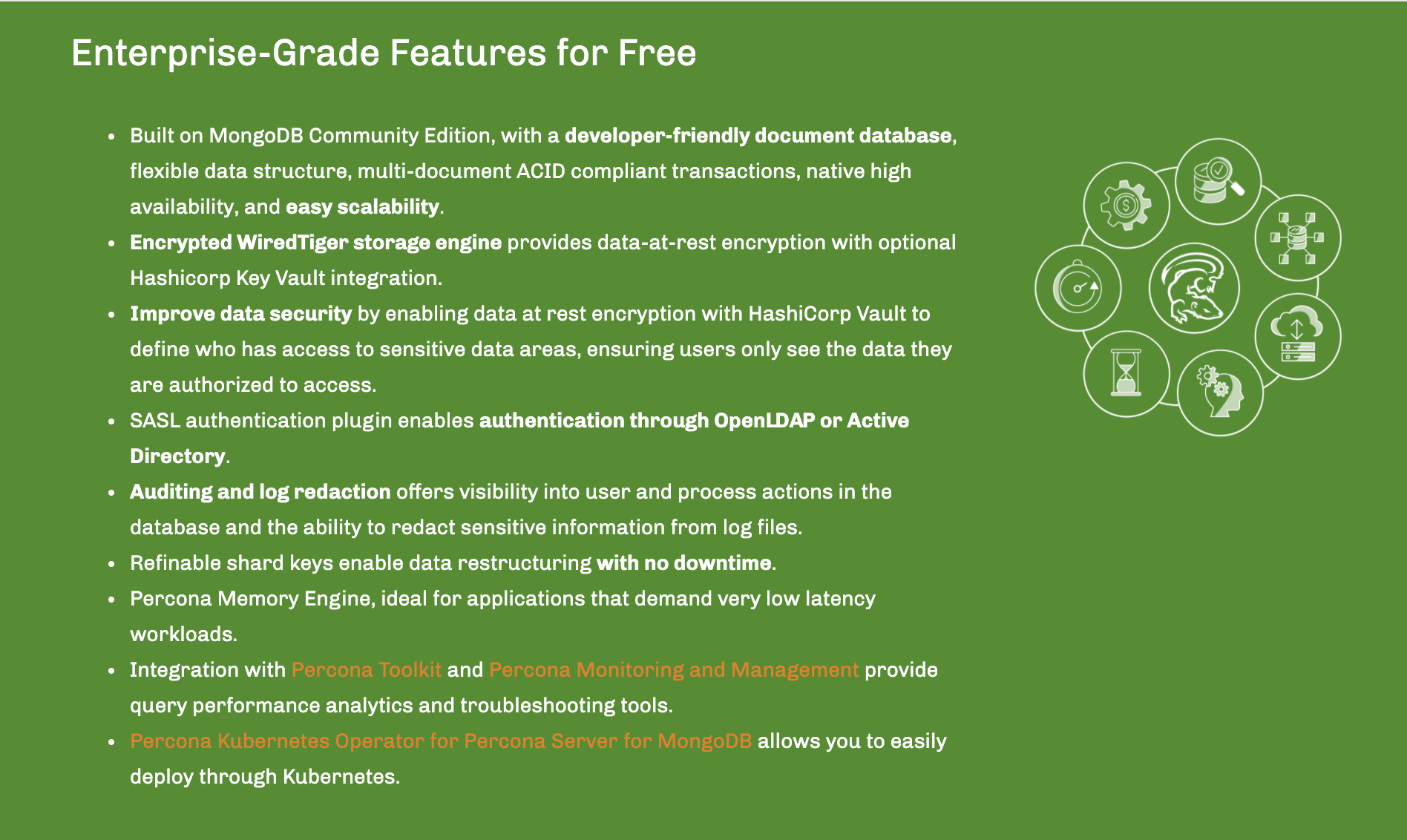
Percona Server for MongoDB is a free and open-source drop-in replacement for MongoDB Community Edition. It combines all the features and benefits of MongoDB Community Edition with enterprise-class features from Percona. Built on the MongoDB Community Edition, Percona Server for MongoDB provides flexible data structure, native high availability, easy scalability, and developer-friendly syntax. It also includes an in-memory engine, hot backups, LDAP authentication, database auditing, and log…
At the performance level, it is similar to other solutions such as MongoDB and Percona Server for MySQL. and at the customization level, it offers better support for the development of specific solutions that seek good performance in transactions.
MySQL is best suited for applications on platform like high-traffic content-driven websites, small-scale web apps, data warehouses which regards light analytical workloads. However its less suited for areas like enterprise data warehouse, OLAP cubes, large-scale reporting, applications requiring flexible or semi-structured data like event logging systems, product configurations, dynamic forms.
It offers good support for the implementation of solutions in the public and on-premises cloud and integration with other services such as Hashicorp Vault for data encryption. One of the main advantages is the ease of configuration, in addition to offering transaction support for the different operations and scalability of the servers.
Learning curve: is big. Newbies will face problems in understanding the platform initially. However, with plenty of online resources, one can easily find solutions to problems and learn on the go.
Backup and restore: MySQL is not very seamless. Although the data is never ruptured or missed, the process involved is not very much user-friendly. Maybe, a new command-line interface for only the backup-restore functionality shall be set up again to make this very important step much easier to perform and maintain.
For teaching Databases and SQL, I would definitely continue to use MySQL. It provides a good, solid foundation to learn about databases. Also to learn about the SQL language and how it works with the creation, insertion, deletion, updating, and manipulation of data, tables, and databases. This SQL language is a foundation and can be used to learn many other database related concepts.
I give MySQL a 9/10 overall because I really like it but I feel like there are a lot of tech people who would hate it if I gave it a 10/10. I've never had any problems with it or reached any of its limitations but I know a few people who have so I can't give it a 10/10 based on those complaints.
One aspect to improve is the user experience since sometimes the steps to take are not clear and the user may need to review some of the actions before continuing with the next ones. Another aspect to improve is the documentation and support for developers who want to know the tool.
We have never contacted MySQL enterprise support team for any issues related to MySQL. This is because we have been using primarily the MySQL Server community edition and have been using the MySQL support forums for any questions and practical guidance that we needed before and during the technical implementations. Overall, the support community has been very helpful and allowed us to make the most out of the community edition.
It offers good support for the implementation of solutions in the public and on-premises cloud and integration with other services such as Hashicorp Vault for data encryption. Also, it offers support for different compatible programming languages such as C, C ++, Java, as well as offering good support for the persistence of schema-free data and the possibility of saving data in memory.
MongoDB has a dynamic schema for how data is stored in 'documents' whereas MySQL is more structured with tables, columns, and rows. MongoDB was built for high availability whereas MySQL can be a challenge when it comes to replication of the data and making everything redundant in the event of a DR or outage.
At the performance level, it is similar to other solutions such as MongoDB and Percona Server for MySQL. and at the customization level, it offers better support for the development of specific solutions that seek good performance in transactions.