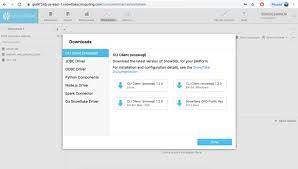
The Snowflake Cloud Data Platform is the eponymous data warehouse with, from the company in San Mateo, a cloud and SQL based DW that aims to allow users to unify, integrate, analyze, and share previously siloed data in secure, governed, and compliant ways. With it, users can securely access the Data Cloud to share live data with customers and business partners, and connect with other organizations doing business as data consumers, data providers, and data service providers.
N/A
TensorFlow
Score7.6 out of 10
N/A
TensorFlow is an open-source machine learning software library for numerical computation using data flow graphs. It was originally developed by Google.
N/A
Pricing
Snowflake
TensorFlow
Editions & Modules
No answers on this topic
No answers on this topic
Offerings
Pricing Offerings
Snowflake
TensorFlow
Free Trial
Yes
No
Free/Freemium Version
No
No
Premium Consulting/Integration Services
No
No
Entry-level Setup Fee
No setup fee
No setup fee
Additional Details
—
—
More Pricing Information
Community Pulse
Snowflake
TensorFlow
Considered Both Products
Snowflake Computing
Verified User
Chose Snowflake
Our initial data warehousing solution was Treasure Data. We had issues with the costly pricing model, which would be exhorbitant if we want to hold our data in memory and query using Presto. As a result, some heavy lifting was done in Hive (managed by Treasure Data); …
A de minimis incentive was given to thank the reviewer for their time. The incentive was not used to bias or drive a particular response, nor was the incentive contingent on a positive endorsement. More Info
Snowflake is well suited when you have to store your data and you want easy scalability and increase or decrease the storage per your requirement. You can also control the computing cost, and if your computing cost is less than or equal to 10% of your storage cost, then you don't have to pay for computing, which makes it cost-effective as well.
A de minimis incentive was given to thank the reviewer for their time. The incentive was not used to bias or drive a particular response, nor was the incentive contingent on a positive endorsement. More Info
TensorFlow is great for most deep learning purposes. This is especially true in two domains: 1. Computer vision: image classification, object detection and image generation via generative adversarial networks 2. Natural language processing: text classification and generation. The good community support often means that a lot of off-the-shelf models can be used to prove a concept or test an idea quickly. That, and Google's promotion of Colab means that ideas can be shared quite freely. Training, visualizing and debugging models is very easy in TensorFlow, compared to other platforms (especially the good old Caffe days). In terms of productionizing, it's a bit of a mixed bag. In our case, most of our feature building is performed via Apache Spark. This means having to convert Parquet (columnar optimized) files to a TensorFlow friendly format i.e., protobufs. The lack of good JVM bindings mean that our projects end up being a mix of Python and Scala. This makes it hard to reuse some of the tooling and support we wrote in Scala. This is where MXNet shines better (though its Scala API could do with more work).
A de minimis incentive was given to thank the reviewer for their time. The incentive was not used to bias or drive a particular response, nor was the incentive contingent on a positive endorsement. More Info
Snowflake scales appropriately allowing you to manage expense for peak and off peak times for pulling and data retrieval and data centric processing jobs
Snowflake offers a marketplace solution that allows you to sell and subscribe to different data sources
Snowflake manages concurrency better in our trials than other premium competitors
Snowflake has little to no setup and ramp up time
Snowflake offers online training for various employee types
A de minimis incentive was given to thank the reviewer for their time. The incentive was not used to bias or drive a particular response, nor was the incentive contingent on a positive endorsement. More Info
A de minimis incentive was given to thank the reviewer for their time. The incentive was not used to bias or drive a particular response, nor was the incentive contingent on a positive endorsement. More Info
Do not force customers to renew for same or higher amount to avoid loosing unused credits. Already paid credits should not expire (at least within a reasonable time frame), independent of renewal deal size.
A de minimis incentive was given to thank the reviewer for their time. The incentive was not used to bias or drive a particular response, nor was the incentive contingent on a positive endorsement. More Info
Theano is perhaps a bit faster and eats up less memory than TensorFlow on a given GPU, perhaps due to element-wise ops. Tensorflow wins for multi-GPU and “compilation” time.
SnowFlake is very cost effective and we also like the fact we can stop, start and spin up additional processing engines as we need to. We also like the fact that it's easy to connect our SQL IDEs to Snowflake and write our queries in the environment that we are used to
A de minimis incentive was given to thank the reviewer for their time. The incentive was not used to bias or drive a particular response, nor was the incentive contingent on a positive endorsement. More Info
Because the fact that you can query tons of data in a few seconds is incredible, it also gives you a lot of functions to format and transform data right in your query, which is ideal when building data models in BI tools like Power BI, it is available as a connector in the most used BI tools worldwide.
A de minimis incentive was given to thank the reviewer for their time. The incentive was not used to bias or drive a particular response, nor was the incentive contingent on a positive endorsement. More Info
A de minimis incentive was given to thank the reviewer for their time. The incentive was not used to bias or drive a particular response, nor was the incentive contingent on a positive endorsement. More Info
We have had terrific experiences with Snowflake support. They have drilled into queries and given us tremendous detail and helpful answers. In one case they even figured out how a particular product was interacting with Snowflake, via its queries, and gave us detail to go back to that product's vendor because the Snowflake support team identified a fault in its operation. We got it solved without lots of back-and-forth or finger-pointing because the Snowflake team gave such detailed information.
A de minimis incentive was given to thank the reviewer for their time. The incentive was not used to bias or drive a particular response, nor was the incentive contingent on a positive endorsement. More Info
Community support for TensorFlow is great. There's a huge community that truly loves the platform and there are many examples of development in TensorFlow. Often, when a new good technique is published, there will be a TensorFlow implementation not long after. This makes it quick to ally the latest techniques from academia straight to production-grade systems. Tooling around TensorFlow is also good. TensorBoard has been such a useful tool, I can't imagine how hard it would be to debug a deep neural network gone wrong without TensorBoard.
A de minimis incentive was given to thank the reviewer for their time. The incentive was not used to bias or drive a particular response, nor was the incentive contingent on a positive endorsement. More Info
A de minimis incentive was given to thank the reviewer for their time. The incentive was not used to bias or drive a particular response, nor was the incentive contingent on a positive endorsement. More Info
I have had the experience of using one more database management system at my previous workplace. What Snowflake provides is better user-friendly consoles, suggestions while writing a query, ease of access to connect to various BI platforms to analyze, [and a] more robust system to store a large amount of data. All these functionalities give the better edge to Snowflake.
A de minimis incentive was given to thank the reviewer for their time. The incentive was not used to bias or drive a particular response, nor was the incentive contingent on a positive endorsement. More Info
Keras is built on top of TensorFlow, but it is much simpler to use and more Python style friendly, so if you don't want to focus on too many details or control and not focus on some advanced features, Keras is one of the best options, but as far as if you want to dig into more, for sure TensorFlow is the right choice
A de minimis incentive was given to thank the reviewer for their time. The incentive was not used to bias or drive a particular response, nor was the incentive contingent on a positive endorsement. More Info
A de minimis incentive was given to thank the reviewer for their time. The incentive was not used to bias or drive a particular response, nor was the incentive contingent on a positive endorsement. More Info
A de minimis incentive was given to thank the reviewer for their time. The incentive was not used to bias or drive a particular response, nor was the incentive contingent on a positive endorsement. More Info