Microsoft's SQL Server Integration Services (SSIS) is a data integration solution.
N/A
Xactly Connect
Score 9.6 out of 10
N/A
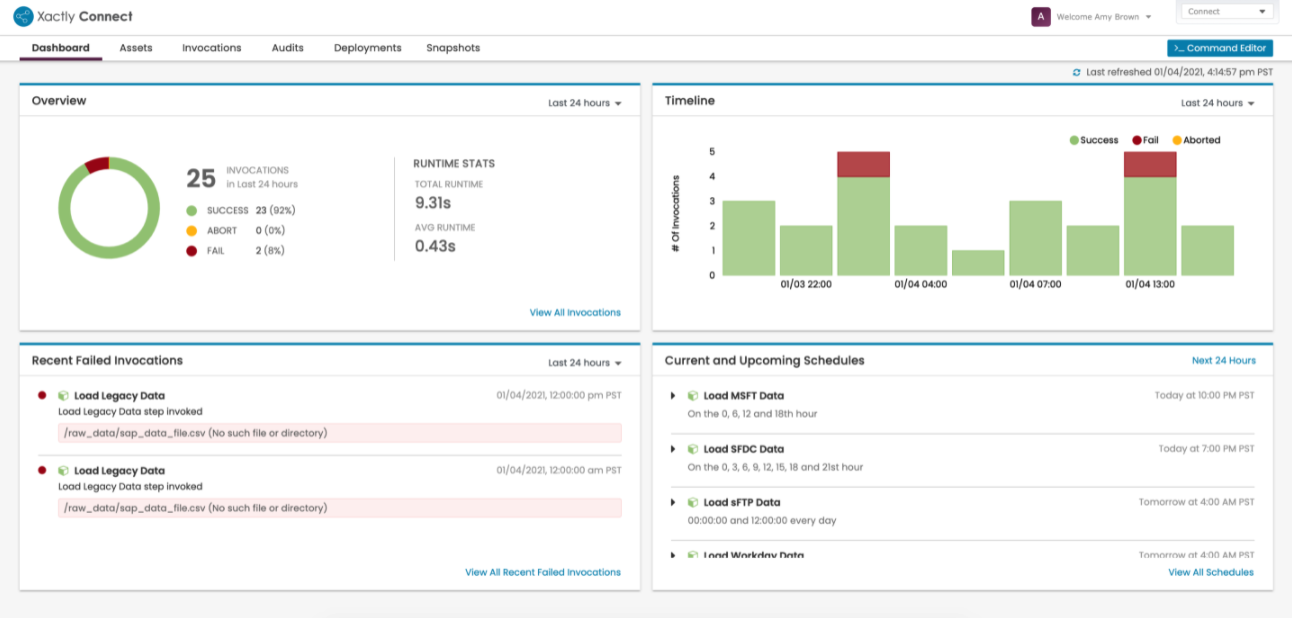
Xactly Connect is a purpose-built platform designed to automate and integrate the secure flow of data from business applications across Xactly solutions. Connect enables organizations to apply custom business logic to data flows and use standardized automation processes to combine Xactly data with internal and external data sources.
N/A
Pricing
SQL Server Integration Services (SSIS)
Xactly Connect
Editions & Modules
No answers on this topic
No answers on this topic
Offerings
Pricing Offerings
SSIS
Xactly Connect
Free Trial
No
No
Free/Freemium Version
No
No
Premium Consulting/Integration Services
No
No
Entry-level Setup Fee
No setup fee
No setup fee
Additional Details
—
Contact Xactly for a demo and pricing.
More Pricing Information
Community Pulse
SQL Server Integration Services (SSIS)
Xactly Connect
Features
SQL Server Integration Services (SSIS)
Xactly Connect
Data Source Connection
Comparison of Data Source Connection features of Product A and Product B
SQL Server Integration Services (SSIS)
7.0
56 Ratings
16% below category average
Xactly Connect
-
Ratings
Connect to traditional data sources
9.056 Ratings
00 Ratings
Connecto to Big Data and NoSQL
5.043 Ratings
00 Ratings
Data Transformations
Comparison of Data Transformations features of Product A and Product B
SQL Server Integration Services (SSIS)
6.8
56 Ratings
17% below category average
Xactly Connect
-
Ratings
Simple transformations
9.056 Ratings
00 Ratings
Complex transformations
4.755 Ratings
00 Ratings
Data Modeling
Comparison of Data Modeling features of Product A and Product B
SQL Server Integration Services (SSIS)
7.5
54 Ratings
4% below category average
Xactly Connect
-
Ratings
Data model creation
9.028 Ratings
00 Ratings
Metadata management
6.035 Ratings
00 Ratings
Business rules and workflow
7.045 Ratings
00 Ratings
Collaboration
9.040 Ratings
00 Ratings
Testing and debugging
6.351 Ratings
00 Ratings
Data Governance
Comparison of Data Governance features of Product A and Product B
As I mentioned earlier SQL Server Integration Services is suitable if you want to manage data from different applications. It really helps in fetching the data and generating reports. Its automation make it very easy and time efficient. It works well with large database as well. But it doesn't work well with real time data, it will take some time to gather the real time data. I would not recommend using it in a real time/fast-paced environment.
When the client has source data in Salesforce, Workday or flat files, it works really well. If the client has too much data, it can be really slow or require lots of preprocessing. It's often better to do as much of the calculations as you can in the configuration rather than on the Xactly Connect side. So that regular comp admins with Incent Connect training but no Xactly Connect are able to make changes.
Connection managers for online data sources can be tricky to configure.
Performance tuning is an art form and trialing different data flow task options can be cumbersome. SSIS can do a better job of providing performance data including historical for monitoring.
Mapping destination using OLE DB command is difficult as destination columns are unnamed.
Excel or flat file connections are limited by version and type.
SQL isn't the same syntax in Connect as it is in Sequal Server Management Studio, making it difficult for communities outside of Xactly to help with certain issues.
Sometimes the scheduling part of the tool does not work as expected, but over all it is consistent.
Some features should be revised or improved, some tools (using it with Visual Studio) of the toolbox should be less schematic and somewhat more flexible. Using for example, the CSV data import is still very old-fashioned and if the data format changes it requires a bit of manual labor to accept the new data structure
SSIS is a great tool for most ETL needs. It has the 90% (or more) use cases covered and even in many of the use cases where it is not ideal SSIS can be extended via a .NET language to do the job well in a supportable way for almost any performance workload.
SQL Server Integration Services performance is dependent directly upon the resources provided to the system. In our environment, we allocated 6 nodes of 4 CPUs, 64GB each, running in parallel. Unfortunately, we had to ramp-up to such a robust environment to get the performance to where we needed it. Most of the reports are completed in a reasonable timeframe. However, in the case of slow running reports, it is often difficult if not impossible to cancel the report without killing the report instance or stopping the service.
Xactly is a very helpful tool ensuring appropriate and correct data is used when calculating commissions. The interface loads timely, but it is not intuitive to use. The learning curve to be proficient in Xactly takes a significant amount of time.
The support, when necessary, is excellent. But beyond that, it is very rarely necessary because the user community is so large, vibrant and knowledgable, a simple Google query or forum question can answer almost everything you want to know. You can also get prewritten script tasks with a variety of functionality that saves a lot of time.
The implementation may be different in each case, it is important to properly analyze all the existing infrastructure to understand the kind of work needed, the type of software used and the compatibility between these, the features that you want to exploit, to understand what is possible and which ones require integration with third-party tools
I think SQL Server Integration Services is better suited for on-premises data movement and ADF is more suited for the cloud. Though ADF has more connectors, SQL Server Integration Services is more robust and has better functionality just because it has been around much longer
Without this, we would have to manually update a spreadsheet of our SQL Server inventory
We would also have poor alerting; if an instance was down we wouldn't know until it was reported by a user
We only have one other person who uses SQL Server Integration Services , he's the expert. It would fall to me without him and I would not enjoy being responsible for it.