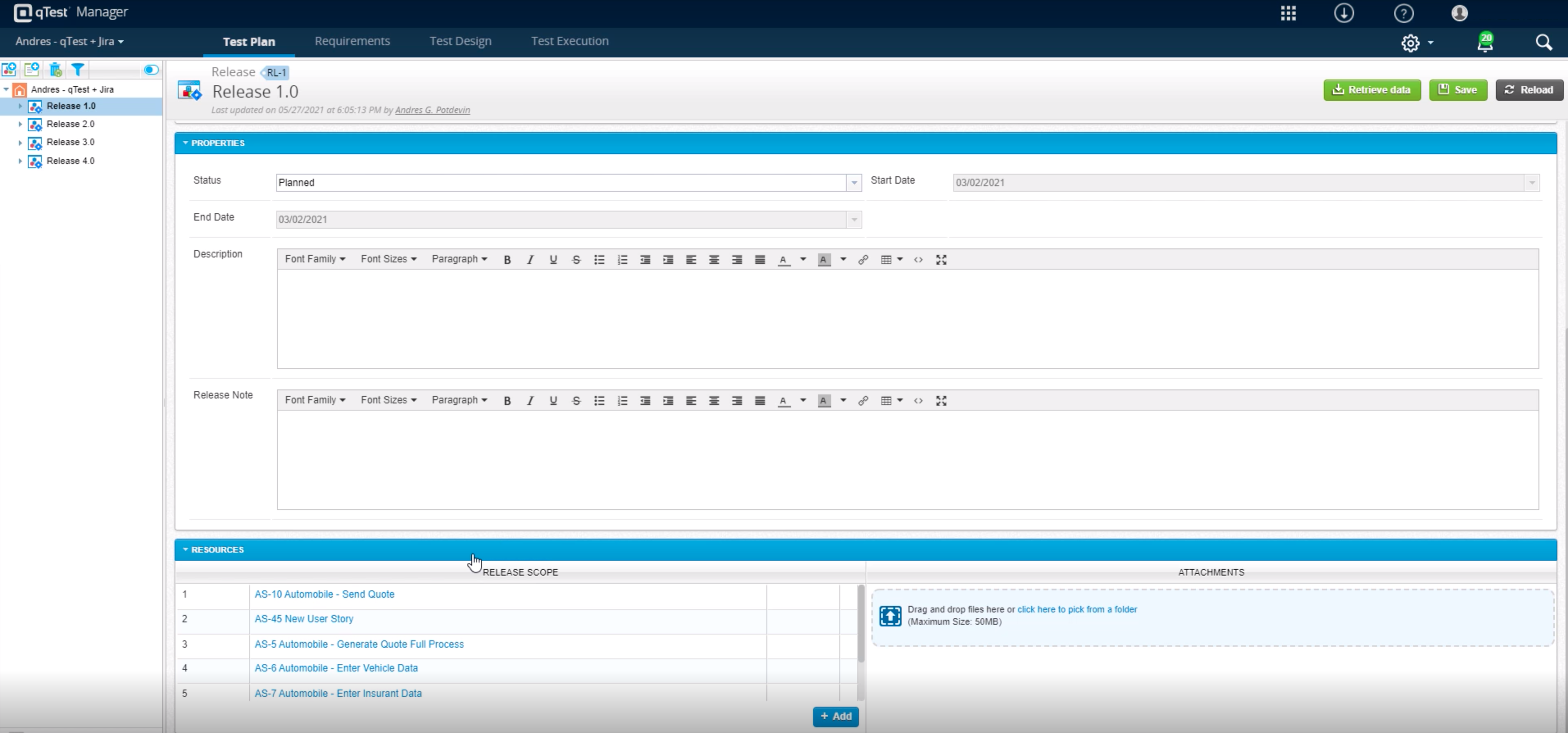
Tricentis qTest (formerly QASymphony) provides enterprise-level agile testing tools giving businesses visibility and control needed to ensure application quality in fast-paced development environments. Tricentis and QASymphony merged in summer 2018.
Tricentis qTest takes a lead on centralised maintenance of all entities of STLC & also qTest takes a big leap when it comes to Proof of testing data capture thru "web explorer" & also it got advantage for its easy configuration against any project management tool i.e. JIRA etc. …
We found that Tricentis qTest and TestRail have some similarities, but the main problem was that we needed to use an existing shared instance of TestRail, and we discovered that there was no easy way to prevent users of other projects from editing or even accidentally deleting …
Tricentis qTest ranks well among all test management platforms. For smaller teams with less activity or reporting requirements, qTest can be overkill. However, as organizations evolve and become more scrutinized or chaotic, qTest is one of, if not, the best option to ensure all …
As I am not the actual decision maker of which tool to purchase. I have always liked the Tricentis qTest tool. Decision has been made by the top management, The tool has proven is value and for the Same reason it is still being used.
Still evaluating. TestRail seems to be a far better solution but we need to solve migration issues.
Verified User
Engineer
Chose Tricentis qTest
looking at the positive features like 3rd party integration, the Tricentis qTest stacks up along with providing the custom build and event driven workflows with open-source solutions (Azure, DevOps, Teams etc). Manages and schedule automated testing along with creating report …
All of them offer formidable solutions in the test management realm, but each one caters to different niche and need. qTest distinguishes itself with its deep integration capabilities, especially with Agile and DevOps tools, enabling streamlined CI/CD process. Its modern, …
Extensive integration options with various third-party tools, enabling seamless integration into existing workflows. Allows for flexibility and customization of workflows, fields, and permissions to adapt to unique testing requirements. Supports robust requirements traceability, …
Tricentis is easy to use and user friendly. Less time consuming with lot of good utilities. And for better test management. qTest also stacks up better than the above tools due to its efficiency, test case interface and test execution interface. Excellent comments area and …
- It was not our decision to use qTest as a tool, as this was a management decision. - Since I have used many Test Management Tools I can compare for e.g The Reporting and Statistics in qTest is very impressive.
Tricentis qtest is well suited as it serves the purpose for both quality assurance and business management. It is very simple for non technical users to write test cases in free hand and they don’t have to bother about traceability as it is automatically handled by this …
I have worked on Jira, but i found it more difficult interface to handle. It was not user friendly. The defect management was also not impressive. qTest experience actually helped me to take decision while evaluating.
I'm not the decision maker, so I can't provide objective comparison criteria, but I can say that Tricentis QTest is a reliable tool for Test Management.
The main tool we compared to Tricentis qTest Explorer was the "Steps Recorder" that comes with Windows. We selected Tricentis qTest Explorer because, at least at the time, Steps Recorder would sometimes skip recording arbitrary steps, which didn't meet our needs.
Tricentis qTest integrates seamlessly with Jira, making it ideal for teams that manage user stories and defects in Jira while keeping test cases and execution in qTest. When paired with automation tools like tosca, Selenium, or WebdriverIO, qTest is excellent for aggregating both manual and automated test results in one place.
As a fresher, when I started using qTest it was very handy and easy to understand.
It helps us trace the test cases that are used to test the quality in a single location
The main thing is its integration with JIRA as soon as we create a ticket we would be getting all the requirements in the qTest so it became easy for me
In requirements , we can't add multiple test cases at once, or search multiple cases at once, need to do one by one. Here actually qtest needs to improve.
Linking cloud hosted qtest and on-premise TOSCA is very difficult especially when you are working with client system with security wall. It requires tunnelling software which is not recommended.
All of them offer formidable solutions in the test management realm, but each one caters to different niche and need. qTest distinguishes itself with its deep integration capabilities, especially with Agile and DevOps tools, enabling streamlined CI/CD process. Its modern, user-centric interface contrasts with ALM's more dated appearance and complex setup. While TestRail provides a clean user experience and caters to a broad spectrum of business, qTest's scalability, from SMBs to large enterprises, stands out. PractiTest's cloud-based solution is geared towards mid-sized companies, but qTest's flexibility, advanced analytics, and robust reporting grant teams actionable insights. qTest' approach to a more holistic test management closely aligning with modern software development practices