

Airtable
847 Reviews and Ratings
What is Airtable?
Airtable is a web-based application builder that combines spreadsheet usability with relational database architecture. The platform enables users to construct custom operational applications, configure automated workflows, and design tailored interfaces without traditional software development.
Airtable now includes Airtable Omni. Omni is an integrated conversational AI assistant that allows builders and end-users to construct applications and analyze data through natural language interaction, enabling users to generate complete apps—including tables, interfaces, and automations—by describing what they need, and to extract advanced analysis, trends, and strategic insights directly from their data. Omni generates production-ready applications with underlying data structures, automations, and interfaces, and all generated components remain fully editable within Airtable using drag-and-drop tools. Omni respects user permissions and is available to all user types regardless of role, and it can execute advanced data analysis including identifying patterns and insights across large volumes of unstructured information such as customer feedback, call transcripts, and contracts.
Airtable now includes Airtable Omni. Omni is an integrated conversational AI assistant that allows builders and end-users to construct applications and analyze data through natural language interaction, enabling users to generate complete apps—including tables, interfaces, and automations—by describing what they need, and to extract advanced analysis, trends, and strategic insights directly from their data. Omni generates production-ready applications with underlying data structures, automations, and interfaces, and all generated components remain fully editable within Airtable using drag-and-drop tools. Omni respects user permissions and is available to all user types regardless of role, and it can execute advanced data analysis including identifying patterns and insights across large volumes of unstructured information such as customer feedback, call transcripts, and contracts.
Key Airtable Capabilities
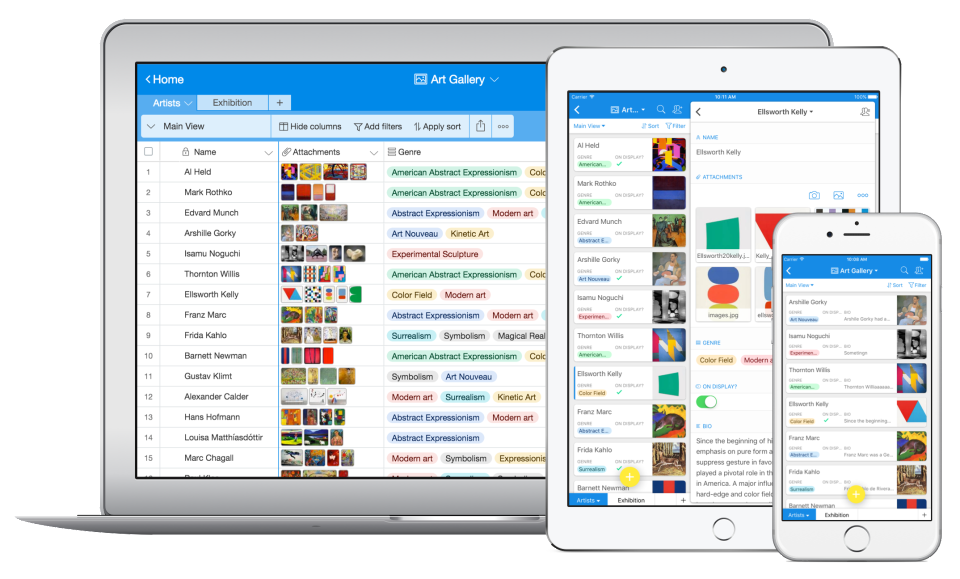
- Relational Data Architecture: The platform integrates spreadsheet-like grid interfaces with enforced relational constraints and data validation. Users establish explicit record-to-record relationships across tables, enforce referential integrity, and manage complex interconnected datasets within a single workspace.
- Workflow Automation: Builders configure event-triggered automation rules directly within the application. The automation engine supports conditional logic, database state changes, external HTTP calls via REST APIs and webhooks, and multi-step sequential processes.
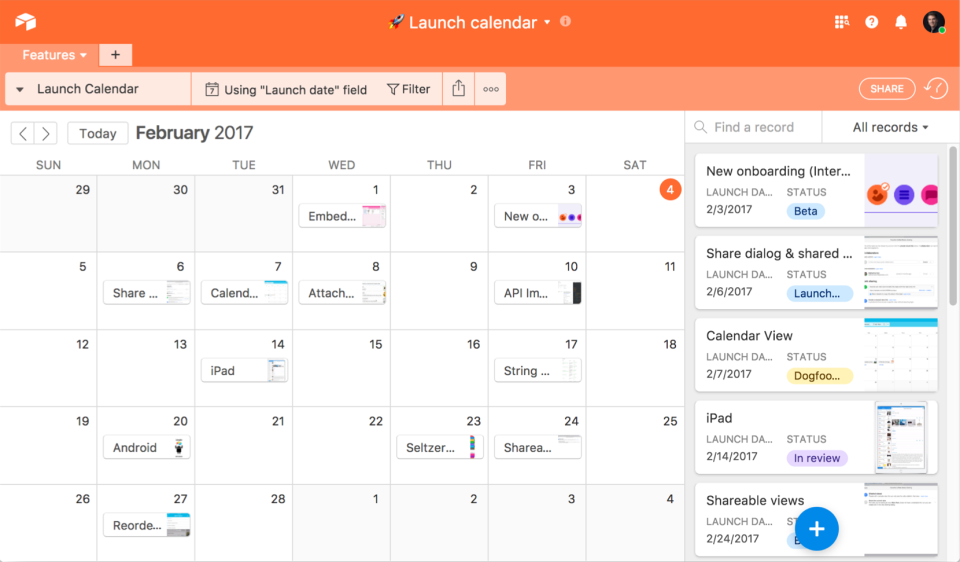
- Visual Interface Builder: The Interface Designer provides drag-and-drop assembly of custom dashboards, data entry screens, and collaborative portals. Front-end components bind directly to underlying data tables, eliminating the need for separate presentation layers.
- AI-Powered Task Execution: The platform includes natural language automation features such as the Omni conversational assistant and cell-level Field Agents, which execute structured tasks within database records—including content generation, text summarization, categorization, and research—without external applications.
- Large-Scale Data Synchronization: Using the HyperDB infrastructure, the platform can ingest and operate on datasets synchronized from cloud sources such as Snowflake, Databricks, and Salesforce, supporting up to 100 million records within a single table.
Audience & Use Cases
- Audience: Database administrators, marketing operations managers, program managers, and business operations teams requiring custom tracking and coordination systems.
- Use Case: Airtable serves as a coordination system for enterprise marketing campaign management, multi-stage project tracking, cross-departmental administrative workflows, and operational pipeline orchestration.
- Storage Capacity: Standard enterprise bases support up to 500,000 records per base; HyperDB scales to 100 million records per table.
- Extensibility: The platform supports custom JavaScript, REST API integrations, and pre-built third-party connectors for data synchronization and workflow extension.
Categories & Use Cases
Videos
Screenshots



1 / 5
Technical Details
| Deployment Types | SaaS |
|---|---|
| Mobile Application | Apple iOS, Android |
FAQs
What is Airtable?
Airtable is a web-based application builder that combines spreadsheet usability with relational database architecture. The platform enables users to construct custom operational applications, configure automated workflows, and design tailored interfaces without traditional software development.
How much does Airtable cost?
Airtable starts at $24.
What are Airtable's top competitors?
Asana, Smartsheet, and Trello are common alternatives for Airtable.
What is Airtable's best feature?
Reviewers rate Task Management highest, with a score of 8.9.