
TrustRadius: an HG Insights company

Liferay Digital Experience Platform (DXP)

Score6.5 out of 10

41 Reviews and Ratings

What is Liferay Digital Experience Platform (DXP)?

Liferay Digital Experience Platform is an enterprise-grade platform that enables companies to create and connect personalized digital experiences across web, mobile, social, in store and other touchpoints. It provides the technical foundation (deep integration, security and modularity) for a digital business to orchestrate unique customer experiences, as well as business value features to support a deeper understanding of their customers.

Media

Liferay Digital Experience Platform (DXP) forms experience was designed to make generating forms simple and straightforward while offering flexibility and deep integration with back end systems.
Liferay Digital Experience Platform (DXP) was designed with usability and beauty in mind.
Liferay Digital Experience Platform (DXP) features a unified look and feel that makes site administration a breeze.
Liferay Digital Experience Platform (DXP) forms experience was designed to make generating forms simple and straightforward while offering flexibility and deep integration with back end systems.
Liferay Digital Experience Platform (DXP) comes with blogs out-of-the-box, designed to give enterprises a slick blogging experience similar to what they're used to with consumer platforms.
Liferay Digital Experience Platform (DXP) was designed with usability and beauty in mind.
Manage documents, video, audio, images and other media types in a unified repository. Allow groups to store, tag, lock and search for assets, use them on site pages or download them for use offline.
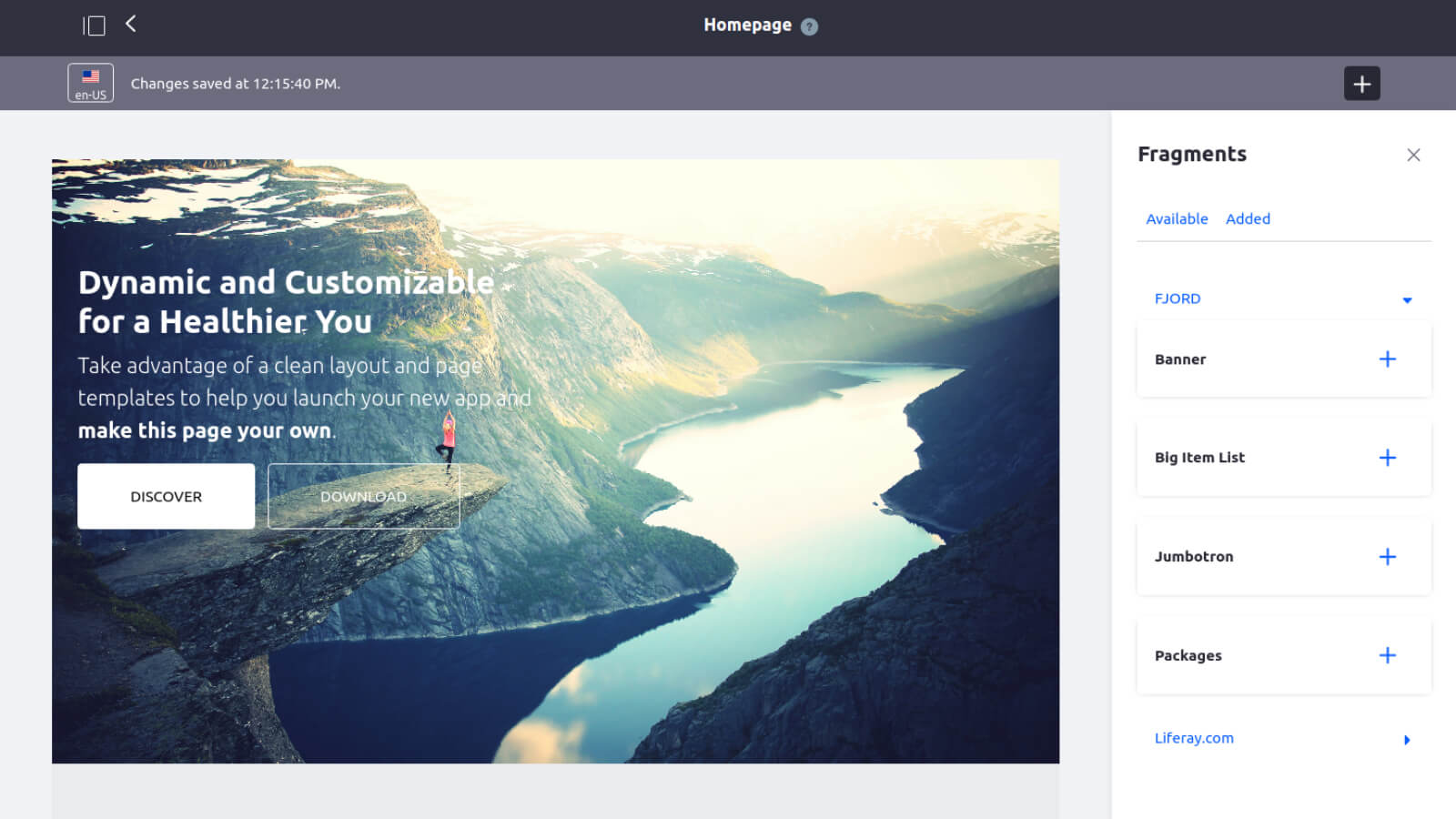
Deliver mobile ready experiences on one development platform.
An all-in-one, integrated development environment for building apps and modules. Developer Studio makes it easy to use project creation wizards to create modular projects based on Maven, Gradle and bndtools.

1 / 9

Liferay Digital Experience Platform (DXP) power

Use Cases and Deployment Scope

We use Liferay Digital Experience Platform (DXP) to build web applications for our customers. Liferay Digital Experience Platform (DXP) is a useful tool to create and build web applications easily editable and customizable by non technical users. Examples of web applications that can be done with Liferay Digital Experience Platform (DXP) are intranets, corporate webs or e-commerce web applications.

Pros

  • User management
  • Security and access management
  • WYSIWYG

Cons

  • Senna.js (SPA)
  • Fragments
  • ADT

Return on Investment

  • Positive: due date
  • Positive: components customization
  • Negative: detail pages

Alternatives Considered

Magnolia

Other Software Used

Magnolia, Eclipse, Oracle Java SE, Microsoft Teams, Jenkins

Review of DXP that is unforgettable

Use Cases and Deployment Scope

I use Lifeary Digital Experience Platform(DXP) for organising my business to have the relations between me and the clients be very smooth.

The problem with these application is that the service builder need to improve a lot so that the software should work faster.

Should have independent resolution for a clear-cut vision.

Pros

  • Personalization
  • Business to client relationship
  • Customer management is better.

Cons

  • Vision should be independent.
  • Picturiastion should be slower.
  • Processing should be a bit faster.
  • Have a well organized framework.

Most Important Features

  • Create a one on one platform
  • Have a organized place to do all works.
  • Digitally having all the objects to be done.

Return on Investment

  • Create a good environment
  • Resolution is not so much better.
  • Have a long things to do.
  • Content management is better off.

Alternatives Considered

Acquia Digital Experience Platform

Other Software Used

SAP Access Control, Acquia Digital Experience Platform, AdColony, from Digital Turbine

Excellent platform, secure, flexible and very powerful.

Pros

  • Liferay's safety.
  • Flexibility and scalability.
  • Segmentation and personalization.
  • Its different features to manage content, users and roles.
  • It is open source.
  • Allows files and documents to be shared among registered users.

Cons

  • It requires technical expertise and the right people to achieve customization.
  • There is little documentation available for certain functions that make them a bit complex to master.
  • The SSL function for login.

Most Important Features

  • High availability and scalability.
  • Allows the inclusion of functions similar to those of social networks.
  • Allows classifying users by categories according to the department.
  • It is highly customizable, which allows us to give identity to our brand.
  • Supports different types of files and documents.

Return on Investment

  • Its high scalability and flexibility has allowed us to include all essential solutions to meet our business needs while preserving the originality of the brand and helping us to improve the quality of our processes and services within the same friendly and unified environment.
  • This powerful platform has allowed us to keep the efforts of all our units aligned, from sales, marketing, operations, support and customer service, in a solid collaborative environment.

Alternatives Considered

Adobe Experience Manager

Other Software Used

Microsoft Teams, Microsoft Power BI, Google Hangouts Meet

Great for Java based enterprises.

Pros

  • Theming
  • Customization based on user roles
  • Content Management
  • Flexibility

Cons

  • Harder to get started
  • Enterprise level of options can cause confusion
  • Development documentation could be better

Return on Investment

  • Can reduce IT costs eventually.
  • Increases upfront costs due to technical knowledge needed for initial setup and maintenance.
  • Hard to analyze ROI until after it's totally implemented.

Alternatives Considered

WordPress, Drupal, Joomla! and ExpressionEngine

Liferay Portal Review

Pros

  • OpenSource: Liferay is open source portal framework so developers can easily extend or customize it for their organization or department based on their requirement.
  • OutOfBox: Liferay Portal is not only a portal platform. It also provides a 60+ applications and tools included in the form of portlets. These portlets are available out of the box or in the form of plugins.
  • MarketPlace: Liferay has it own market place (i.e app store) where developer or contributors are contributing their ideas (application) so community can use it freely (some are paid).
  • Enterprise-Ready Portal Solution: It is fully ready to support mission-critical, enterprise applications in an environment configured for multiple redundancies and 24/7 up-times.
  • High Availability and High Performance: Liferay Portal has been tested to support more than 3,000 concurrent transactions (33,000 simultaneous users) on a single 8-core application server, with mean login times under one second and maximum ½ throughput of 79+ logins per second. Liferay Portal has proven to handle millions of page views and over 1.3 million users.
  • Liferay Portal is also deployable to the Cloud and virtual server environments and ensures high availability and performance with: Hardware/Software Load Balancing, HTTP Failover, Session Replication
  • Distributed Cache using Lightweight Multicast Protocol
  • Terracotta, Oracle RAC, and other scalability solutions

Cons

  • Portal Security: It has good security model but in few areas it requires improvement.
  • Encrypt LDAP passwords on import
  • Log in should be via SSL by default
  • Upgrade/patch process should include an alert in the control panel
  • Add virus scan for uploaded files
  • Server Administration
  • Garbage Collector should be able to be scheduled to run from the control panel
  • Reindexing should be able to be scheduled from the control panel
  • Provide GUI to change the default Liferay favorite icon to any desired logo
  • LDAP mapping GUI to custom Liferay attributes
  • Configurations: Less configurations from properties files and provide more GUI to update from control panel.

Return on Investment

  • Liferay scales well both in terms of performance but also in terms of operational self-service and eases the burden on IT.
  • Compliance, Marketing and Client Engagement teams can create and modify content and submit it for approval. This results in lower operational costs in the areas of new private-label sites and maintenance of current sites because, prior to Liferay, site content management required expensive IT software engineering resources to implement compliance and marketing content changes.