

What is Planview ProjectAdvantage?
Planview ProjectAdvantage is a project and portfolio management (PPM) platform for mid-sized organizations and developing project management offices (PMOs). The platform centralizes project, program, resource, financial, and performance data through configurable workflows, dashboards, and AI-assisted planning tools.
The vendor reports that organizations across IT, research and development, and product development use ProjectAdvantage to plan work, allocate resources, monitor portfolios, and manage delivery.
Key Capabilities
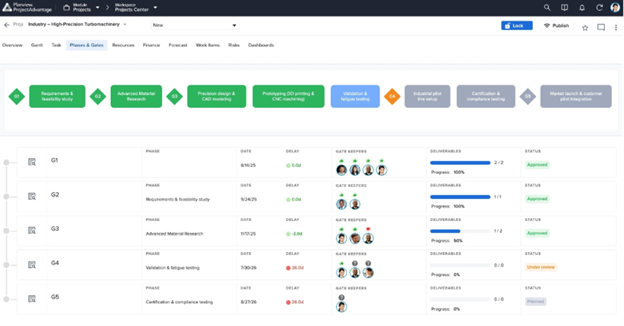
- Project and Program Management: Configurable Gantt charts support drag-and-drop scheduling, role-specific layouts, project hierarchies, and dependency management. Teams can create projects from templates or import project data from Microsoft Project and Microsoft Excel. Phase-gate views and program rollups provide visibility across multilevel portfolio structures.
- Delivery Methodologies: ProjectAdvantage supports Waterfall, Agile, Hybrid, Critical Chain Project Management (CCPM), and Phase-Gate methodologies within the same governed environment.
- Resource and Capacity Management: Named and generic resource assignments support workload analysis, availability checks, forecasting, and role- or skill-based allocation. A request-and-commit workflow supports top-down resource planning. AI-assisted resource fulfillment matches generic resource requirements with named resources based on availability, role alignment, cost, and prior work history.
- Portfolio Simulation: What-if planning tools allow portfolio managers to compare scenarios, rank projects by budget or key performance indicators (KPIs), and analyze time-distributed costs. Roadmaps display dependencies among portfolio initiatives.
- Demand Management: Structured request intake includes approval workflows and configurable scoring models for evaluating proposed projects against strategic priorities.
- Financial Management: Budgeting, time-distributed cost tracking, and financial forecasting operate alongside project and resource data. Actual expenditures can be compared with budgets to monitor financial performance throughout delivery.
- Workflow Configuration and Governance: No-code configuration tools allow administrators to adapt workflows, templates, and stage-gate processes without custom development. Role-based permissions and single sign-on (SSO) support access governance. The vendor states that the platform maintains ISO 27001 and SOC 2 compliance.
- Reporting and Analytics: Self-service dashboards and predefined portfolio KPIs can be shared with stakeholders. Reporting options include a native Microsoft Power BI connector, Microsoft PowerPoint export, and scheduled data exports.
- Microsoft Teams Integration: Users can submit timesheets, update work items, and manage tasks through Microsoft Teams. An AI assistant supports natural-language timesheet entry, work-item updates, and task prioritization.
- Planview Anvi: AI-assisted project initialization generates work breakdown structures, phases, gates, activities, and dependencies from plain-language project descriptions. Risk analysis tools propose potential risks and recommend updates to existing risk records based on project and historical data.
- Conversational and Agentic AI: Anvi Chat provides a conversational interface for questions about project status, timelines, dependencies, and reports. Anvi Agents execute saved, multistep prompt sequences for recurring analysis and reporting tasks.
Audience and Use Cases
- Audience: Project managers, program managers, portfolio managers, resource managers, finance teams, PMO leaders, and business administrators.
- Use Cases: Project planning, program oversight, portfolio prioritization, demand intake, resource allocation, capacity forecasting, financial tracking, governance, and executive reporting.
Technical Specifications
- Project Data Import: Microsoft Project and Microsoft Excel
- Reporting and Visualization: Microsoft Power BI, Tableau, and Microsoft PowerPoint
- CRM and ERP Connectivity: Microsoft Dynamics 365, SAP, Oracle NetSuite, Workday, and Salesforce
- IT Service Management: ServiceNow and Atlassian
- Agile Delivery: Jira Software, Azure DevOps, and Planview AgilePlace
- Ecosystem Integration: Planview Hub
- Security and Access: Role-based permissions and single sign-on
- Compliance: ISO 27001 and SOC 2
Categories & Use Cases
Screenshots


1 / 5
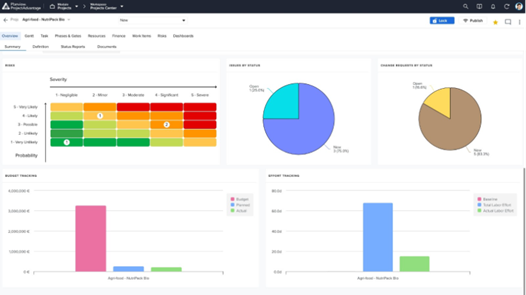
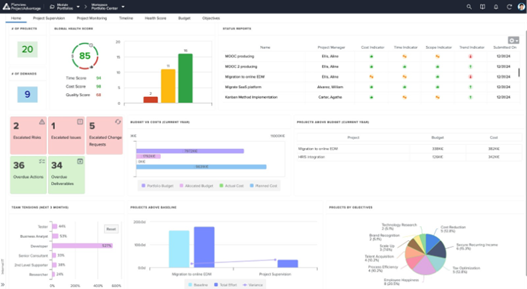
Screenshot of Project Dashboard Summary View - A consolidated dashboard showing project health, status, and key metrics at a glance.
Technical Details
| Deployment Types | On-Premise, SaaS |
|---|---|
| Operating Systems | Windows, Linux, Mac |
| Mobile Application | No |
| Supported Languages | English, French, Spanish, German, Japanese, Hebrew |
FAQs
What are Planview ProjectAdvantage's top competitors?
Adobe Workfront, Planview Portfolios, and Planisware are common alternatives for Planview ProjectAdvantage.
Who uses Planview ProjectAdvantage?
The most common users of Planview ProjectAdvantage are from B2C.