

Roadmark
What is Roadmark?
Roadmark is a web-based product management tool for creating and sharing product roadmaps. When plans change, teams can branch a roadmap rather than replace the original timeline, preserving both the prior direction and the rationale for the change.
Key Capabilities
- Branching roadmaps: Each change in direction creates a dated branch. The original and revised timelines remain visible on the roadmap.
- Decision logging: Roadmark requires a reason when a branch is created, creating a record of why the roadmap changed.
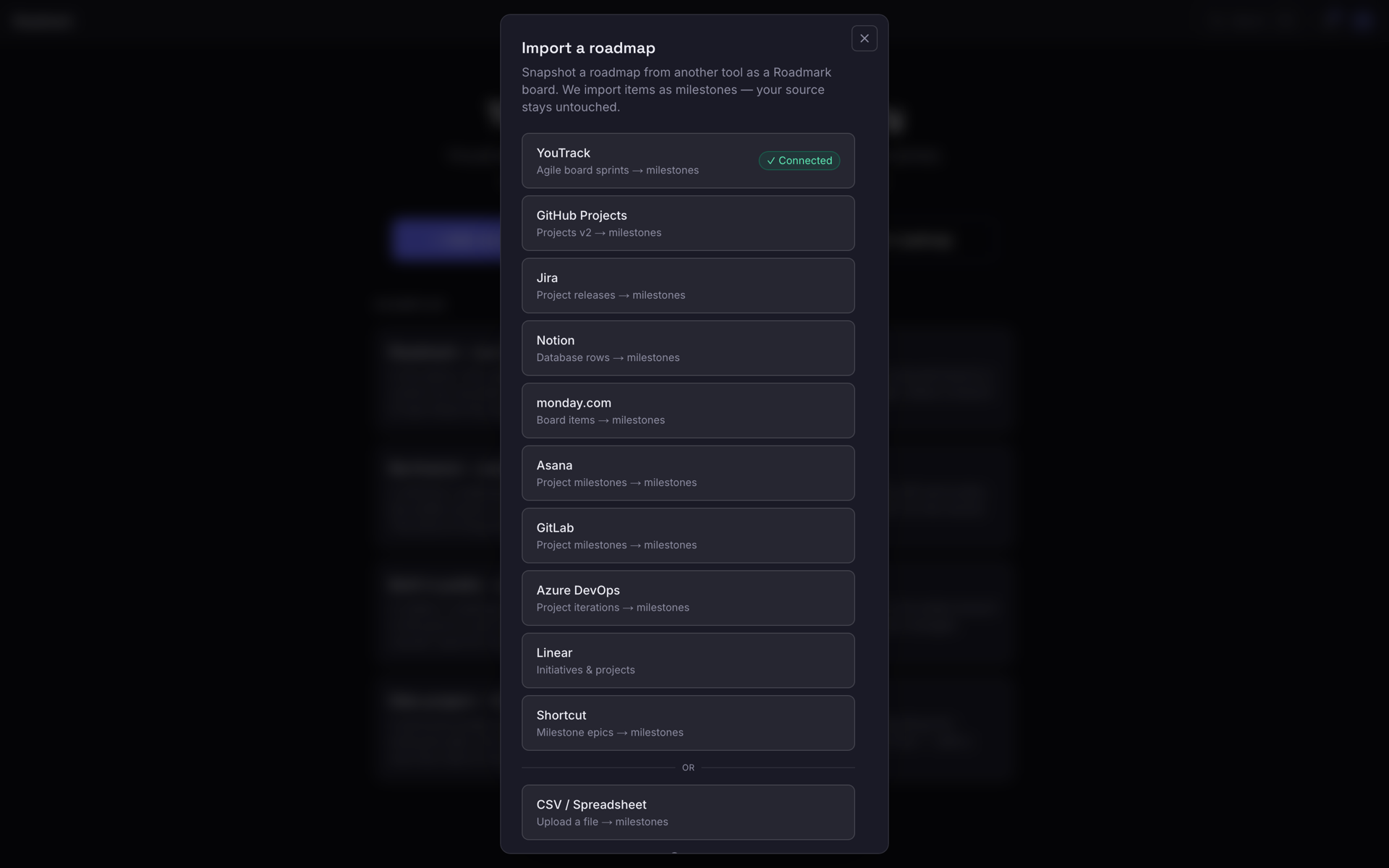
- Data import and synchronization: The platform imports milestones from Linear, Jira, GitHub, GitLab, Asana, Notion, monday.com, Azure DevOps, Shortcut, YouTrack, and CSV files. Optional daily synchronization updates milestone dates and statuses.
- Sharing: Teams can publish read-only roadmap links and embed roadmaps in websites or documentation on any plan. Password-protected links, expiring links, and removal of Roadmark branding are available on paid plans.
- Tracking and collaboration: Confidence levels and slip history are available on all plans. Real-time editing, comments, and @mentions are available on paid plans.
- Decision feed: Public decision feeds let external stakeholders follow roadmap changes, react to updates, and subscribe to email follow-up, with no account required. Shared-link analytics, which record how often a link is opened without identifying individual viewers, are included with the Team plan.
- AI assistance: Milestone drafts and decision-log drafts can be generated using a customer-supplied API key on any plan, or from a managed generation allowance included with paid plans. Investor summaries and roadmap stress tests are available on paid plans.
- Export and audit controls: Roadmaps export to PNG, SVG, PDF, and PPTX on any plan. An append-only audit log of board changes is included with the Team plan.
Audience & Use Cases
- Audience: Product teams, founders, and stakeholders who need to communicate evolving product plans.
- Use cases: Record roadmap decisions, share product direction with customers or investors, import delivery milestones, and preserve the history behind plan changes.
Technical Specifications
- Deployment: Web-based; no local installation required.
- Integrations: Linear, Jira, GitHub, GitLab, Asana, Notion, monday.com, Azure DevOps, Shortcut, YouTrack, and CSV.
- Sharing: Public and embeddable links on all plans; password-protected and expiring links on paid plans.
- Plan availability: Free plan for one roadmap. Pro is $ 15 per workspace per month, and Team is $ 49 per workspace per month, each with a 7-day trial that requires no card. Read-only viewers are unlimited on every plan.
Categories & Use Cases
Media



1 / 4
Screenshot of Creating a branch (pivot) on a roadmap board. The new branch forks from a chosen milestone, and the "Why are we changing direction?" field is required — a roadmap cannot change direction without a recorded reason. The original plan stays on the board as a dashed ghost line.


