
TrustRadius: an HG Insights company

SAP Service Cloud

Score8.5 out of 10

213 Reviews and Ratings

What is SAP Service Cloud?

SAP Service Cloud helps deliver customer value and protect the brand with intelligent customer service. It enables the user to engage with customers at their convenience, connect service with the value chain and deliver greater profitability.

Read more details.

Media

SAP Service Cloud
SAP Service Cloud
SAP Service Cloud
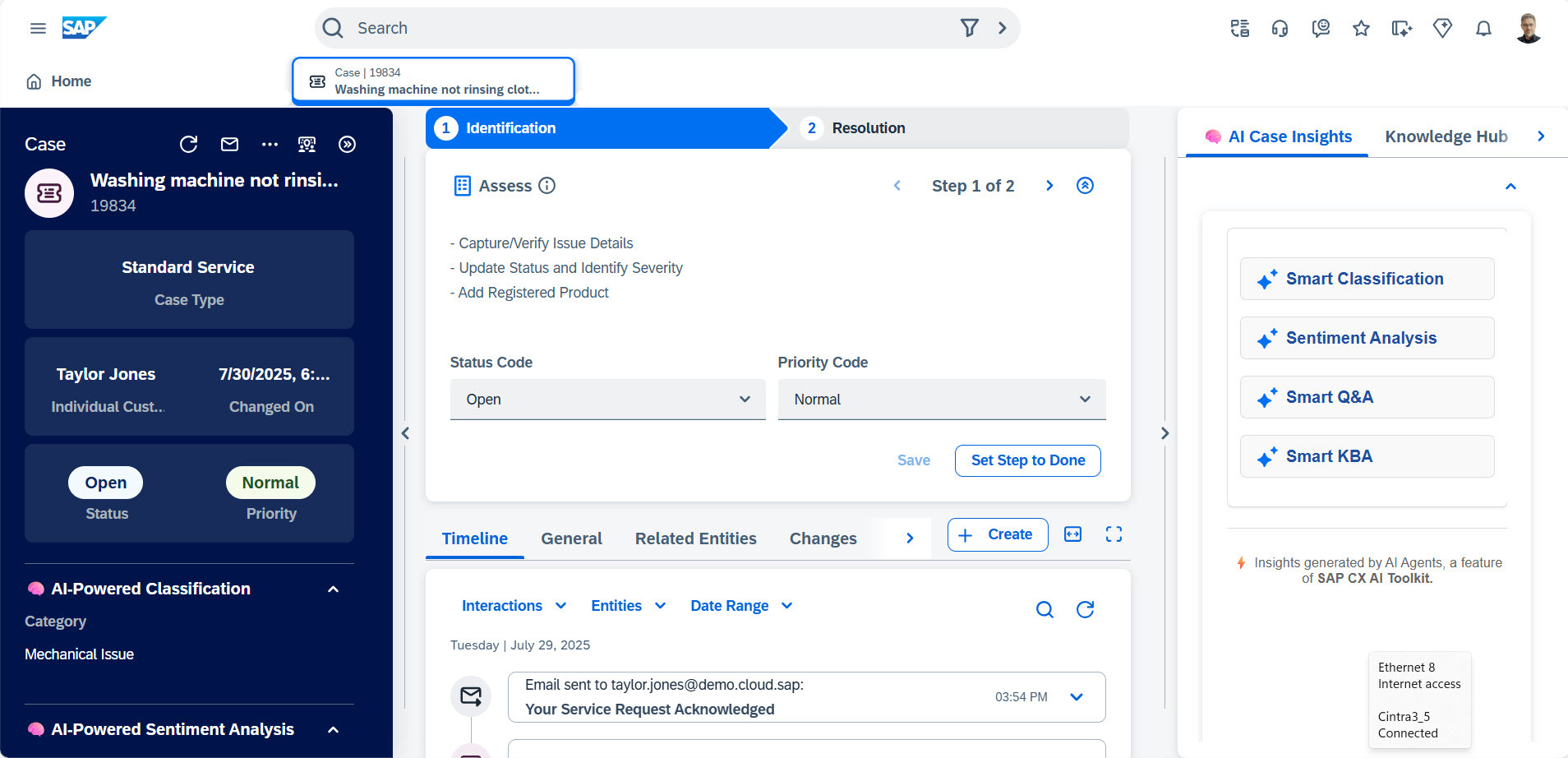
Screenshot of SAP Service Cloud's AI case insights.
Screenshot of SAP Service Cloud's AI case summary.
Screenshot of SAP Service Cloud's AI email drafter.

1 / 6

Who Buys & Uses SAP Service Cloud

Pros

  • Centralized ticket and case management
  • Automation and AI for efficient task handling
  • Seamless integration with SAP ERP systems

Cons

  • Reporting and analytics issues (speed, accuracy, utility)
  • Limited features and optimization in mobile application
  • Challenging integration with non-SAP third-party tools

SAP Service Cloud Review

Use Cases and Deployment Scope

We use SAP Service Cloud as our CRM hub for our electric provider call center to handle pre paid account information and billing. The product is able to handle billing, marketing, and case responses for the customer in order to ensure prompt and expedient service to the customer and handle a pro rated customer experience as well.

Pros

  • Case Management
  • Contact information
  • Embedded payment system

Cons

  • Account functionality
  • customer hub integration

Usability

Driving Customer Service Excellence with SAP Service Cloud

Use Cases and Deployment Scope

We use Sap Cloud as our central customer service and management platform. SAP Service Cloud supports team manage there customer inquiries and complains in a single platform. The main business problem it addresses are fragmented customer information, case resolution and challenges in tracking customer issues across channels. Our case is managing customer support tickets, track service requests and maintain customer history.

Pros

  • Analytics and reposting: Provides dashboards and reports on response times, resolution rates and agent performance.
  • Customer experience Improvement: supports quicker responses,accurate and issue handling
  • Workflow Automation: Automates case routing, approvals and follow-up tasks

Cons

  • Reporting Flexibility: Standard reports and dashboard cover common requirements,creating highly customized reports can be challenging.

Return on Investment

  • Higher agent productivity: Consolidating customer information and communication channels into a single platform has reduced time on switching between systems.
  • SLA compliance: Automated alerts helps teams meet response and resolution targets consistently. SLA adherence has reduced the risk of customer dissatisfaction and service delays.

Quality of SAP Service Cloud in an urban cleaning company

Use Cases and Deployment Scope

We use it for several purposes: warehouse inventory control, receiving invoices for goods, reverse logistics invoices, and placing purchase orders for materials.

Pros

  • Control of incoming invoices, where we can look up past invoices.
  • Inventory control, where we can know the exact quantity of material across all branches.
  • Price control, where we record supplier quotes for future purchases.

Cons

  • Clearer error codes.
  • Better filters to allow combining different criteria for more precise search results.
  • SAP Service Cloud needs performance improvements to prevent crashes and slowdowns.

Return on Investment

  • Time savings for price lookups
  • Time and money savings when executing tasks
  • Negative impact on error identification because error messages are not clear

Other Software Used

Salesforce Agentforce Service, Microsoft Dynamics 365 Customer Service, Oracle Service

SAP Service Cloud Out of the Box

Use Cases and Deployment Scope

SAP Service Cloud allows us to easily track incoming service calls and either immediately resolve the issue or continue the service process onward. How it links back to our larger SAP environment enables us to maintain consistent information throughout our system. The history of a unit it retains is invaluable in solving any future service requests.

Pros

  • easy to use interface
  • tab-based interface to quickly maneuver between different parts of the process
  • maintaining all relevant data in a central location

Cons

  • some areas present only the technical names rather than the business names, making it harder for end-users

Return on Investment

  • SAP Service Cloud has brought us better in line with all of our other companies

Usability

Other Software Used

SAP Field Service Management

The Powerful Enterprise SLA Management Engine.

Use Cases and Deployment Scope

The implementation of SAP service cloud is very useful to the organization after the sale. It effectively identifies and routes tickets based on priority using its advanced artificial intelligence, helping us operate securely. It categorizes traffic based on priority and problem statement, helping us reach the appropriate engineers and strictly adhere to deadlines.

Pros

  • Automated fast-tracking.
  • Prevents SLA breach.
  • Tool that helps in lowering MTTR.
  • Reducing risks factors in real world business process.

Cons

  • GUI can be upgraded.
  • Complex history handling.
  • Lacks Dynamic and faster dashboard for tracking.

Return on Investment

  • Real world business SLA compliance.
  • Elimination of manual ticket triaging.
  • Reduced infra downtime.
  • Protecting the Long term value of our product.

Alternatives Considered

SAP Analytics Cloud, Zendesk Suite and ServiceNow Customer Service Management

Other Software Used

Jira Work Management, Microsoft Teams, ServiceNow Customer Service Management