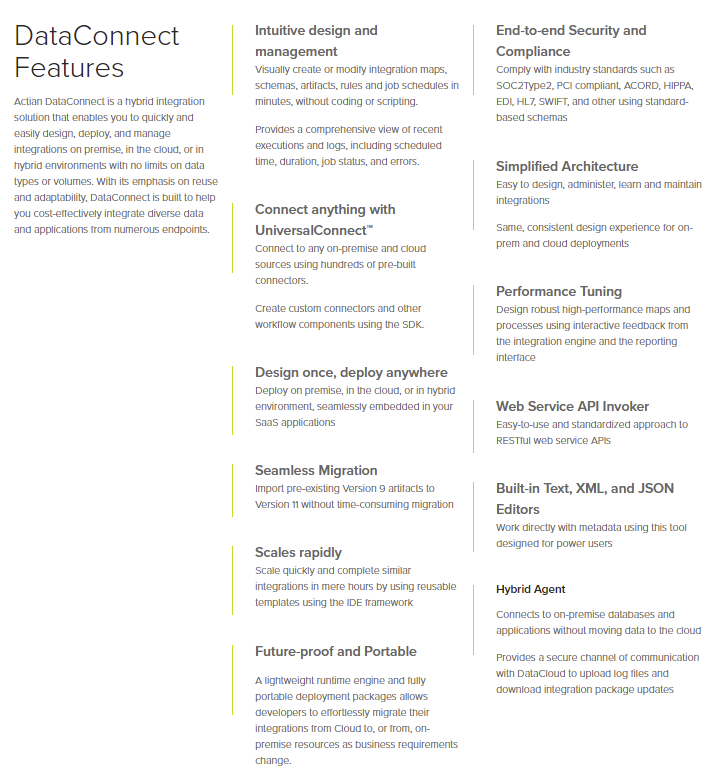
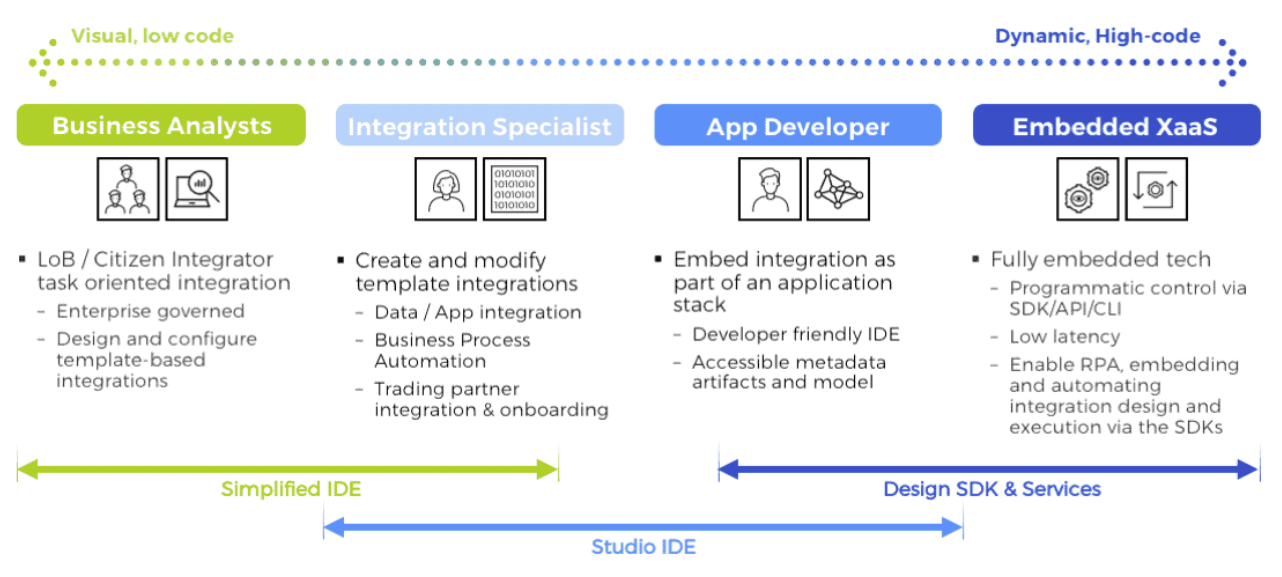
HCL DataConnect (formerly Actian DataConnect) is a hybrid integration solution that enables users to integrate anything, anywhere, anytime. It can be deployed in on-premise, cloud, and/or hybrid environments and offers quick onboarding. With its emphasis data quality, data reuse, adaptability and self-service integration, DataConnect is designed to support rapid onboarding and deliver the fast time to value.
N/A
Informatica Intelligent Data Management Cloud
Score 7.0 out of 10
N/A
The Informatica® Intelligent Data Management Cloud™ (IDMC) is designed to help businesses efficiently handle the complex challenges of dispersed and fragmented data to innovate with their data on virtually any platform, any cloud, multi-cloud and multi-hybrid.
N/A
Pricing
Actian DataConnect
Informatica Intelligent Data Management Cloud
Editions & Modules
No answers on this topic
No answers on this topic
Offerings
Pricing Offerings
Actian DataConnect
Informatica Intelligent Data Management Cloud
Free Trial
No
No
Free/Freemium Version
No
No
Premium Consulting/Integration Services
No
No
Entry-level Setup Fee
Optional
No setup fee
Additional Details
—
—
More Pricing Information
Community Pulse
Actian DataConnect
Informatica Intelligent Data Management Cloud
Considered Both Products
Actian DataConnect
No answer on this topic
Informatica Intelligent Data Management Cloud
Verified User
Manager
Chose Informatica Intelligent Data Management Cloud
Informatica is a proven name in this space, and while Cloud does not have all the exotic features that Powercenter has, it is fast and light, working well for a very agile team that cannot always wait for the dedicated Informatica developer to fully build out an integration. …
The choice to use Actian DataConnect really comes down to pricing and the type of integration project you are performing, specifically with the requirements, whether you want the integration to be on-premise or in the cloud, can you install agents on your servers etc. For integration tools it runs head to head with its competitors.
Informatica Cloud is a great tool for use when data must be formatted consistently. Once configured, it is very robust and reliable. It is also well-suited for an organization without a robust IT staff to maintain a full server infrastructure. It offers a cost-effective approach to high-quality data integration for even the largest organizations. Organizations without staff experienced in data analytics may find it challenging to take advantage of the more complex results of this tool.
Once the secure connection is established it’s quite easy to operate and create new jobs. The controls are simple, and we appreciate the fact there are not a lot of complex fine-tunings required. Navigation is also easy, and we enjoy the ability to open multiple tabs in the browser to work on multiple projects.
The monitoring functionality works well to help track the progress of the jobs, again, without too much complication. In a fast dev environment, speed is essential and we quickly seeing the status/progress of jobs as well as any errors if the jobs fail helps us maintain speed.
The web interface is a lot easier to interact with than the client/on-prem version. Putting much of the heavy lifting of interacting with the tool onto the shoulders of the browser makes it easier to keep multiple sessions open and get in/out quickly without having to VPN into the office.
I've never had trouble getting into contact with Informatica's support for technical help. I give it a nine because it does pretty well for mid to enterprise-scale workflows.
Data Integrator was initially a part of a package deal for us with our new Student Information System. It was chosen prior to my arrival at the institution. Since I discovered we have SQL Server licenses, we have decided to use SSIS instead since I have a background in the MSBI stack and SSIS appears to be more straightforward (process flow philosophy vs "map" philosophy.)
First, the wizard is easy to use making the learning curve for simple ETL tasks nice. Second, since Informatica is mature there are a good variety of connectors available. Finally, we have driven some fairly complex ETL solutions using only the cloud.