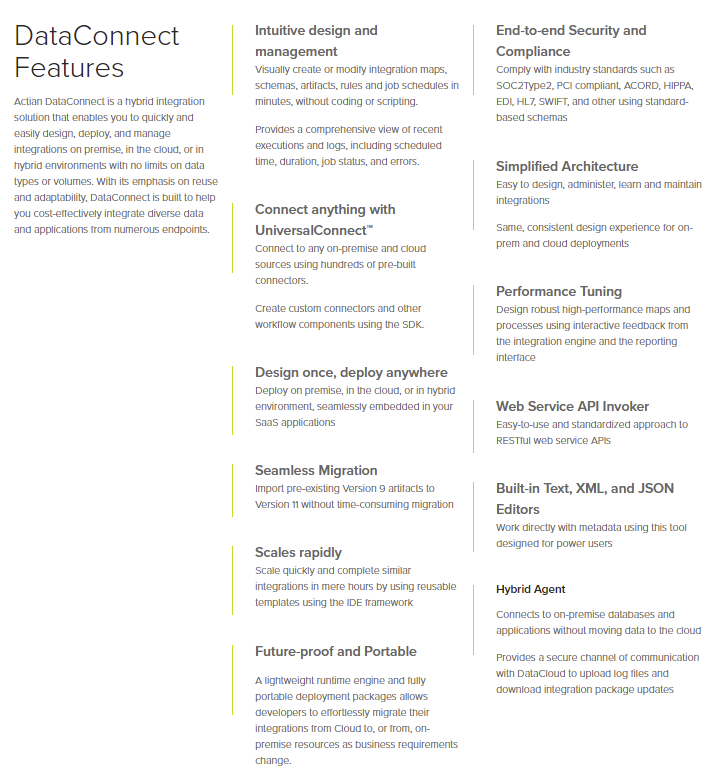
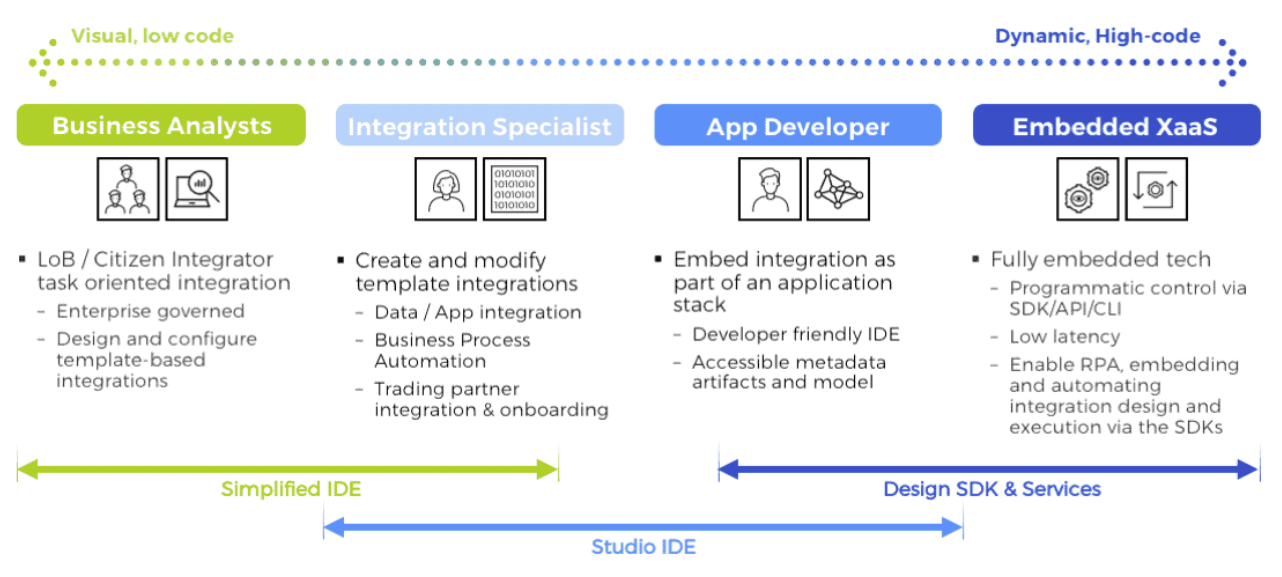
HCL DataConnect (formerly Actian DataConnect) is a hybrid integration solution that enables users to integrate anything, anywhere, anytime. It can be deployed in on-premise, cloud, and/or hybrid environments and offers quick onboarding. With its emphasis data quality, data reuse, adaptability and self-service integration, DataConnect is designed to support rapid onboarding and deliver the fast time to value.
N/A
Qlik Talend Cloud
Score 8.6 out of 10
N/A
The Qlik Talend Cloud suite of solutions offer data integration, data quality, application integration, and data governance that work with key data sources, targets, architectures, or methodologies to ensure business users always have trusted and accurate data.
Sr Integration Engineer - Dual Certified in Dell Boomi Developer 1 & 2, and Actian DataConnect
Chose Actian DataConnect
As I stated earlier, DataConnect makes a head-to-head run against the others. It has advantages and disadvantages compared to the competitors. The choice really comes down to pricing and specific requirement needs for the project you are planning. Questions such as …
Data Integrator was initially a part of a package deal for us with our new Student Information System. It was chosen prior to my arrival at the institution. Since I discovered we have SQL Server licenses, we have decided to use SSIS instead since I have a background in the MSBI …
Talend has many built-in components that reduce the development work. We were able to complete the project sooner than expected. Easy to on-board resources as it is straightforward to use. We can manage all the pipelines in the cloud with simple alerting. No major downtimes. …
In comparison with the other ETLs I used, Talend is more flexible than Data Services (where you cannot create complex commands). It is similar to Datastage speaking about commands and interfaces. It is more user-friendly than ODI, which has a metadata point of view on its own, …
SAP Business Object Data Services is another ETL offering that I have used before Talend. The biggest advantage is that Talend is open source and very user-friendly. SAP BODS needs to improve on the user interface. Also, it works well with relational databases but is not very …
Data Preparation is something which can improved and connectivity with more visualization tools are few factors which can be improved. As Talend Data Integration becomes more cloud focused, the gap in features / functionality widens between on-premise functionality and the …
Talend is the best for ETL out of all the other products we looked at. Of course, it is not meant for synchronous services. But, batch jobs that we schedule and run on bulk data are the best fit for Talend Data Integration. Though Talend does not provide a preview of …
Most other tools of similar nature work well for small and medium sized data warehouses, but fail to maintain performance for very large data warehouses. However, Talend works decently well on large data as well. On the other hand, there are software tools like Oracle Data …
Talend is much versatile in assimilating various different business use cases. It covers more functionality and is packed with tons of features to explore. It has the ability to fine tune to each project, and not be a one-fits all solution. Problems with Excel, is that it is …
There are code building and code conversions internally in most of these ETL tools. The repository is an overhead in the ETL process. There may be a need for a full-time administrator to manage deployments and monitor jobs. With Talend, it seems to be transparent with the pure …
Compared to Microsoft SQL Server Integration Services (SSIS) talend gives developers much more tools and flexibility in order to achieve different ETL processes. For instance, SSIS, separates processing from data management, and Talend mixes both stages so that you can perform …
Talend has all the data integration features needed for an enterprise along with big data integration. It stands tall as a data integration suite and has a low cost as compared to some of its commercial counterparts. Talend does not have reporting tools like Pentaho but its …
I wouldn't recommend Data Integrator over SSIS, but it may be a better tool than other ETL offerings. Having a background in the Microsoft Stack, I am hesitant to recommend any other products especially in a Microsoft-centric company. If this was the only option to use, I think it does a good job at integrating systems after taking time to learn the approach. "Maps" in Data Integrator is definitely different than "process flow" philosophy in SSIS.
The same way you design data integration job can be used to design services. It is easy to enhance by custom components and can adapt to all requirements. Talend Data Integration connects to [a] multitude of data sources and streaming service. Very easy interface to design complex applications without spending much time on coding. Easy to learn and master. Talend constantly strives to better itself by adding more features and functionalities.
We used Talend to ETLing the data from myriad sources such Oracle Database, Clarify, Salesforce, Sugar CRM, SQL DB, MQ, Stibo Step, FTP, Netezza, and Files.
We leverage Talend transformation capabilities for stitching the data , unions and join
We successfully created the final unified set that can be used by business
We use Talend Data Integration day in and day out. It is the best and easiest tool to jump on to and use. We can build a basic integration super-fast. We could build basic integrations as fast as within the hour. It is also easy to build transformations and use Java to perform some operations.
Good support, specially when it relates to PROD environment. The support team has access to the product development team. Things are internally escalated to development team if there is a bug encountered. This helps the customer to get quick fix or patch designed for problem exceptions. I have also seen support showing their willingness to help develop custom connector for a newly available cloud based big data solution
As I stated earlier, DataConnect makes a head-to-head run against the others. It has advantages and disadvantages compared to the competitors. The choice really comes down to pricing and specific requirement needs for the project you are planning. Questions such as On-premise or Cloud, Security, and Specific Connectors available will drive your decision.
Talend has many built-in components that reduce the development work. We were able to complete the project sooner than expected. Easy to on-board resources as it is straightforward to use. We can manage all the pipelines in the cloud with simple alerting. No major downtimes. Connectors to all new applications in the market.
It’s only been a positive RoI with Talend given we’ve interfaced large datasets between critical on-Prem and cloud-native apps to efficiently run our business operations.