Active Query Builder is a component for business applications which helps users without any SQL experience to work with SQL queries and get data fast. Users can get a clear view of database schema and design SQL queries with natural point-and-click actions rather than tedious typing. Active Query Builder assists novice users learning SQL and allows experienced users to analyze and understand their queries better by parsing them and building the visual diagram. With…
$199
per developer
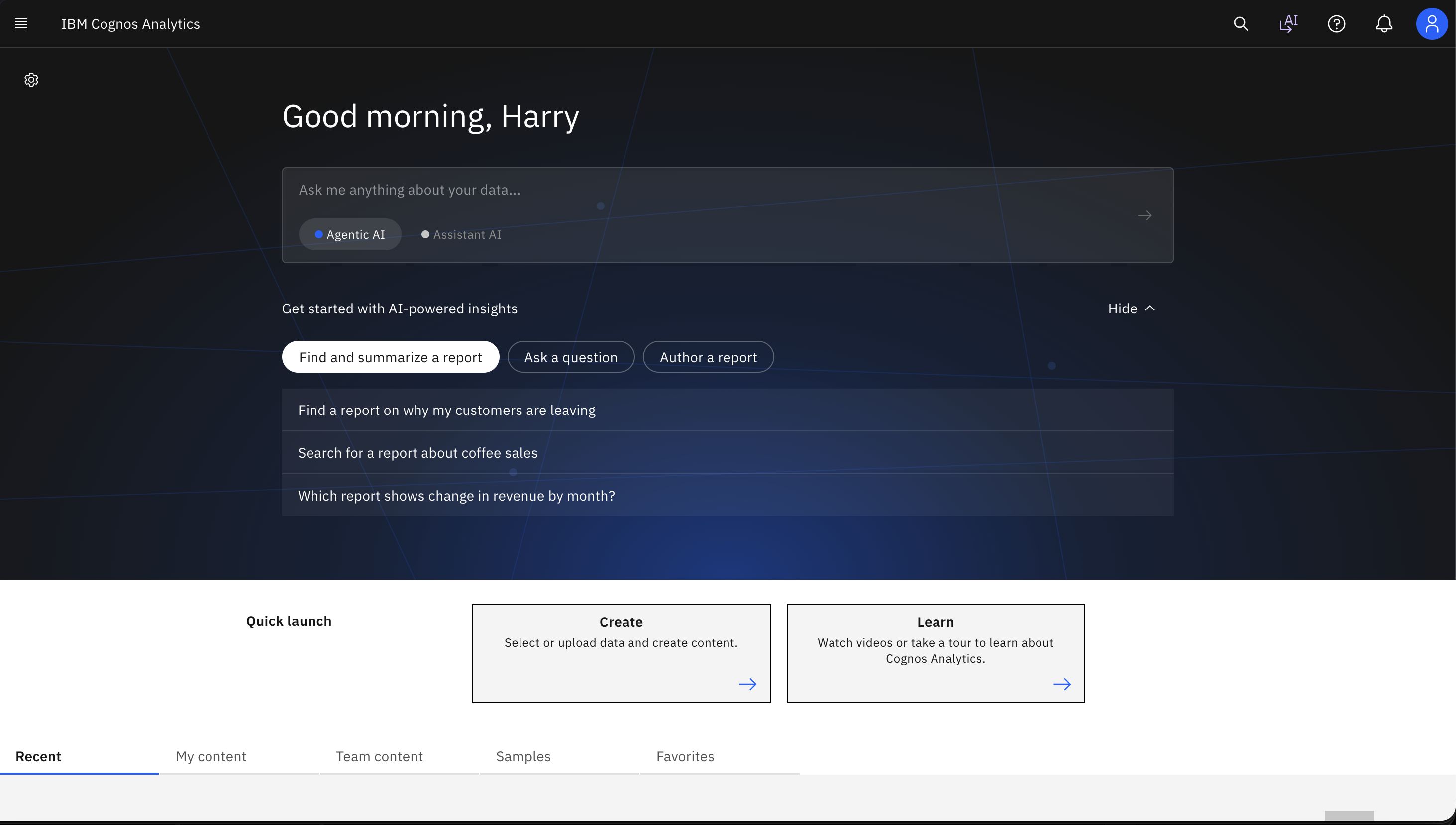
IBM Cognos Analytics
Score 7.4 out of 10
N/A
IBM Cognos is a full-featured business intelligence suite by IBM, designed for larger deployments. It comprises Query Studio, Reporting Studio, Analysis Studio and Event Studio, and Cognos Administration along with tools for Microsoft Office integration, full-text search, and dashboards.
In contrast, Active Query Builder was less expensive, more rapidly implemented, and received universally positive feedback from consumers. I have found that it is hard to anticipate all of the different ways that end users would want to query their data, and although I am not …
I have used Flutter to begin and with flutter you need learn a language called Dart which is not needed with AQB, which is the main reason for us to pick Active Query Builder as a choice over Flutter. AQB supports all the merchant SQL databases with native syntax support, query …
AQB for cheap, faster to market, and reviews were really good. It has proved impossible for me to predict every which way that end users would want to query their data and whilst I'm not averse to creating new views for end-users one person's wishes will not always suit …
It's good quality software, simple to use, support is also great. It's easy to get started and the integration is also easy. Security-wise it's the best and the usage as compared to the security is by large the best and for end users with no technical knowledge, it's a great …
i believe that CA is more powerful, has better modelling, and is not held back by a cumbersome method of re-using data models. The only thing that holds it back is the complexity of licensing.
IBM Cognos Analytics is robust in terms of reporting, governance and scheduling while Power BI excels in use, interactivity and visuals. In nutshell, IBM Cognos Analytics has edge over Power BI for enterprise grade , structured reporting needs.
Power BI is stronger for quick ad-hoc analysis and dashboards, but IBM Cognos Analytics is better when consistency, precision, and mass distribution matter. Tableau is best for interactive analysis, while IBM Cognos Analytics is better for standardized, repeatable enterprise …
IBM Cognos Analytics was more matured enterprise modeling-based tool. Our power Bi struggled against large ERP data sets, which IBM didn't after few initial days.
IBM had much better scalability and security when comes to user reports distribution. The schedule feature worked …
Compared to other tools like Power BI, Tableau, and Google studio, IBM Cognos Analytics is better for the companies who looks strong control on detailed reports. Power BI and Tableau are easy to use and good for quick presentation, but Cognos has more options for security, such …
Tableau, Power BI, QlikView were the other options considered. Tableau lacked the following key components of business intelligence and analytics. Some other statistical functions that are available on the platform were not matched by Power BI. QlikView lacked robust …
We selected IBM Cognos Analytics based on the following. The scalable and robust features for large organizations allowing it to grow as we do. The nest feature is the strong data governance and security features. It also supports a wide variety of data sources. Lastly, it …
It was due to trust in IBM. Very good support provide by IBM. Response time is pretty good Product is proven in past & well robust feature Many good enterprises have used this product
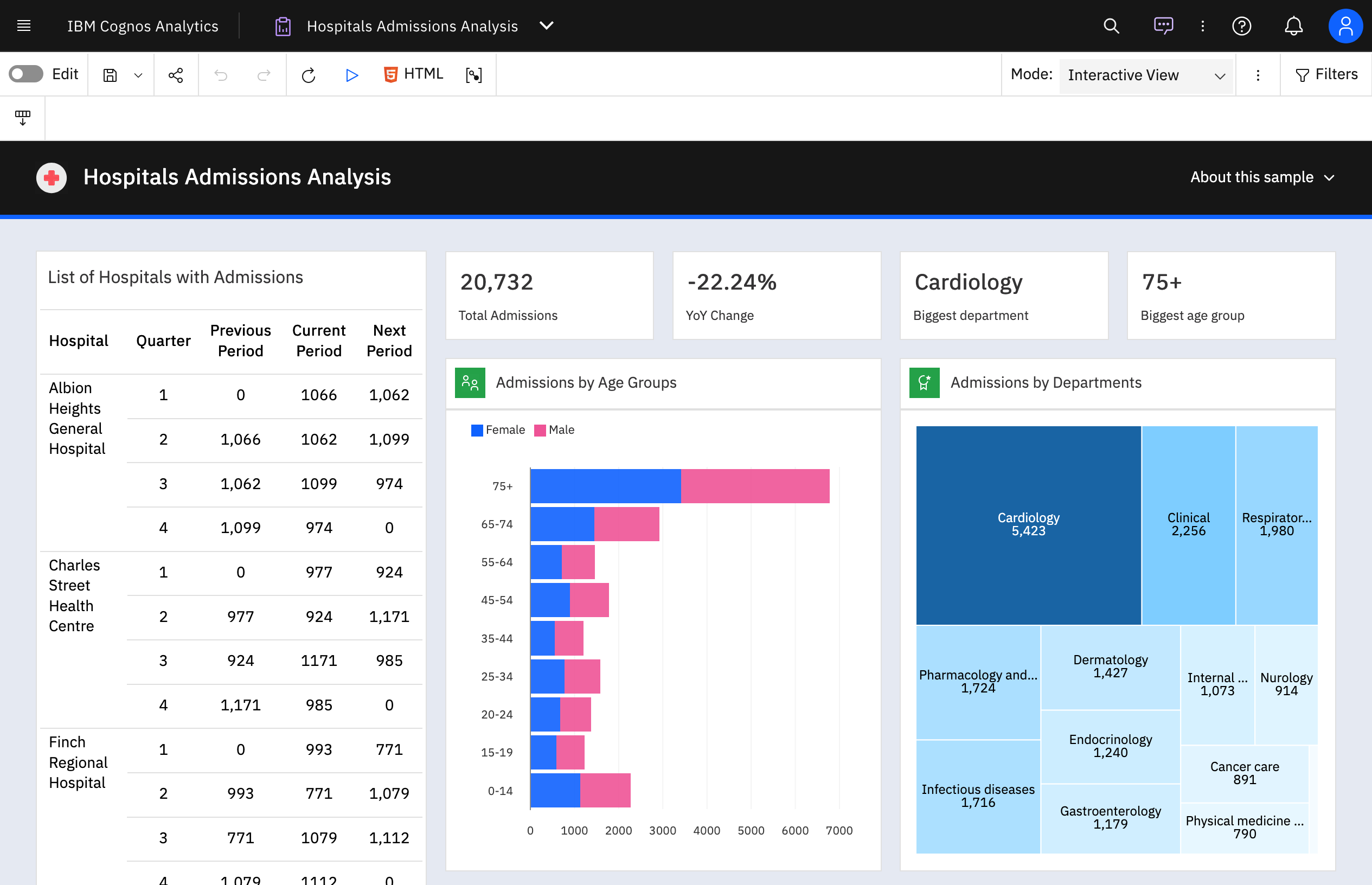
My company selected IBM Congos Analytics because of its advanced features and data representation for data analysis. Its row and column features are very effective for creating dashboards and reports to visualize data. It's chart representation and view format are very …
IBM Cognos Analytics is our legacy BI solution. It hadn't stacked up well against its modern contemporaries. We are thinking of replacing it with Microsoft BI.
Cognos provides very advanced analytics functionalities, maybe even more advanced than the competition, and works great when used in collaboration with Watson. However, Tableau and other newer products are much better regarding overall usability.
It is a good one for business users who are in no way technical and do not have any insights about the backend databases and do not have any SQL experience. They can simply go in and create queries without any SQL knowledge by just using a drag and drop way..now tell me how cool is that? :)
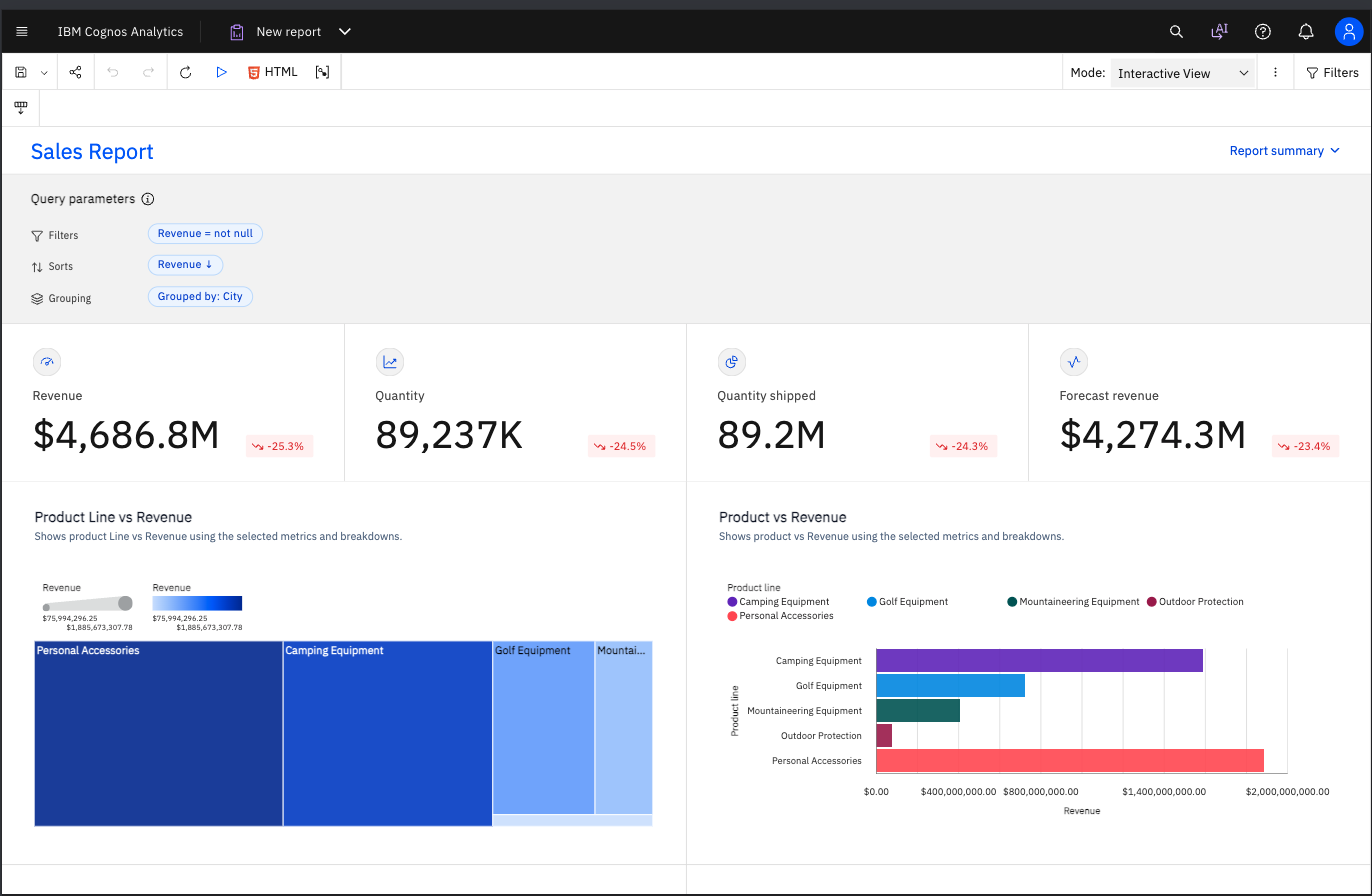
IBM Cognos Analytics has great scheduling capabilities. A single report can be parameterized (e.g., “Store Manager ID”) and burst to thousands of recipients with their slice of data.IBM Cognos Analytics is a good fit for highly complex, multi-level calculations which can be handled by Report Studio. For example Monthly balance sheet that requires multi step calculation
IBM Cognos Analytics enables customer data segmentation, which is essential for marketing, improving and streamlining purchasing behavior and preferences. This helps companies create more targeted and effective marketing campaigns.
Our clients Through data analysis, we can identify and observe trends in the behavior of other clients, allowing us to anticipate needs and adjust strategies to avoid consequences.
It took my BI team one year to become productive at developing useful content on the IBM Cognos platform. After this year, the reports being developed for a client were stale and no longer relative to the ever changing needs of the business client. Given the same opportunity, I would select a platform that allows the team to quickly produce BI content. Fail fast and recover quickly!
We have a strong user base (3500 users) that are highly utilizing this tool. Basic users are able to consume content within the applied security model. We have a set of advanced users that really push the limits of Cognos with Report and Query Studio. These users have created a lot of personal content and stored it in 'My Reports'. Users enjoy this flexibility.
Reports can typically be viewed through any browser that can access the server, so the availability is ultimately up to what the company utilizing it is comfortable with allowing, though report development tends to be more picky about browsers and settings as mentioned above. It also has an optional iPad app and general mobile browsing support, but dashboards lack the mobile compatibility. What keeps it from getting a higher score is the desktop tools that are vital to the development process. The compatibility with only Windows when the server has a wide range of compatibility can be a real sore point for a company that outfits its employees exclusively with Mac or Linux machines. Of course, if they are planning on outsourcing the development anyways, it's a rather moot point
Overall no major complaints but it doesn't handle DMR (Dimensionally Modeled for Relational) very well. DMR modelling is a capability that IBM Cognos Framework Manager provides allowing you to specify dimensional information for relational metadata and allows for OLAP-style queries. However, the capability is not very efficient and, for example, if I'm using only 2 columns on a 20-column model, the software is not smart enough to exclude 18 columns and the query side gets progressively larger and larger until it's effectively unusable.
Why is their web application not working as fast as you think it should? They never know, and it is always a a bunch of shots in the dark to find out. Trying to download software from them is like trying to find a book at the library before computers were invented.
Onsite training provided by IBM Cognos was effective and as expected. They did not perform training with our data which was a bit difficult for our end-users.
The online courses they offer are thorough and presented in such a way that someone who isn't already familiar with the general design methodologies used in this field will be capable of making a good design. The training environments are provided as a fully self contained virtual machine with everything needed already to create the environments. We've had some persisting issues with the environments becoming unavailable, but support has been responsive when these issues arise and straightening them out for us
The implementation was handled very well. The initial implementation exposed a lot of disagreement between our campuses and departments as to how we define data. This was not entirely unexpected, but I thought that we did a nice job as a team to work through some of these challenges.
In contrast, Active Query Builder was less expensive, more rapidly implemented, and received universally positive feedback from consumers. I have found that it is hard to anticipate all of the different ways that end users would want to query their data, and although I am not opposed to designing new views for end-users, it is important to keep in mind that the preferences of a single user will not be shared by all. Due to its complete visual access, Active Query Builder is the optimal choice.
IBM Cognos Analytics is robust in terms of reporting, governance and scheduling while Power BI excels in use, interactivity and visuals. In nutshell, IBM Cognos Analytics has edge over Power BI for enterprise grade , structured reporting needs.
The Cognos architecture is well suited for scalability. However, the architecture must be designed with scalability in mind from day one of the implementation. We recently upgraded from 10.1 to 10.2.1 and took the opportunity to revamp our architecture. It is now poised for future growth and scalability.