Altova MapForce is a graphical data mapping tool for any-to-any conversion and integration. Its data mapping tools convert data instantly and provide multiple options to automate recurrent transformations.
$315
one-time fee
dbForge Studio (Edge)
Score 8.0 out of 10
N/A
dbForge Studio is provided by
Devart and is a universal front-end client for database
management, administration and development. Devart's GUI tool provides
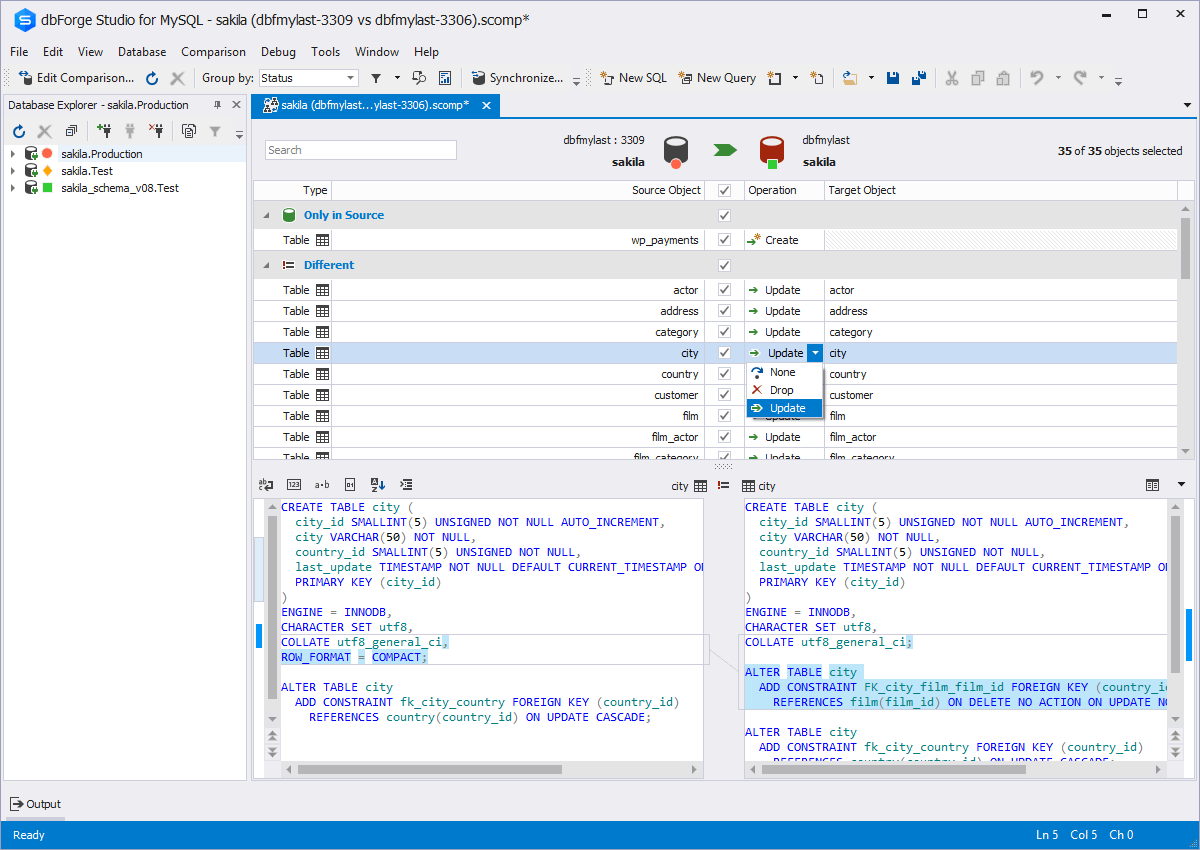
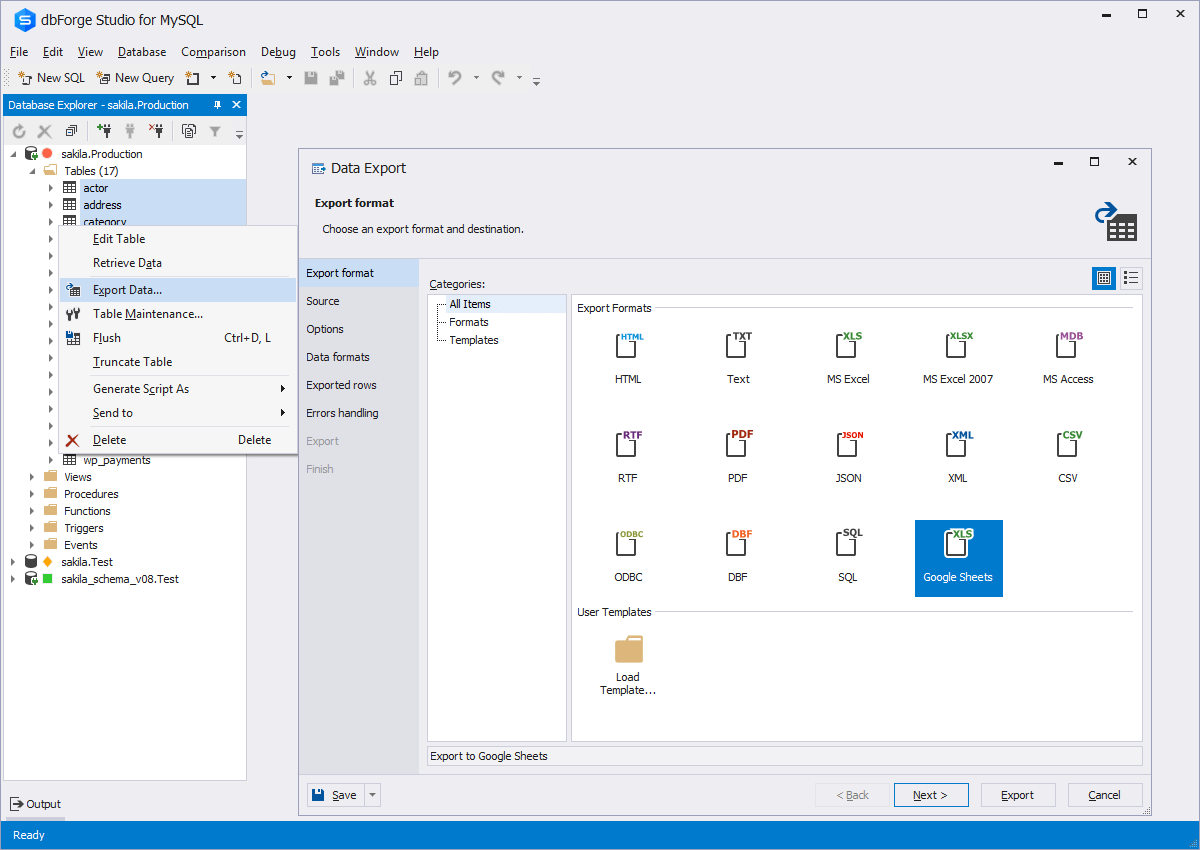
utilities to compare, synchronize, and back up databases (e.g. MySQL, Oracle, SQL Server, PostgreSQL, etc.) with scheduling,
and includes the possibility to analyze and report MySQL tables data. For example, dbForge
Studio for MySQL works with any MariaDB database servers, and supports all
MariaDB objects types. This solution enables users…
$9.95
per month
Oracle Data Integrator (ODI)
Score 7.6 out of 10
N/A
Oracle Data Integrator is an ELT data integrator designed with interoperability other Oracle programs. The program focuses on a high-performance capacity to support Big Data use within Oracle.
N/A
Pricing
Altova MapForce
dbForge Studio (Edge)
Oracle Data Integrator (ODI)
Editions & Modules
Altova® MapForce 2025 Basic Edition
From $315
one-time fee
Altova® MapForce 2025 Professional Edition
From $619
one-time fee
Altova® MapForce 2025 Enterprise Edition
From $999
one-time fee
Standard (subcription)
$9.95
per month
Professional (subscription)
$19.95
per month
Enterprise (subscription)
$29.95
per month
Standard (subcription)
$99.95
per year
Professional (subscription)
$179.95
per year
Standard
$199.95
Enterprise (subscription)
$229.95
per year
Professional
$349.95
Enterprise
$449.95
No answers on this topic
Offerings
Pricing Offerings
Altova MapForce
dbForge Studio (Edge)
Oracle Data Integrator (ODI)
Free Trial
No
Yes
No
Free/Freemium Version
No
Yes
No
Premium Consulting/Integration Services
No
Yes
No
Entry-level Setup Fee
No setup fee
No setup fee
No setup fee
Additional Details
—
—
—
More Pricing Information
Community Pulse
Altova MapForce
dbForge Studio (Edge)
Oracle Data Integrator (ODI)
Features
Altova MapForce
dbForge Studio (Edge)
Oracle Data Integrator (ODI)
Database Development
Comparison of Database Development features of Product A and Product B
Altova MapForce
-
Ratings
dbForge Studio (Edge)
8.4
2 Ratings
1% below category average
Oracle Data Integrator (ODI)
-
Ratings
Version control tools
00 Ratings
8.01 Ratings
00 Ratings
Test data generation
00 Ratings
7.01 Ratings
00 Ratings
Performance optimization tools
00 Ratings
9.01 Ratings
00 Ratings
Schema maintenance
00 Ratings
9.01 Ratings
00 Ratings
Database change management
00 Ratings
9.02 Ratings
00 Ratings
Database Administration
Comparison of Database Administration features of Product A and Product B
Altova MapForce
-
Ratings
dbForge Studio (Edge)
7.0
1 Ratings
14% below category average
Oracle Data Integrator (ODI)
-
Ratings
User management
00 Ratings
6.01 Ratings
00 Ratings
Database security
00 Ratings
6.01 Ratings
00 Ratings
Database status reporting
00 Ratings
7.01 Ratings
00 Ratings
Change management
00 Ratings
9.01 Ratings
00 Ratings
Data Source Connection
Comparison of Data Source Connection features of Product A and Product B
Altova MapForce
-
Ratings
dbForge Studio (Edge)
-
Ratings
Oracle Data Integrator (ODI)
8.0
12 Ratings
3% below category average
Connect to traditional data sources
00 Ratings
00 Ratings
8.012 Ratings
Connecto to Big Data and NoSQL
00 Ratings
00 Ratings
8.010 Ratings
Data Transformations
Comparison of Data Transformations features of Product A and Product B
Altova MapForce
-
Ratings
dbForge Studio (Edge)
-
Ratings
Oracle Data Integrator (ODI)
8.0
12 Ratings
1% below category average
Simple transformations
00 Ratings
00 Ratings
8.012 Ratings
Complex transformations
00 Ratings
00 Ratings
8.012 Ratings
Data Modeling
Comparison of Data Modeling features of Product A and Product B
Altova MapForce
-
Ratings
dbForge Studio (Edge)
-
Ratings
Oracle Data Integrator (ODI)
7.4
12 Ratings
5% below category average
Data model creation
00 Ratings
00 Ratings
8.011 Ratings
Metadata management
00 Ratings
00 Ratings
8.011 Ratings
Business rules and workflow
00 Ratings
00 Ratings
7.012 Ratings
Collaboration
00 Ratings
00 Ratings
7.011 Ratings
Testing and debugging
00 Ratings
00 Ratings
7.012 Ratings
Data Governance
Comparison of Data Governance features of Product A and Product B
This tool is useful for small and large IT departments and associated data analysts that perform direct database functions such as DBA tasks or extracting/importing data. Non-technical staff members would not benefit from this tool as much as the functions are detailed and technical. However, automation engineers will find this tool very open for automation, and can generate the scripting code for any of its functions.
Oracle Data Integrator is well suited in all the situations where you need to integrate data from and to different systems/technologies/environments or to schedule some tasks. I've used it on Oracle Database (Data Warehouses or Data Marts), with great loading and transforming performances to accomplish any kind of relational task. This is true for all Oracle applications (like Hyperion Planning, Hyperion Essbase, Hyperion Financial Management, and so on). I've also used it to manage files on different operating systems, to execute procedures in various languages and to read and write data from and to non-Oracle technologies, and I can confirm that its performances have always been very good. It can become less appropriate depending on the expenses that can be afforded by the customer since its license costs are quite high.
Oracle Data Integrator nearly addresses every data issue that one can expect. Oracle Data Integrator is tightly integrated to the Oracle Suite of products. This is one of the major strengths of Oracle Data Integrator. Oracle Data Integrator is part of the Oracle Business Intelligence Applications Suite - which is highly used by various industries. This tool replaced Informatica ETL in Oracle Business Intelligence Applications Suite.
Oracle Data Integrator comes with many pre-written data packages. If one has to load data from Excel to Oracle Database, there is a package that is ready available for them - cutting down lot of effort on writing the code. Similarly, there are packages for Oracle to SQL, SQL to Oracle and all other possible combinations. Developers love this feature.
Oracle Data Integrator relies highly on the database for processing. This is actually an ELT tool rather than an ETL tool. It first loads all the data into target instance and then transforms it at the expense of database resources. This light footprint makes this tool very special.
The other major advantage of Oracle Data Integrator, like any other Oracle products, is a readily available developer pool. As all Oracle products are free to download for demo environments, many organizations prefer to play around with a product before purchasing it. Also, Oracle support and community is a big advantage compared to other vendors.
The ability to parameterize searches more would be advantageous. For example, being able to specify to only look for certain columns, certain data type changes, etc.
The output reports from dbForge are very plain and could contain more detail, and perhaps be structured more like a pivot table form Excel
ODI does not have an intuitive user interface. It is powerful, but difficult to figure out at first. There is a significant learning curve between usability, proficiency, and mastery of the tool.
ODI contains some frustrating bugs. It is Java based and has some caching issues, often requiring you to restart the program before you see your code changes stick.
ODI does not have a strong versioning process. It is not intuitive to keep an up to date repository of versioned code packages. This can create versioning issues between environments if you do not have a strong external code versioning process.
It is maturing and over time will have a good pool of resources. Each new version has addressed the issues of the previous ones. Its getting better and bigger.
dbForge Studio (Edge) has a great UI and it's versatile, but it still has some glitches. Its multiple database support makes it possible to stick with only one UI to handle different RDBM systems, even though you have to redefine user credentials for each new connection (no copying/cloning feature for database connections). The Edit View and diagramming features also could be improved.
Oracle Data Integrator (ODI) is a reliable ELT tool, supporting data loads from various heterogenous sources. It is effective both for structured as well as non structured data. Its works well for creating translations and transformation and also aids in the data quality checks when combined with an MDM solution. Troubleshooting issues can be of a challenge if it is not configured properly.
Although experience here is limited, as only one question has been asked and answered promptly, the registration and licensing process was very smooth and professional. There are forums online that discuss dbForge issues, as well as a Facts and Questions section on dbForge's website, so product support does seem to exist if needed.
Before choosing dbForge Studio I evaluated at least a dozen tools, especially on the Visual Query Builder function. For now, I have identified only one product that has a better Visual Query Builder than dbForge Studio. This other product also manages UNIONs, while dbStudio still doesn't do it visually. However, the better alternative product is enormously slower in operations and less feature-rich than DbForge Studio
I have used Trifacta Google Data Prep quite a bit. We use Google Cloud Platform across our organization. The tools are very comparable in what they offer. I would say Data Prep has a slight edge in usability and a cleaner UI, but both of the tools have comparable toolsets.