AWS offers the Amazon API Gateway supports the creation and publication of an API for web applications, as well as its monitoring and maintenance. The Amazon API Gateway is able to support thousands of API calls concurrently and provides traffic management, as well as monitoring and access control.
$0.90
Per Million
Azure API Management
Score 8.7 out of 10
N/A
Microsoft's Azure API Management supports creation of API.
$0.04
per 10,000 calls
Anypoint Platform
Score 7.8 out of 10
N/A
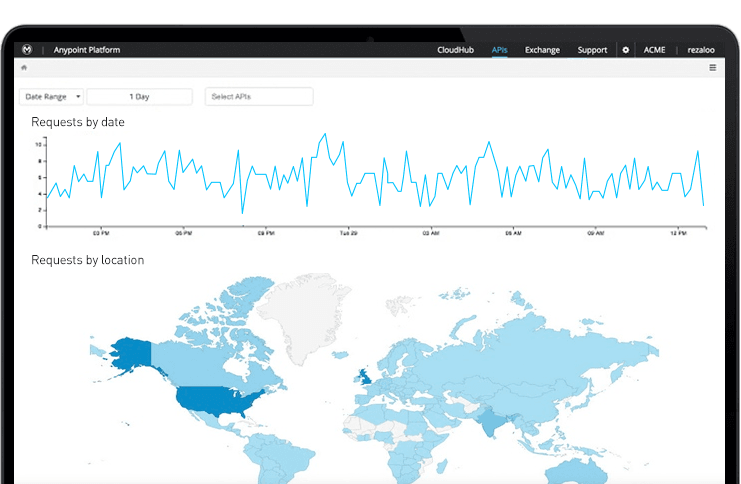
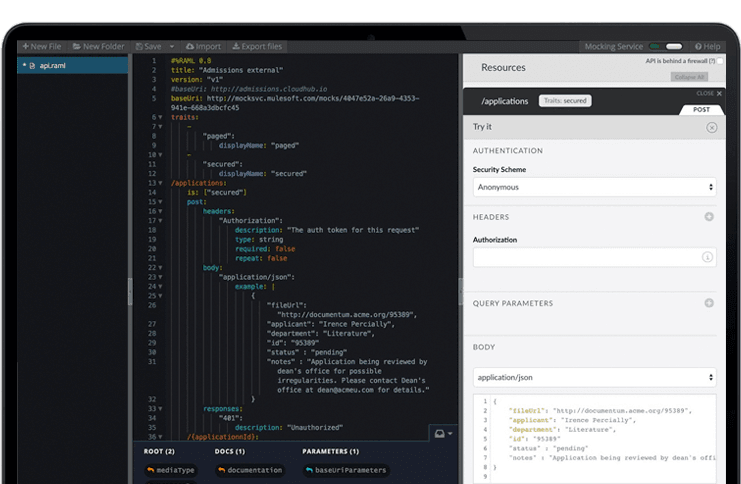
The Anypoint Platform developed by MuleSoft and acquired by Salesforce in early 2018 is designed to
connect apps, data, and devices anywhere, on-premises or in the cloud. This platform was built to
offer out-of-the-box connectors as well as tools that architects and developers can adopt quickly to
design, build and manage the entire lifecycle of their APIs, applications, and products.
N/A
Pricing
Amazon API Gateway
Azure API Management
MuleSoft Anypoint Platform
Editions & Modules
Past 300 Million
$0.90
Per Million
First 300 Million
$1.00
Per Million
Consumption
0.042 per 10,000 calls
Lightweight and serverless version of API Management service, billed per execution
Developer
$48.04
per month Non-production use cases and evaluations
Basic
$147.17
per month Entry-level production use cases
Standard
$686.72
per month Medium-volume production use cases
Premium
$2,795.17
per month High-volume or enterprise production use cases
Isolated
TBA
per month Enterprise production use cases requiring high degree of isolation
No answers on this topic
Offerings
Pricing Offerings
Amazon API Gateway
Azure API Management
Anypoint Platform
Free Trial
No
No
Yes
Free/Freemium Version
No
No
Yes
Premium Consulting/Integration Services
No
No
No
Entry-level Setup Fee
No setup fee
No setup fee
No setup fee
Additional Details
—
—
—
More Pricing Information
Community Pulse
Amazon API Gateway
Azure API Management
MuleSoft Anypoint Platform
Considered Multiple Products
Amazon API Gateway
Verified User
Technician
Chose Amazon API Gateway
When we tested Azure API Management at the time, it had serious connectivity issues, it was very unstable, and it needed to do a lot using the command line. Comparing with the AWS solution, which was more mature, and the fact that we have services in use on AWS, we ended up …
Compared to other solutions, Azure is much easier to use and setup, but probably for hybrid solution Talend API in the cloud is the best solution and Talend API can take advantage of Amazon API Gateway, thus all this hard work is done by other software solution. Additionally, …
As AWS API comes with more security and API key authentication functions, it's easy for the organization to handle the various customers based with different level of permission. And also very easy comparable to others for tracking the API calls. Also, scalability and …
It’s a great tool, and so easy to seamlessly connect into your current Azure world that it’s hard not to look at it or even test the waters with it. It’s priced well, and is feature-rich enough to accomplish most tasks. I think the ease of having everything together and the …
AWS is a very good tool but still evolving and offers a small set of API management features. The main reason why we chose MuleSoft Anypoint Platform API Manager is because it is well suited with the APIs developed in Mule ESB.
Once we have moved all of our system integration APIs to the MuleSoft Anypoint Platform, we will need to communicate with a wide variety of external systems. All of our business and service logic is stored in the aforementioned core systems. Anypoint Platform (and all of our …
We selected Mulesoft for speed of implementation. We did not have the luxury of time and needed a solution that can be learned and implemented within weeks so we can take advantage of newly formed partnerships. The training that was provided to use during our pre-sales and …
Experienced a lack of available programming languages while working on a minor project. I had to halt the project and wait for it to be added later. It took ages and had a hit on our productivity. It has a centralized management system which helps and an easy interface which helps to manage multiple tasks in case of large-scale operations and projects.
1) Securing your back-end APIs - If you have a legacy back-end web service that has a basic authentication scheme, you can add some additional security by placing APIM in front, and requiring subscription keys. Leverage your existing firewall to ensure only your APIM instance can communicate with your back-end API, and you've basically added a layer of protection.
2) Lift and shift - there are always going to be clients that don't want to update their clients to use a newer API; in some cases you can make a newer API look like an older one by implementing some complex policies in APIM. You can also do the opposite, making older APIs look new, such as making an XML back-end accept both JSON and XML.
3) Centralizing your APIs - if you've acquired another company and want to make their API set look as if it's a part of the larger whole, APIM is an easy way to provide a consistent front-end interface for developers.
MuleSoft Anypoint Platform is best tool in the market for developing APIs with complex structures communicating with various different types of applications including web applications as well as legacy applications. Also applications including database connectivity for fetching and updating data in the DB tables. I cant think of any scenario which MuleSoft Anypoint Platform could not be used for developing the integrations.
API Gateway integrates well with AWS Lambda. This allows us to build a web server in the language and framework of our choice, deploy it as a Lambda function, and expose it through API Gateway.
API Gateway manages API keys. Building rate limiting and request quota features are not trivial (or interesting).
API Gateway's pricing can be very attractive for services that are accessed infrequently.
Lack of robustness is a bit of an issue. Several other providers offer more options and capabilities, but then, they are lacking in interface ease.
As with anything Azure, pricing is really hard to stay on top of. I always find that you really don’t know what you’re paying for until you get the bill. Having an excellent Azure Administrator can help resolve that.
Integrating with app services outside of Azure can be a challenge, or at least much more challenging than just using Azure App Services.
Has more features than what we really need so we're paying for more than we use. Sort of like paying for an Abrams tank when all we really need is a Toyota Corolla.
Not a value product, tends to be expensive.
Takes a while for developers to learn to use Mulesoft Anypoint.
It is a great product very reliable and stable for connecting various aws services like we connected with lambda function and it is working very well, never faced any issue after the setup. It also saves out lots of money as well as time after we implemented the automatic ec2 server recovery system
There’s a lot of learning curve at the beginning when it comes to building the code and everything. In terms of usability, I’d say once you get used to it, it’s fine — but it’s not very easy during the initial stages.
We always had a great experience with the AWS support team. They were always on time and very dependable. It was a good partnership while we worked to resolve our issues.
Anypoint Platform support is very responsive. There is also a huge knowledge base and an active online forum where answers to most questions can be found. When needed support engages the engineering group so adequate solutions or workarounds are always provided.
When we tested Azure API Management at the time, it had serious connectivity issues, it was very unstable, and it needed to do a lot using the command line. Comparing with the AWS solution, which was more mature, and the fact that we have services in use on AWS, we ended up choosing to continue using AWS products. This so as not to run the risk of increasing latency in accesses, and of some functionality not working, due to being developed yet.
Once we have moved all of our system integration APIs to the MuleSoft Anypoint Platform, we will need to communicate with a wide variety of external systems. All of our business and service logic is stored in the aforementioned core systems. Anypoint Platform (and all of our APIs) makes it easy to connect to various other platforms. In order to link to these many other systems, connectors and/or components are utilized, and they are simple to configure and integrate.