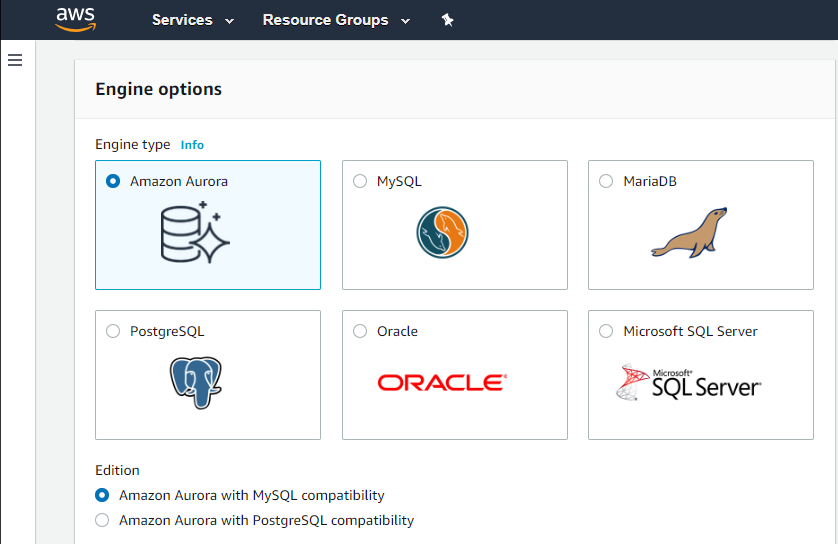
Amazon Relational Database Service (Amazon RDS) is a database-as-a-service (DBaaS) from Amazon Web Services.
N/A
MariaDB Platform
Score9.1 out of 10
N/A
MariaDB is an open-source relational database made by the original developers of MySQL, supported by the MariaDB Foundation and a community of developers. The community states recent additional capabilities as including clustering with Galera Cluster 4, compatibility with Oracle Database, and Temporal Data Tables, allowing one to query the data as it stood at any point in the past.
N/A
Pricing
Amazon RDS
MariaDB Platform
Editions & Modules
Amazon RDS for PostgreSQL
$0.24 ($0.48)
per hour, R5 Large (R5 Extra Large)
Amazon RDS for MariaDB
$0.25 ($0.50)
per hour, R5 Large (R5 Extra Large)
Amazon RDS for MySQL
$0.29 ($0.58)
per hour, R5 Large (R5 Extra Large)
Amazon RDS for Oracle
$0.482 ($0.964)
per hour, R5 Large (R5 Extra Large)
Amazon RDS for SQL Server
$1.02 ($1.52)
per hour, R5 Large (R5 Extra Large)
No answers on this topic
Offerings
Pricing Offerings
Amazon RDS
MariaDB Platform
Free Trial
No
Yes
Free/Freemium Version
No
Yes
Premium Consulting/Integration Services
No
Yes
Entry-level Setup Fee
Optional
Optional
Additional Details
—
—
More Pricing Information
Community Pulse
Amazon RDS
MariaDB Platform
Considered Both Products
Amazon AWS
Verified User
Chose Amazon RDS
Amazon Relational Database Service manages MariaDB and MySQL, so if you need to use those databases, then Amazon Relational Database Service will manage everything from the installation to the incremental updates needed for operation. Not having to worry about maintaining a …
A de minimis incentive was given to thank the reviewer for their time. The incentive was not used to bias or drive a particular response, nor was the incentive contingent on a positive endorsement. More Info
Product Solution Architect in Information Technology at NeoSoft Technologies Ltd (Information Technology & Services, 5001-10,000 employees)
Chose Amazon RDS
Every traditional rational Database requires server installation & accessing needs to be monitored periodically manually. But Amazon provides easy-to-access and monitor health and scale-up and scale-down option just by clicks without adding any additional hardware.
A de minimis incentive was given to thank the reviewer for their time. The incentive was not used to bias or drive a particular response, nor was the incentive contingent on a positive endorsement. TR verified that a representative sample of customers was invited. More Info
Tech Co-Founder in Corporate at Infofree.com (Computer Software, 1-10 employees)
Chose Amazon RDS
It's hard to identify how Amazon RDS stacks up against the databases they support, because to install and use a relational database in a production environment you need a Database Administrator to help install, configure and manage. Amazon RDS keeps the details simple enough …
A de minimis incentive was given to thank the reviewer for their time. The incentive was not used to bias or drive a particular response, nor was the incentive contingent on a positive endorsement. More Info
DevOps Engineer/Linux Admin in Information Technology at Vidyayug (Education Management, 11-50 employees)
Chose Amazon RDS
Automated snap-shotting every 24 hours is, again something that I could just set up in minutes with a few clicks, though we also backup on cron jobs to elsewhere, and, because of our industry we have a HUGE "forensic logs" that initially live in the database but get archived …
A de minimis incentive was given to thank the reviewer for their time. The incentive was not used to bias or drive a particular response, nor was the incentive contingent on a positive endorsement. More Info
MariaDB
Verified User
Chose MariaDB Platform
MariaDB provided the best fit for our business in upgrading legacy systems which were originally designed to use MySQL as a backend. By using MariaDB, no changes to the overall systems needed to be altered, reducing the time needed to upgrade everything. Other solutions …
A de minimis incentive was given to thank the reviewer for their time. The incentive was not used to bias or drive a particular response, nor was the incentive contingent on a positive endorsement. More Info
Owner in Engineering at IĮ "Technologica Ecliptica" (Computer Software, 1-10 employees)
Chose MariaDB Platform
We migrated away from MySQL because of stability issues; when choosing a new database system we considered FirebirdSQL (having some experience from other projects) and did not use it because of stability and lack of standard SQL features in its query language; and Amazon's …
A de minimis incentive was given to thank the reviewer for their time. The incentive was not used to bias or drive a particular response, nor was the incentive contingent on a positive endorsement. More Info
If your application needs a relational data store and uses other AWS services, AWS RDS is a no-brainer. It offers all the traditional database features, makes it a snap to set up, creates cross-region replication, has advanced security, built-in monitoring, and much more at a very good price. You can also set up streaming to a data lake using various other AWS services on your RDS.
A de minimis incentive was given to thank the reviewer for their time. The incentive was not used to bias or drive a particular response, nor was the incentive contingent on a positive endorsement. More Info
A de minimis incentive was given to thank the reviewer for their time. The incentive was not used to bias or drive a particular response, nor was the incentive contingent on a positive endorsement. More Info
Automated Database Management: We use it for streamlining routine tasks like software patching and database backups.
Scalability on Demand: we use it to handle traffic spikes, scaling both vertically and horizontally.
Database Engine Compatibility: It works amazingly with multiple database engines used by different departments within our organization including MySQL, PostgreSQL, SQL Server, and Oracle.
Monitoring: It covers our extensive monitoring and logging, and also has great compatibility with Amazon CloudWatch
A de minimis incentive was given to thank the reviewer for their time. The incentive was not used to bias or drive a particular response, nor was the incentive contingent on a positive endorsement. TR verified that a representative sample of customers was invited. More Info
Simpler learning curve. MariaDB is a cleaner, simpler system that is (IMO) easier to learn and easier to manage effectively than many other database systems.
Lower hardware requirements. After migrating to MariaDB from another database software system, we find that our hardware needs have substantially decreased.
MariaDB support is very responsive. It's like they actually care. On the few occasions we've run into technical issues, support has always come through with what we needed. Once it was showing me a relatively new feature the server supported that I wasn't aware of, that, once I was able to properly make use of it helped me resolve a serious production performance issue.
Architectural flexibility. As an example, the ready availability of synchronous (Galera) versus asynchronous replication schemes without being locked into one of the other by enormous technical complexity or punitive licensing, allows the customer to find what really works best for their needs.
A de minimis incentive was given to thank the reviewer for their time. The incentive was not used to bias or drive a particular response, nor was the incentive contingent on a positive endorsement. More Info
It is a little difficult to configure and connect to an RDS instance. The integration with ECS can be made more seamless.
Exploring features within RDS is not very easy and intuitive. Either a human friendly documentation should be added or the User Interface be made intuitive so that people can explore and find features on their own.
There should be tools to analyze cost and minimize it according to the usage.
A de minimis incentive was given to thank the reviewer for their time. The incentive was not used to bias or drive a particular response, nor was the incentive contingent on a positive endorsement. TR verified that a representative sample of customers was invited. More Info
Driver Support - Some third party applications use database drivers that cause unexplained slowness with MariaDB. This can be worked around by using the MySQL drivers, but it's not clear what causes the problem in the first place.
Support - While online communities are helpful in diagnosing problems, there isn't as much professional documentation/support available for MariaDB as some of the other major database options.
Data Visualization - It would be helpful if there were more built in options for analyzing statistics and generating reports.
A de minimis incentive was given to thank the reviewer for their time. The incentive was not used to bias or drive a particular response, nor was the incentive contingent on a positive endorsement. More Info
We do renew our use of Amazon Relational Database Service. We don't have any problems faced with RDS in place. RDS has taken away lot of overhead of hosting database, managing the database and keeping a team just to manage database. Even the backup, security and recovery another overhead that has been taken away by RDS. So, we will keep on using RDS.
A de minimis incentive was given to thank the reviewer for their time. The incentive was not used to bias or drive a particular response, nor was the incentive contingent on a positive endorsement. More Info
I've been using AWS Relational Database Services in several projects in different environments and from the AWS products, maybe this one together to EC2 are my favourite. They deliver what they promise. Reliable, fast, easy and with a fair price (in comparison to commercial products which have obscure license agreements).
A de minimis incentive was given to thank the reviewer for their time. The incentive was not used to bias or drive a particular response, nor was the incentive contingent on a positive endorsement. More Info
MariaDB is very usable and stable to be used in production settings as an alternative to MySQL. The shortcomings of SQL are present but well understood in the community, and if the decision were to be made again, I would choose MariaDB over MySQL on future projects.
A de minimis incentive was given to thank the reviewer for their time. The incentive was not used to bias or drive a particular response, nor was the incentive contingent on a positive endorsement. More Info
I have only had good experiences in working with AWS support. I will admit that my experience comes from the benefit of having a premium tier of support but even working with free-tier accounts I have not had problems getting help with AWS products when needed. And most often, the docs do a pretty good job of explaining how to operate a service so a quick spin through the docs has been useful in solving problems.
A de minimis incentive was given to thank the reviewer for their time. The incentive was not used to bias or drive a particular response, nor was the incentive contingent on a positive endorsement. More Info
We have launched several inquiries to MariaDB support and they have always responded very quickly and have not been tutoring for the duration of the incident/problem.
Likewise, they want to hold constant meetings with the client to get their opinion as well as how they can help.
I see a very human support and concerned about the customer.
A de minimis incentive was given to thank the reviewer for their time. The incentive was not used to bias or drive a particular response, nor was the incentive contingent on a positive endorsement. More Info
A de minimis incentive was given to thank the reviewer for their time. The incentive was not used to bias or drive a particular response, nor was the incentive contingent on a positive endorsement. TR verified that a representative sample of customers was invited. More Info
Amazon Relational Database Service (RDS) stands out among similar products due to its seamless integration with other AWS services, automated backups, and multi-AZ deployments for high availability. Its support for various database engines, such as MySQL, PostgreSQL, and Oracle, provides flexibility. Additionally, RDS offers managed security features, including encryption and IAM integration, enhancing data protection. The pay-as-you-go pricing model makes it cost-effective. Overall, Amazon RDS excels in ease of use, scalability, and a comprehensive feature set, making it a top choice for organizations seeking a reliable and scalable managed relational database service in the cloud.
MariaDB stacks up the the competition just fine. Due to is ture open source nature we do not have to worry about licencing and spending money on nothing. Moreover, MariaDB does everything that we need to get done. We can run data that is a million rows or many smaller projects on the same environment with little overhead. One of the best features that MariaDB has is the ability of backup or dump data to standard text sql statements. That was one of the reasons why we choose MariaDb because it makes backups or transferring data a snap
A de minimis incentive was given to thank the reviewer for their time. The incentive was not used to bias or drive a particular response, nor was the incentive contingent on a positive endorsement. More Info
A de minimis incentive was given to thank the reviewer for their time. The incentive was not used to bias or drive a particular response, nor was the incentive contingent on a positive endorsement. More Info
A de minimis incentive was given to thank the reviewer for their time. The incentive was not used to bias or drive a particular response, nor was the incentive contingent on a positive endorsement. More Info