Apache HTTP Server vs. NGINX

Overview
ProductRatingMost Used ByProduct SummaryStarting Price
Apache HTTP Server
Score 9.1 out of 10
N/A
Apache Web Server (Apache HTTP Server) is an open source HTTP web server for modern operating systems including UNIX and Windows.N/A
NGINX
Score 9.1 out of 10
Enterprise companies (1,001+ employees)
NGINX, a business unit of F5 Networks, powers over 65% of the world's busiest websites and web applications. NGINX started out as an open source web server and reverse proxy, built to be faster and more efficient than Apache. Over the years, NGINX has built a suite of infrastructure software products o tackle some of the biggest challenges in managing high-transaction applications. NGINX offers a suite of products to form the core of what organizations need to create…N/A
Pricing
Apache HTTP ServerNGINX
Editions & Modules
No answers on this topic
Offerings
Pricing Offerings
Apache HTTP ServerNGINX
Free Trial
NoYes
Free/Freemium Version
NoYes
Premium Consulting/Integration Services
NoNo
Entry-level Setup FeeNo setup feeOptional
Additional Details
More Pricing Information
Community Pulse
Apache HTTP ServerNGINX
Considered Both Products
Apache HTTP Server
Chose Apache HTTP Server
Apache HTTP Server has more stability and features than the other products. It is also more secure. Apache HTTP Server has a more developer base so it is easier to find resources on it.
Chose Apache HTTP Server
I has a lot more features, except that IIS is more integrated in a Windows environment. But now with .net core also possible from Apache it would work anywhere really. Only in a full Windows environment where full integration is needed I would chose to go for IIS. Otherwise …
Chose Apache HTTP Server
IIS has a clear advantage over Apache: Configuration can be done through a convenient visual editor. But, sometimes, IIS can be tricky to use for serving other things than asp.net. We had bad experiences working at scale with IIS7.5 while serving PHP websites. I know that more …
Chose Apache HTTP Server
The comparison with other products from IBM or Oracle is difficult. These are mostly software that has to be paid for. The only fair comparison at eye level is probably the Nginx web server: It is also free and offers even higher performance. In the meantime, there is also a …
Chose Apache HTTP Server
Apache is more simple, also it tends to be more stable and it is less complicated to use, comparing with other complex solutions that are difficult to troubleshot.
So wherever possible I select Apache HTTP Server for own/enterprise use also advise consumers to select the Apache …
Chose Apache HTTP Server
By having a similar purpose, which is to publish and manage access to services, sites, and/or web systems, I have had to implement them to analyze their qualities and virtues, but stability, the power of implementation of different solutions and to be able to expand through own …
Chose Apache HTTP Server
Apache lacks the scalability and feature set of NGINX but our team was not only far more experienced with Apache HTTP Server but was relying on tools and frameworks that required Apache HTTP Server. We've recently considered moving to NGINX but the workload to migrate and train …
Chose Apache HTTP Server
Oracle WebLogic /Tuxedo is great when you are using it to install Oracle stack on top including other Oracle middleware and applications. Similarly, if you have IBM applications that need to be configured with IBM DB2, IBM WebSphere is better than Apache Web Server. Red Hat …
Chose Apache HTTP Server
To be quite honest I often select Apache because it is the world's most commonly used web server and I have been using it for more than 20 years across many organizations. I have never been burned using Apache. Apache rises above IIS in functionality, configurability, and the …
Chose Apache HTTP Server
Against Nginx: Mainly- it's been in the field the longest. There's not really a reason to move to Nginx on it's own. Apache has a mountain of documentation and how-tos that extend from the Foundation itself, to Individual Developers, spanning over 20 years, and most of it …
Chose Apache HTTP Server
We chose Apache because it handles dynamic content better than Nginx and it's very well supported. Nginx does handle high traffic sites better, but most of our sites do not get thousands of visitors or more a day as we are a small company serving niche markets. It is notable …
Chose Apache HTTP Server
Apache Web Server is the oldest among all of these above-mentioned web server solutions provide a wider range of tools and support available which is of great help when creating a web app because less investment of time and money is what contributes to the success of a project …
Chose Apache HTTP Server
I have loved Apache and the brief experience I had with IIS wasn't as good. Nginx I have heard good things and though we use it heavily for our servers now without problems, I haven't configured it myself.
Chose Apache HTTP Server
Apache is often used in conjunction with Nginx, with Nginx in front of Apache to serve static assets like CSS and JS. Both are easy to configure. IIS is pretty cumbersome and is not as flexible as Apache.
Chose Apache HTTP Server
  • Add EAR files to Apache Web Server
  • Keep portability. Web Server machine provides an option to the person to complete their own updates along with deploy their unique application. If live mirroring is not used, some users will have to wait for renewed content. More servers equals …
Chose Apache HTTP Server
Apache is far superior to Microsoft's IIS. The only reason to consider IIS would be for compatibility with a given software package that is made exclusively for IIS.
Chose Apache HTTP Server
Both NGinx and Apache are trying to accomplish the same thing, with the exception that NGinx is a much faster product. It allows for multi-threading which spreads out the traffic around the server. Apache is typically enabled by default and due to the high volume of websites …
Chose Apache HTTP Server
I've used Microsoft's IIS and IBM's HTTP server. The major and a clear advantage of Apache web server over these products is that it’s free and has no licensing issues. Being in the industry for quite sometime (oldest web server) a lot of products and customizations have been …
Chose Apache HTTP Server
Apache is terrific. Zeus is actually built on Apache and adds a mediocre at best interface to controlling it. IIS is only good on Windows. Netscape servers are probably not even around anymore, but when they were, were the absolute worst. I couldn't move my office off of them …
NGINX
Chose NGINX
Evolution and coupling with F5

Evolución y acople con F5
Chose NGINX
HAProxy Community Edition, HAProxy Enterprise and NGINX Ingress Controller
Chose NGINX
We chose NGINX because, in our experience, NGINX is a Better product and does its core role
Chose NGINX
All of those are paid solutions with very good features, but they also offer dedicated scenarios for web application hosting. If you run applications on on-premises web servers and don't have a Microsoft licence agreement, Nginx is a very good and reliable option, based on …
Chose NGINX
NGINX its part of Modular Solution and can be used integrated with XC and BIG IP
Chose NGINX
In our organization, we use different solutions depending on if the database is on premise or in the cloud. We went from multiple solutions across different departments towards a more consolidated model to achieve standardization and economies of scale. We’ve mainly moved …
Chose NGINX
Apache AGE, Azure Front Door and F5 Distributed Cloud API Security
Chose NGINX
NGINX is more expensive than HA Proxy.
Chose NGINX
The support and ability to provide near zero downtime for changes is a winner. The lightweight engine also helps reduce cost.
Chose NGINX
Apache HTTP Server, Apache Tomcat and Microsoft IIS
Chose NGINX
Easy to Install and configure.
Pick the configuration dynamically without restarting
All the configurations at one place
Chose NGINX
NGINX is faster to deploy and it has minimal setup needs for our POCs over Apache Tomcat
Chose NGINX
How does it compare? We use Apache ATP server and we also use Tom Cat also owned by Apache, but both Apache, ATP, and MKA. They are relatively older than GX and so they're one problem for Apache and MKA they need more power, more memory, and more space.
Chose NGINX
NGINX have higher market share which obviously show to us it is the preferred choice of most of the customers. Both of platform competes in the Web and Application server areas, but due the security features of NGINX be more flexible this in my opinion makes more sense.
Chose NGINX
It is like comparing a formula 1 car against a regular street car in terms of performance or installation simplicity
Chose NGINX
Apache is a market leader but NGINX is new and has new features. Lightweight and can handle static requests. We use EC2 and I believe NGINX is more suited when it comes to scalability.
Chose NGINX
Imperva Web Application Firewall (WAF)
Features
Apache HTTP ServerNGINX
Application Servers
Comparison of Application Servers features of Product A and Product B
Apache HTTP Server
-
Ratings
NGINX
8.8
Ratings
10% above category average
IDE support00 Ratings8.10 Ratings
Security management00 Ratings8.60 Ratings
Administration and management00 Ratings8.90 Ratings
Application server performance00 Ratings9.10 Ratings
Installation00 Ratings9.10 Ratings
Open-source standards compliance00 Ratings9.00 Ratings
Best Alternatives
Apache HTTP ServerNGINX
Small Businesses
NGINX
NGINX
Score 9.1 out of 10
Apache HTTP Server
Apache HTTP Server
Score 9.1 out of 10
Medium-sized Companies
NGINX
NGINX
Score 9.1 out of 10
Apache Tomcat
Apache Tomcat
Score 7.9 out of 10
Enterprises
NGINX
NGINX
Score 9.1 out of 10
Apache Tomcat
Apache Tomcat
Score 7.9 out of 10
All AlternativesView all alternativesView all alternatives
User Ratings
Apache HTTP ServerNGINX
Likelihood to Recommend
8.0
(0 ratings)
9.3
(0 ratings)
Likelihood to Renew
-
(0 ratings)
9.0
(0 ratings)
Usability
-
(0 ratings)
8.3
(0 ratings)
Support Rating
9.3
(0 ratings)
8.0
(0 ratings)
Implementation Rating
-
(0 ratings)
8.0
(0 ratings)
User Testimonials
Apache HTTP ServerNGINX
Likelihood to Recommend
Well Suited: Perfect for hosting your own website. And, I don't mean just an individual with a port of MySpace. I mean an industrial strength, commercial grade replacement for Microsoft IIS. If you need a web server that provides a feature-rich environment with support for multiple sites (hosted in the same server), with such features as virtual hosting, and modular feature design, than Apache Web Server is right on the money. Less Well-Suited: Single page, small feature-set websites. Apache is a lot of trouble for developers to set up, just to send/receive JSON strings of a few bytes. You're really better off using something smaller and faster/simpler (lighttpd for example).
Read full review
[NGINX] is very well suited for high performance. I have seen it used on servers with 1k current connections with no issues. Despite seeing it used in many environments I've never seen software developers use it over apache, express, IIS in local dev environments so it may be more difficult to setup. I've also seen it used to load balance again without issues.
Read full review
Pros
  • Apache is Open Source, governed well (the foundation) and probably the most stable computing platform ever.
  • Apache is probably one of the most customizable and configurable pieces of software that I have ever run across in more than 30 years of development.
  • If there is something that Apache can not do, then you need to ask yourself; should I be doing that? The point here is that it is a solid solution and seems to only integrate other technologies that are of the highest caliber.
  • Apache will live forever and you can not go wrong with it.
Read full review
  • Straight-forward configuration format that users of all skill levels can learn, and yet is powerful enough for the huge breadth of features that Nginx provides.
  • Massive scale right out the box. We've never had a Nginx instance overwhelmed by requests, and if we did it would be trivial to spin up more Nginx instances to handle the load.
  • SSL termination means that we can deliver content over HTTPS without needing our individual services to require TLS support. This saves us a lot of time and headache while keeping us secure.
  • Nginx is open-source and free, meaning that anyone can use it to power their services, from individual projects to billion-dollar websites.
Read full review
Cons
  • Configuration files are located on different places depending on your Linux distro.
  • If you have an error on one configuration file, apache refuses to start and sometimes is difficult to know why.
  • Security is not great by default, but making a todo list help when you configure a new server.
Read full review
  • Customer support can be strangely condescending, perhaps it's a language issue?
  • I find it a little weird how the release versions used for Nginx+ aren't the same as for open source version. It can be very confusing to determine the cross-compatibility of modules, etc., because of this.
  • It seems like some (most?) modules on their own site are ancient and no longer supported, so their documentation in this area needs work.
  • It's difficult to navigate between nginx.com commercial site and customer support. They need to be integrated together.
  • I'd love to see more work done on nginx+ monitoring without requiring logging every request. I understand that many statistics can only be derived from logs, but plenty should work without that. Logging is not an option in many environments.
Read full review
Likelihood to Renew
No answers on this topic
Great value for the product
Read full review
Usability
No answers on this topic
This tool is really easy to use and configure. Consumes very less system resources. It is highly modular and configurable. You can easily use it with other tools like certbot for SSLs. You can configure basic security with configuration and headers
Read full review
Support Rating
I give this rating because there is so much Apache documentation and information on the web that you can literally do anything. This has to do with the fact that there is a huge Open Source community that is beyond mature and perhaps one of the most helpful to be found. The only thing that should hold anyone back from anything is that they can not read. RTFM, my friend. And I must say that the manual is excellent.
Read full review
Community support is great, and they've also had a presence at conferences. Overall, there is no shortage of documentation and community support. We're currently using it to serve up some WordPress sites, and configuring NGINX for this purpose is well documented.
Read full review
Alternatives Considered
The comparison with other products from IBM or Oracle is difficult. These are mostly software that has to be paid for. The only fair comparison at eye level is probably the NGINX web server: It is also free and offers even higher performance. In the meantime, there is also a paid Plus version of NGINX. This has extended support and special functions.
Read full review
All of those are paid solutions with very good features, but they also offer dedicated scenarios for web application hosting. If you run applications on on-premises web servers and don't have a Microsoft licence agreement, Nginx is a very good and reliable option, based on Linux distributions and available as freeware.
Read full review
Return on Investment
  • Apache web server helped us in building client applications without much investment in the underlying server configuration which gives us the ability to start on a new project quickly and upgrade its resources as and when needed.
  • Using software which is well-supported by a community of open source contributors makes tasks easy and affordable when need help since a couple of minutes on Google saves a couple of dollars every time and you don't need a specialized support person unless there is something significant needing to be changed.
Read full review
  • Our websites are noticeably faster, causing an increase in customer satisfaction.
  • Nginx has such a low memory/resource footprint that we save money from not needing multiple large, expensive servers.
  • Ability to load balance traffic, have server-redundancy, and have high-availability allows for 100% uptime and provides cost-effective solutions to alternatives that can cost a lot.
Read full review
ScreenShots

NGINX Screenshots

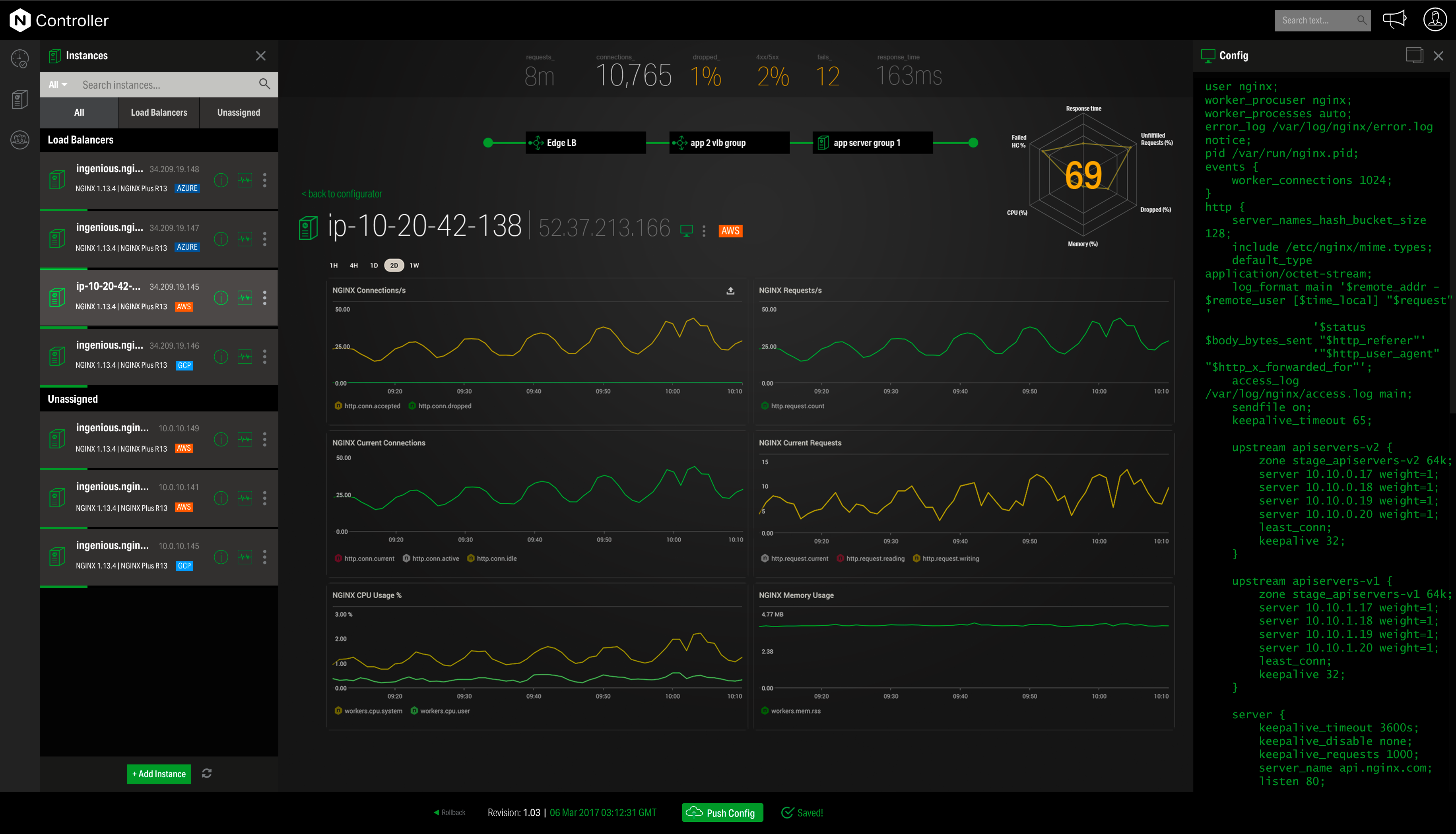
Screenshot of Overview of the NGINX Application PlatformScreenshot of NGINX Controller - MonitoringScreenshot of NGINX Controller - Configuration