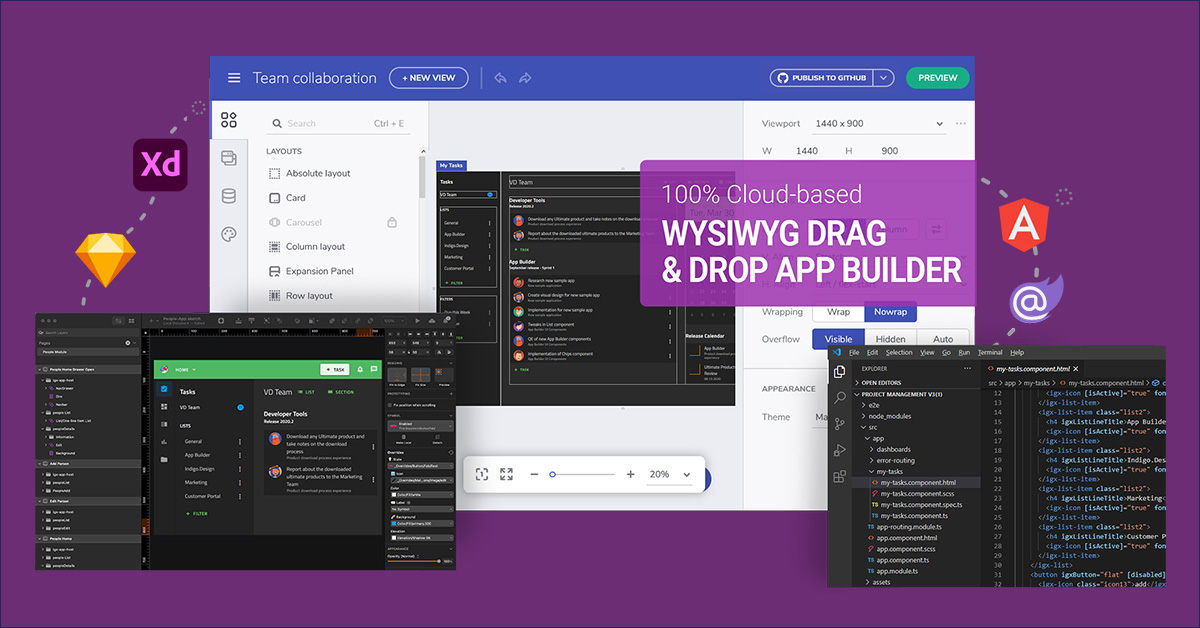
App Builder - Design and Build Real Apps Fast The brand-new App Builder aims to provide design
and development teams with a solution to help them deliver apps quickly and efficiently,
without losing focus on UX. Users can start an app from scratch or choose from a library of pre-built app templates or responsive screen layouts and then customize with a toolbox of 60+ UI controls to kick-start the next digital product design. If a design already exists in Sketch or Adobe…
$1,295
per year per user
Flutter
Score 8.5 out of 10
N/A
Flutter is an open-source mobile application development framework created by Google. It is used to develop applications for Android and iOS, as well as being the primary method of creating applications for Google Fuchsia.
$0
Pega Platform
Score 8.5 out of 10
N/A
Pega Platform is a combined business process management and robotic process automation (RPA) platform with advanced workforce analytics from Pegasystems.
$0.45
one-time fee per case**
Pricing
App Builder by Infragistics
Flutter by Google
Pega Platform
Editions & Modules
Ignite UI
$1,295
per year per user
Infragistics Professional
$1,295
per year per user
Infragistics Ultimate
$1,495
per year per user
No answers on this topic
Low-code Factory Edition
$0.45
one-time fee per case**
Standard Edition
$0.80
one-time fee per case**
Enterprise Edition
Custom Quote
Offerings
Pricing Offerings
App Builder
Flutter
Pega Platform
Free Trial
Yes
No
Yes
Free/Freemium Version
No
Yes
No
Premium Consulting/Integration Services
No
No
No
Entry-level Setup Fee
No setup fee
No setup fee
No setup fee
Additional Details
This product is free to use for non-commercial, educational purposes for students in K-12 grades or University programs, and for educators to use in a classroom setting as examples/tools in their curriculum.
—
**350,000 cases / year minimum. Additional cases available in blocks of 150,000.
More Pricing Information
Community Pulse
App Builder by Infragistics
Flutter by Google
Pega Platform
Features
App Builder by Infragistics
Flutter by Google
Pega Platform
Low-Code Development
Comparison of Low-Code Development features of Product A and Product B
App Builder by Infragistics
5.8
3 Ratings
37% below category average
Flutter by Google
-
Ratings
Pega Platform
-
Ratings
Visual Modeling
6.02 Ratings
00 Ratings
00 Ratings
Drag-and-drop Interfaces
7.53 Ratings
00 Ratings
00 Ratings
Reusability
6.02 Ratings
00 Ratings
00 Ratings
Platform Scalability
3.61 Ratings
00 Ratings
00 Ratings
Reporting & Analytics
Comparison of Reporting & Analytics features of Product A and Product B
App Builder by Infragistics
-
Ratings
Flutter by Google
-
Ratings
Pega Platform
5.3
63 Ratings
38% below category average
Dashboards
00 Ratings
00 Ratings
4.062 Ratings
Standard reports
00 Ratings
00 Ratings
6.062 Ratings
Custom reports
00 Ratings
00 Ratings
6.061 Ratings
Process Engine
Comparison of Process Engine features of Product A and Product B
App Builder by Infragistics
-
Ratings
Flutter by Google
-
Ratings
Pega Platform
8.0
66 Ratings
4% below category average
Process designer
00 Ratings
00 Ratings
8.965 Ratings
Process simulation
00 Ratings
00 Ratings
7.857 Ratings
Business rules engine
00 Ratings
00 Ratings
9.965 Ratings
SOA support
00 Ratings
00 Ratings
7.251 Ratings
Process player
00 Ratings
00 Ratings
7.048 Ratings
Support for modeling languages
00 Ratings
00 Ratings
5.46 Ratings
Form builder
00 Ratings
00 Ratings
9.059 Ratings
Model execution
00 Ratings
00 Ratings
8.756 Ratings
Collaboration
Comparison of Collaboration features of Product A and Product B
App Builder by Infragistics
-
Ratings
Flutter by Google
-
Ratings
Pega Platform
9.0
50 Ratings
7% above category average
Social collaboration tools
00 Ratings
00 Ratings
9.050 Ratings
Content Management Capabilties
Comparison of Content Management Capabilties features of Product A and Product B
App Builder will be great where you have a small team with limited resources. Obviously this product is only good if you are starting a new project. I have used Radzen before which does almost the same thing using a database first approach, but it was a real pain as the application crashes a lot.
Flutter by Google is well suited where you have to make an app across multiple platforms like iOS, Android, Web, Desktop and you don't have the bandwidth to create multiple teams for the Native app. This makes sure you have a faster development and you don't have to worry about how your product will look across different platforms. It is also very smooth/fast in response, making it close to feel like a Native app, this makes it an easy pick for a Fintech product where speed matters. Flutter by Google also has a huge library of Components, which are well tested and developed by Google's Flutter by Google team itself, making the development even more fast since the majority of required components are already available.
Pega Platform has introduced the low code feature, using app studio seasonal and professional developer can develop application easily and quickly. The initial application can be build by Business analyst and product owner who has less knowledge of Pega Platform, further application can be enhanced/extended by professional developer. We can develop end to end application and promote to higher environment. Easily we can perform parallel development using branch.
Quick development time. Much of the Pega "rules" are easy to configure and implement.
Visually friendly and modern. Much of the UI/UX elements in the system are continuously supported and updated, giving a nice feel to the apps.
Many of the configurations and rules Pega gives to the developers can also be delegated to business users. The organization and structure of the client's business can easily be adapted in the Pega platform.
Occasionally updates to the Flutter SDK result in wide-sweeping changes that seem to not be thoroughly tested and considered. Flutter sometimes evolves too fast for its own good.
While the 3rd-party Flutter package ecosystem is vast and rich, 1st-party support for basic things (audio/video playback, battery information, Bluetooth services, etc.) are lacking. You are occasionally forced to rely on an open-source package for use-cases that other platforms have native support for.
Documentation, particularly around testing, is lacking. While there are some great docs, like the Dart Style Guide, many Flutter-focused support documents are lacking in quality and real-world usability.
Flutter allows you to architect an app however you want. While this is a great feature, it also adds complexity and leads to the current state of Flutter's state management, where there are 50+ options on how to organize your app, with very little official guidance or recommendations from the Flutter team. For a beginner, this can create decision paralysis.
Pegasystems has continued to demonstrate a strong partnership with our organization and investment in their product that aligns with our overall vision and need. Pegasystems has engaged us at every level, with the assistance of minor defects to the overall roadmap planning and alignment of our goals
Flutter by Google is very easy to start with. The initial setup they provide is very helpful and easy to understand. The default project setup is also good and can be deployed to production without changing much. Flutter by Google provides a huge library of components, which are created and tested by their own team, making the development of application much faster and robust. Flutter by Google also has a huge community support where we can find components built by the community and we can contribute our own components as well, which helps in faster dev time. Applications developed using Flutter by Google are very smooth, almost feels like native, which helps in creating good impression on customers/clients.
Pega Platform is enhancing its product and launching new features day by day which help to achieve customers needs. If I talk about the earlier version of Pega Platform (i.e. pega v5 and 6.3) there were many numbers of limitations in Pega Platform and if we need to do some customization then needed to write custom java and jave scripts to achieve the functionally. Now I can say Pega Platform is running with market trends and demand. Pega Platform is giving all the options which support the current technologies like decisioning capabilities, real time processing, mashup, process fabrics etc..
It’s very slow sometimes, but that may be our servers. Also the Knowledge Library needs some work - again, not sure if it’s our setup or what- but I’m unable to search the body of an article for content, so I have to be very intentional with tagging, but it’s not ideal.
I have experience with react and React Native. I would say that the idea behind all those frameworks are quite similar. However, I found the javascript-based frameworks a bit more accessible as you could utilise your javascript knowledge. Here, Flutter works with its own language. This has advantages and disadvantages sometimes. I found the community around javascript frameworks bigger and therefore sometimes more helpful. However, Flutter does a good job here as well. I think the main argument for Flutter is its usability for less experienced developers. If you do not have knowledge in javascript or other programming languages then I think it is much easier to start with Flutter than with another framework like react. I think the package that you get form scratch is better than in the other frameworks were you have to set up and learn a lot more before you can start.
We did evaluate multiple products offerings with Pega Platform capabilities and observed that Pega PRPC rules engine and case management capabilities are better over so many BPM Tools. We also conducted a detailed study with developers to identify the best products out of Suite of BPM products. It's observed that Rules engines integration is very streamlined with forms in Pega whereas other tools multiple have powerful data model capabilities but lacks the ease of creating business rules.
The rapid development capabilities of Flutter allow us to build apps we could not have previously considered commercially viable, opening new revenue streams.
Free and open licensing made adoption very easy (ie. free/low cost!).
In comparison to Qt, our time spent arguing with build tools and perfecting development environments has decreased substantially.
For one of the applications we worked on, we were able to reduce the processing time on a case from 2 days to 20 minutes by utilizing Pega
We were able to resolve the issue of the routing of cases to users based on a specific algorithm by use of Pega
Pega case management feature was extensively used in one of the application to establish a parent-child relationship which was very helpful for all the business users