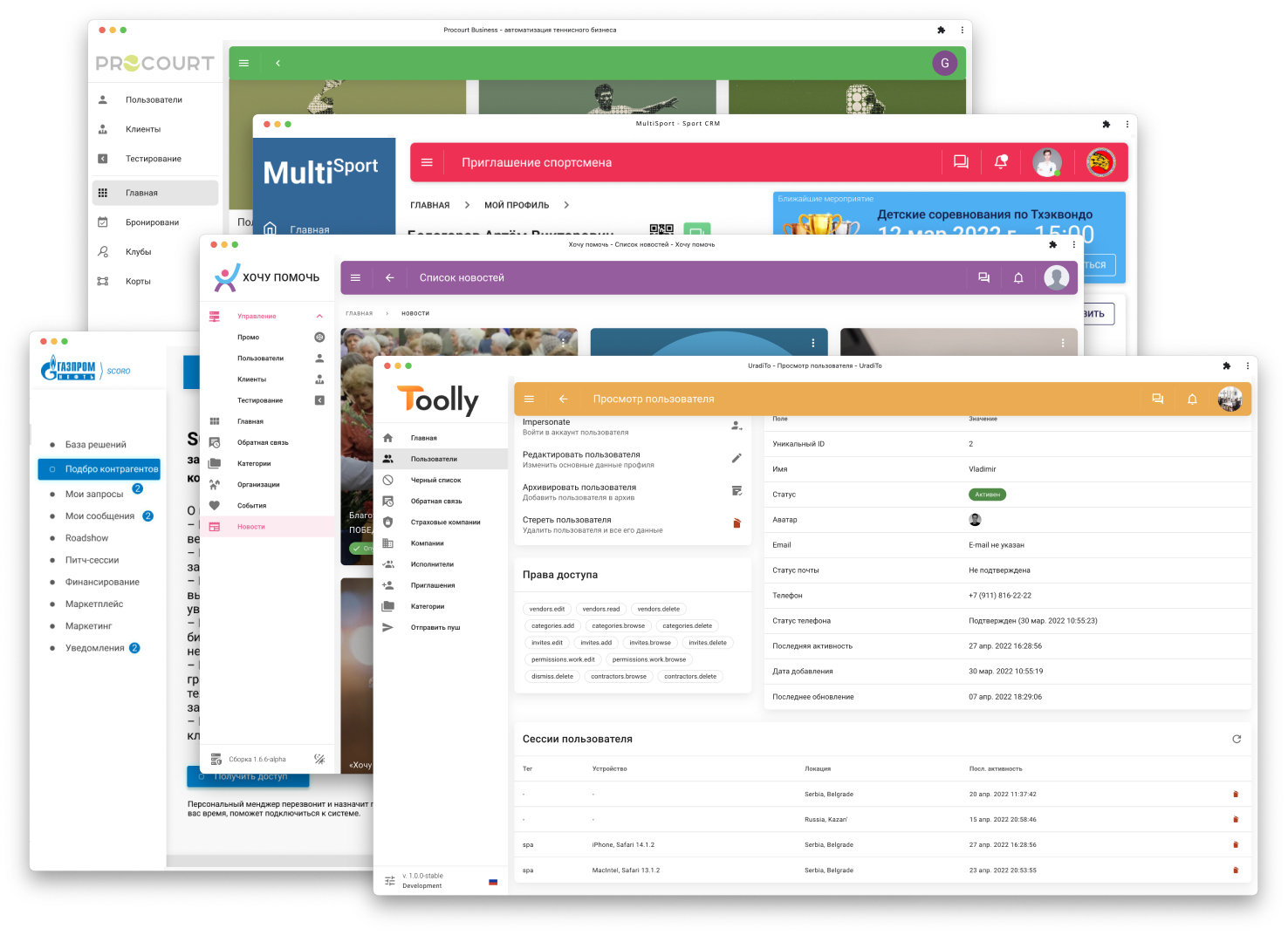
Appocore is a platform dedicated to facilitating efficient and quality-driven development of digital products. It's a collection of proprietary operational and cloud-based software solutions, tailored to meet the specific needs of each project. Appocore's functionality encompasses the following: Appocore Passport - Used to create and manage user profiles from out of the box. Gmail, Facebook, VK, Apple ID, SMS, e-mail registration, login and recovery. E-mail…
N/A
Azure App Service
Score 8.1 out of 10
N/A
The Microsoft Azure App Service is a PaaS that enables users to build, deploy, and scale web apps and APIs, a fully managed service with built-in infrastructure maintenance, security patching, and scaling. Includes Azure Web Apps, Azure Mobile Apps, Azure API Apps, allowing developers to use popular frameworks including .NET, .NET Core, Java, Node.js, Python, PHP, and Ruby.
$9.49
per month
Red Hat OpenShift
Score 9.1 out of 10
N/A
OpenShift is Red Hat's Cloud Computing Platform as a Service (PaaS) offering. OpenShift is an application platform in the cloud where application developers and teams can build, test, deploy, and run their applications.
N/A
Pricing
Appocore
Azure App Service
Red Hat OpenShift
Editions & Modules
No answers on this topic
Shared Environment for dev/test
$9.49
per month
Basic Dedicated environment for dev/test
$54.75
per month
Standard Run production workloads
$73
per month
Premium Enhanced performance and scale
$146
per month
No answers on this topic
Offerings
Pricing Offerings
Appocore
Azure App Service
Red Hat OpenShift
Free Trial
No
Yes
Yes
Free/Freemium Version
No
No
Yes
Premium Consulting/Integration Services
No
No
No
Entry-level Setup Fee
$1,500 one-time fee per installation
No setup fee
No setup fee
Additional Details
—
Free and Shared (preview) plans are ideal for testing applications in a managed Azure environment. Basic, Standard and Premium plans are for production workloads and run on dedicated Virtual Machine instances. Each instance can support multiple applications and domains.
AWS CodeDeploy certainly feels powerful; however, to perform some tasks with it will require some scripting experience. Azure App Service provides deployment, scaling, and hosting in a single, managed platform, and it feels easy and very well laid out. It is also dev- and …
When we chose it, we did so because of its integration with Microsoft applications; now we need to integrate with AI, and Azure doesn't offer a good integration. That is the main reason to change it. It is still great to develop Windows- and Microsoft-based applications, but if …
AppServices that's easier to manage than its competitors, specially if you have everything in Azure. But also that's the most expensive service when you escalate or start using it for massive data processing. It would be an excellent containers platform if were easier to deal …
Azure is some what easy to use and we can learn the azure platform easily. And mainly for students they are giving free credits. So by using the credits we can learn or deploy using that credit
In terms of deploying your apps, Azure App Service provides a solid foundation. You may use either the Azure command-line interface or the Web Portal to administer these apps. As a whole, I find You may easily deploy your apps to Azure App Service to be a really difficult …
Azure has many data center, their services are more reliable. Azure has way more features than both linode and digitalocean. If someone wants a complete reliable service, he/she must go to Azure instead of linode and digitalocean because even though azure charges more, it is …
Azure App Service will give you a very solid and strong platform to deploy your applications. It gives you great interfaces to manage those applications either through a Web Portal or the Azure command-line interface. However, I consider Azure overall to be very complex and …
Red Hat maintains a consistent user interface across their products, and their feature sets facilitate easy and rapid adoption. Configuration as code is the optimal approach for all of them, and they all provide a level of command-line access that ensures teams can work in the …
OCP and OpenShift Virtualization are better for a code based infrastructure our organization is attempting to move towards shortly. VMware has also been acquired which has added instability with their future. We are planning to move all VMware workloads to OpenShift …
I don't have as much experience with the other two, I have heard of them and know they are container management systems. I have the most experience with Red Hat OpenShift.
Red Hat Enterprise Linux (RHEL), Red Hat Data Grid, Red Hat Integration, Red Hat JBoss Enterprise Application Platform and Red Hat Ansible Automation Platform
As a specialized partner in container platform Red Hat OpenShift is our preffered solution. It provides a supported kubernetes platform which contains all the required tools to make the life of customers easier and offer them the same experience accross all hyperscalers, …
I find OpenShift opinionated but also requiring less configuration to be functional than the other platforms that I've mentioned, and Tanzu requires Faustian contracts to be signed.
You may easily deploy your apps to Azure App Service if they were written in Visual Studio IDE (typically.NET applications). With a few clicks of the mouse, you may already deploy your application to a remote server using the Visual Studio IDE. As a result of the portal's bulk and complexity, I propose Heroku for less-experienced developers.
Red Hat OpenShift, despite its complexity and overhead, remains the most complete and enterprise-ready Kubernetes platform available. It excels in research projects like ours, where we need robust CI/CD, GPU scheduling, and tight integration with tools like Jupyter, OpenDataHub, and Quiskit. Its security, scalability, and operator ecosystem make it ideal for experimental and production-grade AI workloads. However, for simpler general hosting tasks—such as serving static websites or lightweight backend services—we find traditional VMs, Docker, or LXD more practical and resource-efficient. Red Hat OpenShift shines in complex, container-native workflows, but can be overkill for basic infrastructure needs.
One of the big advantages of Red Hat OpenShift is, especially over Kubernetes itself, is that it provides a lot of built-in operators for doing a lot of different things right out of the box that you don't have to worry about trying to configure. So one of the big ones is, I mean, right in your face is that user interface and being able to work with it inside of a browser. And I think that works very, very well.
I would say that's the logging part because Red Hat OpenShift write tons of locks and if most time in the finance industry, we cannot use the built in logging infrastructure for compliance reasons. And we have to forward the logs out of the system and this is, it's too much, which we forward from one cluster. Most time we'll build up multi clusters, so we speak about 10 or more clusters. And if you send log files from 10 or more clusters, the logging systems are not prepared to take that much load. And then really often you have license problems with the logging system, so that's not really, really fun. So logging could be improved.
Going to stay with this platform for the unforeseeable future. It matches our Target Architecture 2030 strategy internally to adopt more modularized platforms with Open Source on the back-end so that if needed containerized workloads can move to a different platform. With open-source based application telemetry collection being utilized on the back-end, integrating our already existing oTeL observability based platform makes it easier for our apps to be monitored
To change from one tech stack to another is very hard. Converting from the .NET environment to an agnostic environment without AI takes a long time, and if we want to use AI to make the conversion, it's better to use external solutions like Claude. Copilot can't handle the conversion, generating tons of errors and hallucinations.
As I said before, the obserability is one of the weakest point of OpenShift and that has a lot to do with usability. The Kibana console is not fully integrated with OpenShift console and you have to switch from tab to tab to use it. Same with Prometheus, Jaeger and Grafan, it's a "simple" integration but if you want to do complex queries or dashboards you have to go to the specific console
Redhat openshift is generally reliable and available platform, it ensures high availability for most the situations. in fact the product where we put openshift in a box, we ensure that the availability is also happening at node and network level and also at storage level, so some of the factors that are outside of Openshift realm are also working in HA manner.
Overall, this platform is beneficial. The only downsides we have encountered have been with pods that occasionally hang. This results in resources being dedicated to dead or zombie pods. Over time, these wasted resources occasionally cause us issues, and we have had difficulty monitoring these pods. However, this issue does not overshadow the benefits we get from Openshift.
Microsoft has always been known for providing a high standard in terms of customer support and Azure App Service (and as a matter of fact the whole Azure Platform) is no exception. Azure App Service never caused us any issues and we only contacted their customer support for questions regarding server locations and pricing. I feel pretty satisfied with how they treat their customers.
Their customer support team is good and quick to respond. On a couple of occassions, they have helped us in solving some issues which we were finding a tad difficult to comprehend. On a rare occasion, the response was a bit slow but maybe it was because of the festival season. Overall a good experience on this front.
I was not involved in the in person training, so i can not answer this question, but the team in my org worked directly with Openshift and able to get the in person training done easily, i did not hear problem or complain in this space, so i hope things happen seamlessly without any issue.
We went thru the training material on RH webesite, i think its very descriptive and the handson lab sesssions are very useful. It would be good to create more short duration videos covering one single aspect of openshift, this wll keep the interest and also it breaks down the complexity to reasonable chunks.
AWS CodeDeploy certainly feels powerful; however, to perform some tasks with it will require some scripting experience. Azure App Service provides deployment, scaling, and hosting in a single, managed platform, and it feels easy and very well laid out. It is also dev- and qa-friendly, enabling faster deployments and improving overall team productivity.
We utilized the Thycotic Secret Service to manage all our application secrets, resulting in seamless integration with our applications. We developed all the applications using Red Hat Fuse (currently migrated to Quarkus). We used the built-in Kali Linux support of OpenShift to manage and configure the services and API. Additionally, the Red Hat Developer Studio facilitates faster development.
This is a great platform to deployment container applications designed for multiple use cases. Its reasonably scalable platform, that can host multiple instances of applications, which can seamlessly handle the node and pod failure, if they are configured properly. There should be some scalability best practices guide would be very useful
Azure App Service has allowed us to quickly deploy high-budget projects very quickly, netting us a healthy profit vs the cost to develop. (We make, on average, about 10x what it costs to get up and running per project thanks to how easy it is to implement a skeleton framework.)
Costs are low to run the services thanks to the scaling functionality that comes with Azure App Service. We can utilize less resources during slow times and save hundreds of dollars per month vs costs of traditional servers.
When you talk about ROIs, I don't have any negative impacts I wanted to call out here. There is no negative impacts. In fact, it's all positive impacts what we set as our milestones towards achieving our goals, towards achieving our greater vision. Red Hat OpenShift has got a big role in it and it is certainly helping us.