AWS CloudFormation vs. Rackspace OpenStack

Overview
ProductRatingMost Used ByProduct SummaryStarting Price
AWS CloudFormation
Score 8.7 out of 10
N/A
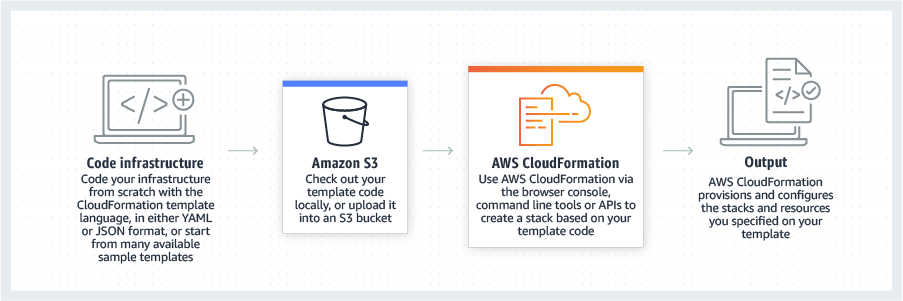
AWS CloudFormation gives developers and systems administrators a way to create and manage a collection of related AWS resources, provisioning and updating them in a predictable fashion. Use AWS CloudFormation’s sample templates or create templates to describe the AWS resources, and any associated dependencies or runtime parameters, required to run an application. Users don’t need to figure out the order for provisioning AWS services or the subtleties of making those dependencies work.…
$0
Rackspace OpenStack
Score 9.7 out of 10
N/A
Rackspace delivers OpenStack private clouds as-a-service, architected like a public cloud and designed for scale and service availability to any data center in the world. It includes a 99.99% API Uptime SLA.
$0.12
per GB/per month
Pricing
AWS CloudFormationRackspace OpenStack
Editions & Modules
Free Tier - 1,000 Handler Operations per Month per Account
$0.00
Handler Operation
$0.0009
per handler operation
Rackspace OpenStack
$0.12
per GB/per month
Offerings
Pricing Offerings
AWS CloudFormationRackspace OpenStack
Free Trial
YesNo
Free/Freemium Version
YesNo
Premium Consulting/Integration Services
YesNo
Entry-level Setup FeeNo setup feeNo setup fee
Additional DetailsThere is no additional charge for using AWS CloudFormation with resource providers in the following namespaces: AWS::*, Alexa::*, and Custom::*. In this case you pay for AWS resources (such as Amazon EC2 instances, Elastic Load Balancing load balancers, etc.) created using AWS CloudFormation as if you created them manually. You only pay for what you use, as you use it; there are no minimum fees and no required upfront commitments. When you use resource providers with AWS CloudFormation outside the namespaces mentioned above, you incur charges per handler operation. Handler operations are create, update, delete, read, or list actions on a resource.
More Pricing Information
Community Pulse
AWS CloudFormationRackspace OpenStack
Features
AWS CloudFormationRackspace OpenStack
Configuration Management
Comparison of Configuration Management features of Product A and Product B
AWS CloudFormation
8.2
2 Ratings
2% above category average
Rackspace OpenStack
-
Ratings
Infrastructure Automation8.52 Ratings00 Ratings
Automated Provisioning8.52 Ratings00 Ratings
Parallel Execution8.02 Ratings00 Ratings
Node Management7.52 Ratings00 Ratings
Reporting & Logging7.52 Ratings00 Ratings
Version Control9.02 Ratings00 Ratings
Best Alternatives
AWS CloudFormationRackspace OpenStack
Small Businesses
HashiCorp Vagrant
HashiCorp Vagrant
Score 10.0 out of 10

No answers on this topic

Medium-sized Companies
Ansible
Ansible
Score 9.2 out of 10

No answers on this topic

Enterprises
Ansible
Ansible
Score 9.2 out of 10

No answers on this topic

All AlternativesView all alternativesView all alternatives
User Ratings
AWS CloudFormationRackspace OpenStack
Likelihood to Recommend
8.0
(7 ratings)
8.0
(1 ratings)
Usability
8.0
(2 ratings)
-
(0 ratings)
User Testimonials
AWS CloudFormationRackspace OpenStack
Likelihood to Recommend
Amazon AWS
I still give it an 8 because it's one of those tools that just quietly does the heavy lifting for you but it can really test your patience when it breaks esp with deep nested stacks. It's perfect for projects where we need clean consistent environments every time. It's less ideal for quick experimental setups like new EC2 configs or Lambda permission tweaks.
Read full review
Rackspace
Need to get an application up and running, then I would say the open stack is a great place to test it out. Why spend time setting things up when you can let them do it for you? Many people also have experience with using Rackspace in some capacity so its an easier learning curve for many people.
Read full review
Pros
Amazon AWS
  • All resources can segregated based on stacks which provides greater visibility
  • A complete audit trail of what went wrong while deploying a particular resource
  • Automatically rollbacks if any service as part of CloudFormation results in an error
  • The UI tool is useful
Read full review
Rackspace
  • Quick uptime
  • Simple Signup
  • Lots of options on what you need
  • Rackspace is a known company (not some unknown startup)
Read full review
Cons
Amazon AWS
  • Error Description upon Failure Needs to be Improved.
  • Slow to create, delete or update.
  • Need to delete resources manually. It can ask before starting deletion whether to skip those resources or delete them.
Read full review
Rackspace
  • Support does not seem to be what it use to be, use to be a solid 10 when dealing with them, now more like an 8
  • Pricing can be tricky to figure out
  • For some people too many options.
Read full review
Usability
Amazon AWS
It's easy enough to get a shared template & apply it. You don't even have to download-then-upload or copy-and-paste, a publicly-accessible url works.
Diving deeper, it has enough powerful capabilities to make the life of a platform / DevOps engineer bearable.
However, you need equally deep knowledge to troubleshoot issues, when they inevitably pop up. This is the same for all IaC technologies, as they are additional abstraction layers on top of the native API provided by the cloud providers.
Read full review
Rackspace
No answers on this topic
Alternatives Considered
Amazon AWS
Cloning a virtual machine creates a virtual machine that is cloning a virtual machine creates a virtual machine that is a copy of the original. The new virtual machine is configured with the same virtual hardware, installed software, and other properties that were configured for the original virtual machine. For information about persistent memory and PMem storage, see the vSphere Cloning a virtual machine creates a virtual machine that is a copy of the original. The new virtual machine is configured with the same virtual hardware, installed software, and other properties that were configured for the original virtual machine. For information. Management guide.For information copy of the original. The new virtual Cloning virtual machine creates a virtual machine that is a copy of the original. The new virtual machine is configured with the same virtual hardware, installed software, and other properties that were configured for the original virtual machine. For information about persistent memory and PMem storage, see the vSphere Resource Management Guide. For information is configured with the same virtual hardware, installed software, and other properties that were configured for the original virtual machine. For information about persistent memory and PMem storage, see the vSphere Resource Management Guide. For information
Read full review
Rackspace
I looked into going with Amazon EC2, was very comparable in pricing, services, options, etc. and a bit cheaper too. Why I did not go with Amazon mainly has to do with knowing Rackspace and being familiar with them. It was easier for me to use a Rackspace product then go with Amazon Elastic Compute Cloud
Read full review
Return on Investment
Amazon AWS
  • + We can standup a VPC in minutes
  • - It took a lot of inital time to set up
  • + With logging/rollback, made testing much easier.
Read full review
Rackspace
  • Quick setup allowed me to work on the application not setup of where it was going to run
  • Expand ability with a few clicks was a great help, no worrying about if I needed more "power", few clicks and I had it.
  • Tech support is hit or miss so that can be problematic and that was cause for concern and took time away from development
Read full review
ScreenShots

AWS CloudFormation Screenshots

Screenshot of CloudFormation - How it works overviewScreenshot of CloudFormation - High level how it worksScreenshot of CloudFormation - Template exampleScreenshot of CloudFormation - Template inputs overview