Barracuda Web Application Firewall, from Barracuda Networks in Campbell, California, protects web applications from bots, DDoS attacks, and other advanced threats to enterprise apps.
N/A
NGINX
Score 9.1 out of 10
Mid-Size Companies (51-1,000 employees)
NGINX, a business unit of F5 Networks, powers over 65% of the world's busiest websites and web applications. NGINX started out as an open source web server and reverse proxy, built to be faster and more efficient than Apache. Over the years, NGINX has built a suite of infrastructure software products o tackle some of the biggest challenges in managing high-transaction applications. NGINX offers a suite of products to form the core of what organizations need to create…
Easy to use and reliable, with very little maintenance required and zero downtime to date. For the education sector, ease of use is hugely important as IT Managers/Technicians are often "Jack of all trades" with a good, broad general knowledge but perhaps lacking specific expertise in certain aspects. Being provided with easy-to-follow tutorials and instructions has been very useful in setting up and configuring the firewall, especially as my background is more in desktop support.
Nginx is well-suited for any web server scenarios, such as web applications, backend or reverse proxy for both application and HTTP requests, and distribution. It is less appropriate for Windows-based applications that run directly on a Windows Server host. In any case, it is very easy to manage, through separate conf files for each application or site you want to host with it.
STM crashes sometimes happen due to unusual traffic pattern
Obfuscation on the client side user credentials which appears in the developer tools of browser
URL Profiles redundancy during the learning of traffic needs to be fixed
Dos Protection should be more granular like escalation period to throw JS challenge, Captcha and rate limit when escalation period hits until the WAF stops the attack
Client Fingerprinting should work as expected when verifying the clients as in rare some scenarios, it creates issues
Customer support can be strangely condescending, perhaps it's a language issue?
I find it a little weird how the release versions used for Nginx+ aren't the same as for open source version. It can be very confusing to determine the cross-compatibility of modules, etc., because of this.
It seems like some (most?) modules on their own site are ancient and no longer supported, so their documentation in this area needs work.
It's difficult to navigate between nginx.com commercial site and customer support. They need to be integrated together.
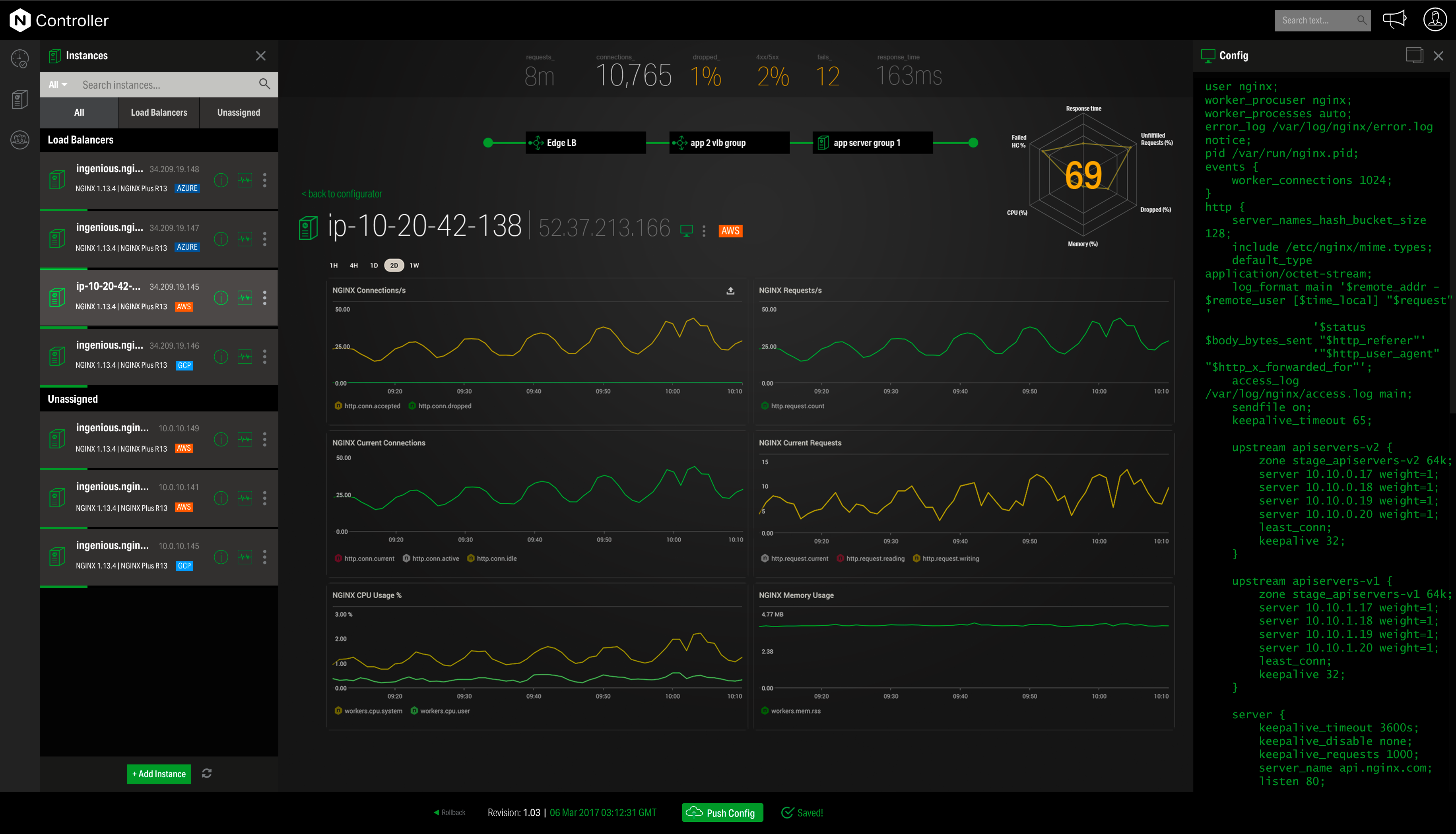
I'd love to see more work done on nginx+ monitoring without requiring logging every request. I understand that many statistics can only be derived from logs, but plenty should work without that. Logging is not an option in many environments.
-User friendly interface for quick learning -Quick deployment for deploying applications -Easy to manage for naive -System components and upgradation of the WAF is very easy go with -Back restoration is very to make it up and ready anytime -Seperate JSON and XmL profiles for each URLs of the application is plus -Amazing and world class support engineer in comparison other vendors and always available to support -Quick resolution on bugs with their patch applying process
This tool is really easy to use and configure. Consumes very less system resources. It is highly modular and configurable. You can easily use it with other tools like certbot for SSLs. You can configure basic security with configuration and headers
The Barracuda Web Application Firewall is easy to use. Support from Barracuda is great also. Load Balancing of the Web Application Firewall is also nice. This allows you to do maintenance or have large loads for the end-user. Threat monitoring of our network and traffic coming into our services within our cloud solution.
Community support is great, and they've also had a presence at conferences. Overall, there is no shortage of documentation and community support. We're currently using it to serve up some WordPress sites, and configuring NGINX for this purpose is well documented.
We have been using their Backup products especially Backup Appliances and legacy products like Intronis. We are also using their Cloud Backup Solutions for O365. This is the reason we opted for this product.
I have found that [NGINX] seems to perform better throughout the years with less issues although I've used Apache more. I would definitely recommend [NGINX] for any high volume site and I've seen this to usually be the case from most provided web hosts who will pick [NGINX] over alternatives
By using Nginx, we can host multiple web services on a single server, keeping our infrastructure costs lower.
Nginx maintains our HTTPS connections, allowing us to keep our promise to our customers that their data is safe in transit.
Due to Nginx's extremely low failure rate, our web addresses always return something meaningful, even when individual services go down. In sense, this means we are "always online" and allows us to maintain brand and support our customers even in the face of catastrophe.