CloudBees Codeship vs. TeamCity

Overview
ProductRatingMost Used ByProduct SummaryStarting Price
CloudBees Codeship
Score 9.0 out of 10
N/A
Codeship from CloudBees is a build automation platform from the Austrian company of the same name.N/A
TeamCity
Score 7.1 out of 10
N/A
TeamCity is a continuous integration server from Czeck company JetBrains.N/A
Pricing
CloudBees CodeshipTeamCity
Editions & Modules
No answers on this topic
Offerings
Pricing Offerings
CloudBees CodeshipTeamCity
Free Trial
YesNo
Free/Freemium Version
YesNo
Premium Consulting/Integration Services
NoNo
Entry-level Setup FeeNo setup feeNo setup fee
Additional Details
More Pricing Information
Community Pulse
CloudBees CodeshipTeamCity
Considered Both Products
CloudBees Codeship
Chose CloudBees Codeship
Codeship is easier to use than Jenkins because it does not require you to set up your own server, and it provides a large amount of out-of-the-box integrations for version control systems and cloud environments. AWS CodePipeline is native to AWS and cannot deploy applications …
Chose CloudBees Codeship
Codeship has been easier for our devops team to work with as far as making delivery plans and build scripts. Anecdotally, it has been more stable over time, cutting down on time investigating why some random part of the delivery process has broken. I am not sure why this is, …
Chose CloudBees Codeship
We have been using Codeship for a few years, and what we like is that it's very clear what is built and when. We usually only have one-liners for any configuration option (build, test, deploy) and this way all changes to the build are managed in the version control system and …
Chose CloudBees Codeship
Our company uses Jenkins for all internal deployment processes for one very important reason - it's hosted internally. But Codeship is great for personal use - it has intuitive UI, easy setup and tons of integrations.
Chose CloudBees Codeship
Back in those days, we didn't know about Gitlab, and Bitbucket didn't provide a CI pipeline. Jenkins is just too much for the simple tasks we wanted to achieve, besides, we didn't have a dedicated server for the sole purpose of having our code pipelined though continuous …
TeamCity
Chose TeamCity
Jenkins relies on being open source as the primary driver for its success. This low cost is a huge factor for many companies, both small and large. The professional, free tier of TeamCity offers a huge amount of growth before ever needing to pay anything. I personally also find …
Chose TeamCity
Since we were already making use of other JetBrains offerings, TeamCity had a leg up on the competition due to the ease of integration with these tools. With that said, TeamCity's feature set stacks up well with the competition. Jenkins definitely has some nice features, but …
Chose TeamCity
We are in the process to select one of them, but we are not decided yet
Chose TeamCity
This application is easy to install and deploy at site than most of the similar solutions in market. Easy user interface is one of the reason it can be installed. However each software have its good points and bad points. Study your organizations case and then only choose …
Chose TeamCity
I would also like to compare TeamCity against Snap-Ci as well as Concourse. We chose TeamCity over all of these tools because of its ability to be set up easily against a restricting corporate firewall. We needed to integrate unit tests, integration tests, pushes to production, …
Chose TeamCity
While TeamCity is more limited product than VSTS (VSTS includes a git repository), it is easier to use and better priced.
Chose TeamCity
TeamCity competes against the TFS build, Visual Studio Team services and Jenkins the open source workhorse. The reason for selecting TeamCity was because it was found to be a great fit for all the diverse projects on a spectrum of technologies we have which the TFS Build …
Chose TeamCity
TeamCity by far has the best interface TeamCity still supported our old SubVersion reports as well.
Chose TeamCity
TeamCity is a great on-premise Continuous Integration tool.
Visual Studio Team Services (VSTS) is a hosted SAAS application in Microsoft's Cloud.
VSTS is a Source Code Repository, Build and Release System, and Agile Project Management Platform - whereas TeamCity is a Build and …
Chose TeamCity
I like the quality of Jetbrains products. TeamCity is well supported and regularly updated by Jetbrains. They have an active support forum and most questions are answered quickly.

TeamCity is very extendable and has been able to handle everything we've been required to do.
Chose TeamCity
We've only ever really used TeamCity as a CI platform. Running tests on these CI clusters is worlds more efficient and just plain easier than having to run individual tests on your local machine. You just hit one button here, versus either writing some run script or even worse …
Chose TeamCity
TeamCity is the best combination of price and full features. It has a good web UI and doesn't need a lot of manual configuration files, but it still is incredibly extensible and can do just about any build or release task you set it at. If it can't do it, the odds are it has a …
Chose TeamCity
Jenkins and Team Foundation Server (TFS) are both strong products. Compared to Jenkins, TeamCity is much more mature and polished. Though Jenkins is open-source/free, the cost of TeamCity is a drop in the bucket compared to the total cost of even one project we're using it …
Best Alternatives
CloudBees CodeshipTeamCity
Small Businesses
GitLab
GitLab
Score 8.8 out of 10
GitLab
GitLab
Score 8.8 out of 10
Medium-sized Companies
GitLab
GitLab
Score 8.8 out of 10
GitLab
GitLab
Score 8.8 out of 10
Enterprises
GitLab
GitLab
Score 8.8 out of 10
GitLab
GitLab
Score 8.8 out of 10
All AlternativesView all alternativesView all alternatives
User Ratings
CloudBees CodeshipTeamCity
Likelihood to Recommend
9.0
(0 ratings)
10.0
(0 ratings)
Performance
-
(0 ratings)
9.3
(0 ratings)
User Testimonials
CloudBees CodeshipTeamCity
Likelihood to Recommend
Codeship is very well suited to teams that have specialized devops members along with other specialized developers. It lets the other developers focus on what they do best, without having to learn another technology stack. This has cut down on a lot of headaches at our company with developers needing to deploy code to various different hosting services across different content management systems. The experience to push code is essentially the same for a developer no matter what the underlying technology is
Read full review
TeamCity is well suited for an organization using continuous integration, meaning you release code to production often, and an agile project management system. There are free versions available for small teams and enterprise versions available for large teams with many different builds. TeamCity is probably overkill for basic e-commerce or blog website builds that do not require much development after the initial launch
Read full review
Pros
  • Easy and fast deployment
  • A lot of tool integrations (Slack, GitHub, Bitbucket, GitLab)
  • Getting tests to run is fast and easy
Read full review
  • Fully customizable build process. Each step of the build process can be parameterized and customized to address specific needs of particular applications. This allowed us to easily convert from a custom VM-based environment to our current Docker-based environment.
  • Manages large numbers of build agents seamlessly. This allows us to run multiple builds on many different applications in a most efficient manner.
  • Build steps can be managed in an arbitrary manner, allowing some parts of the process to proceed in parallel while restricting others to depend on completion of all relevant steps.
Read full review
Cons
  • UX: The overall UX is not bad, but it still needs a lot of improvement.
  • It took me quite a while to realize that in order to switch projects I needed to press my current project name so a dropdown would appear.
  • Integration with bitbucket is somewhat hidden from the users's hands. Got to make some improvements there.
Read full review
  • It is not plug and play thing
  • Need more specific configurations for smaller projects as well
  • Online help is less available
  • Basic implementation is easy but I think feature add on can be complex as it involve some language knowledge as well.
Read full review
Performance
No answers on this topic
TeamCity runs really well, even when sharing a small instance with other applications. The user interface adequately conveys important information without being overly bloated, and it is snappy. There isn't any significant overhead to build agents or unit test runners that we have measured.
Read full review
Alternatives Considered
Codeship is easier to use than Jenkins because it does not require you to set up your own server, and it provides a large amount of out-of-the-box integrations for version control systems and cloud environments. AWS CodePipeline is native to AWS and cannot deploy applications reliably to other cloud environments such as GCP or Azure.
Read full review
Jenkins relies on being open source as the primary driver for its success. This low cost is a huge factor for many companies, both small and large. The professional, free tier of TeamCity offers a huge amount of growth before ever needing to pay anything. I personally also find the user experience of TeamCity to be much better, both from a look and feel, as well as from an out-of-the-box feature set perspective. The big selling feature of ADO is its native integration with Azure. TeamCity integrates very well with out-of-the-box .NET support and greatly simplifies our use of another diverse tooling outside of the Microsoft ecosystem.
Read full review
Return on Investment
  • We have a few small projects with different developers and Codeship shows everyone clearly, if something work, or if it doesn't.
  • In one small project with a team of three developers, we have configured two builds and it takes 2-5 minutes for everyone on the team to push changes to an infrastructure handling a little over 3M users.
Read full review
  • TeamCity was a key contributor to our organization's adoption of Agile.
  • TeamCity made it possible to KILL "It works on my laptop" conversations with Developers. If it does not compile in TeamCity - the project is not deployable. TeamCity's easy to use interface made it possible to quickly adopt a "Deploy Only from TeamCity" policy, further ensuring TeamCity Builds were the gold-standard for well-configured source code.
Read full review
ScreenShots

CloudBees Codeship Screenshots

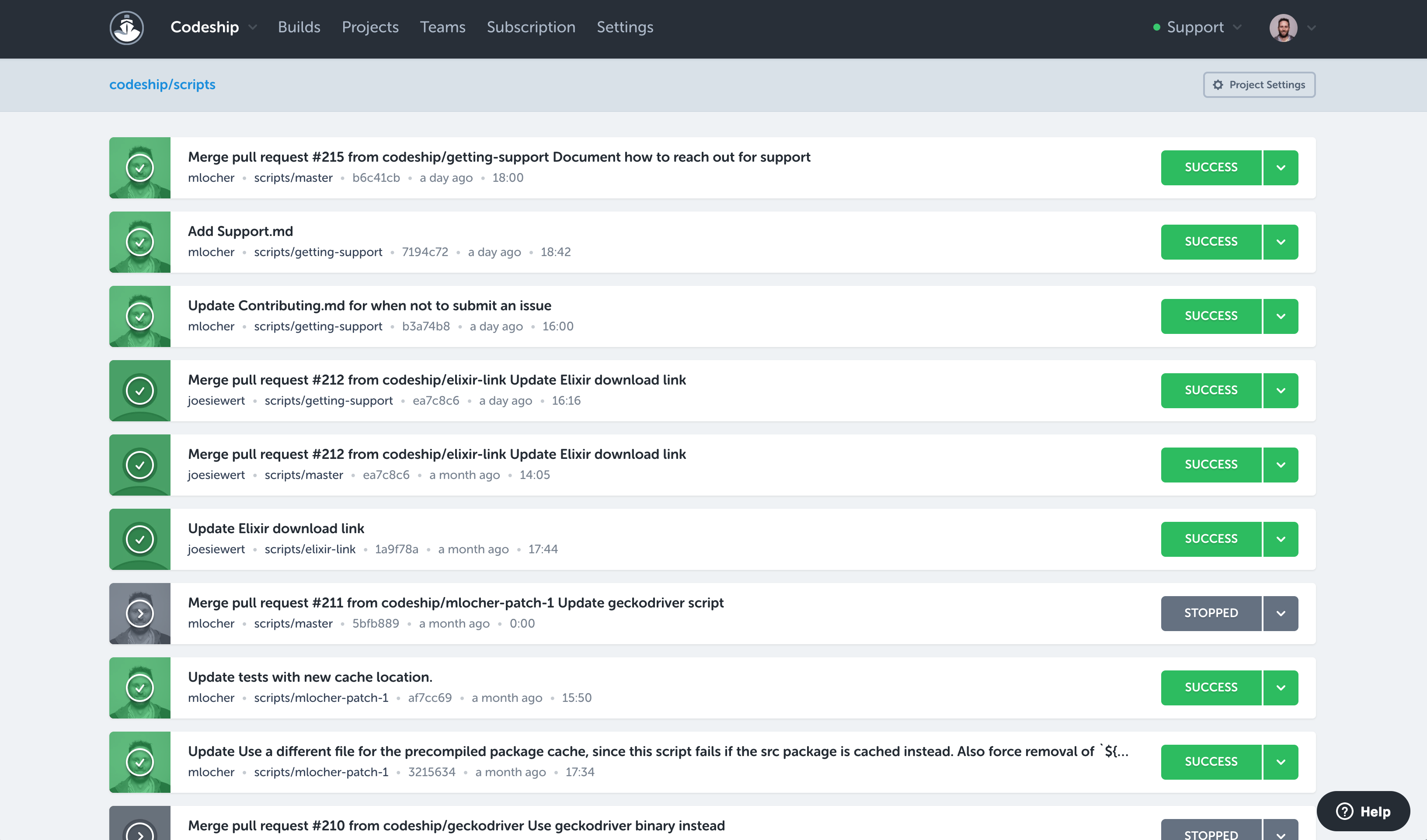
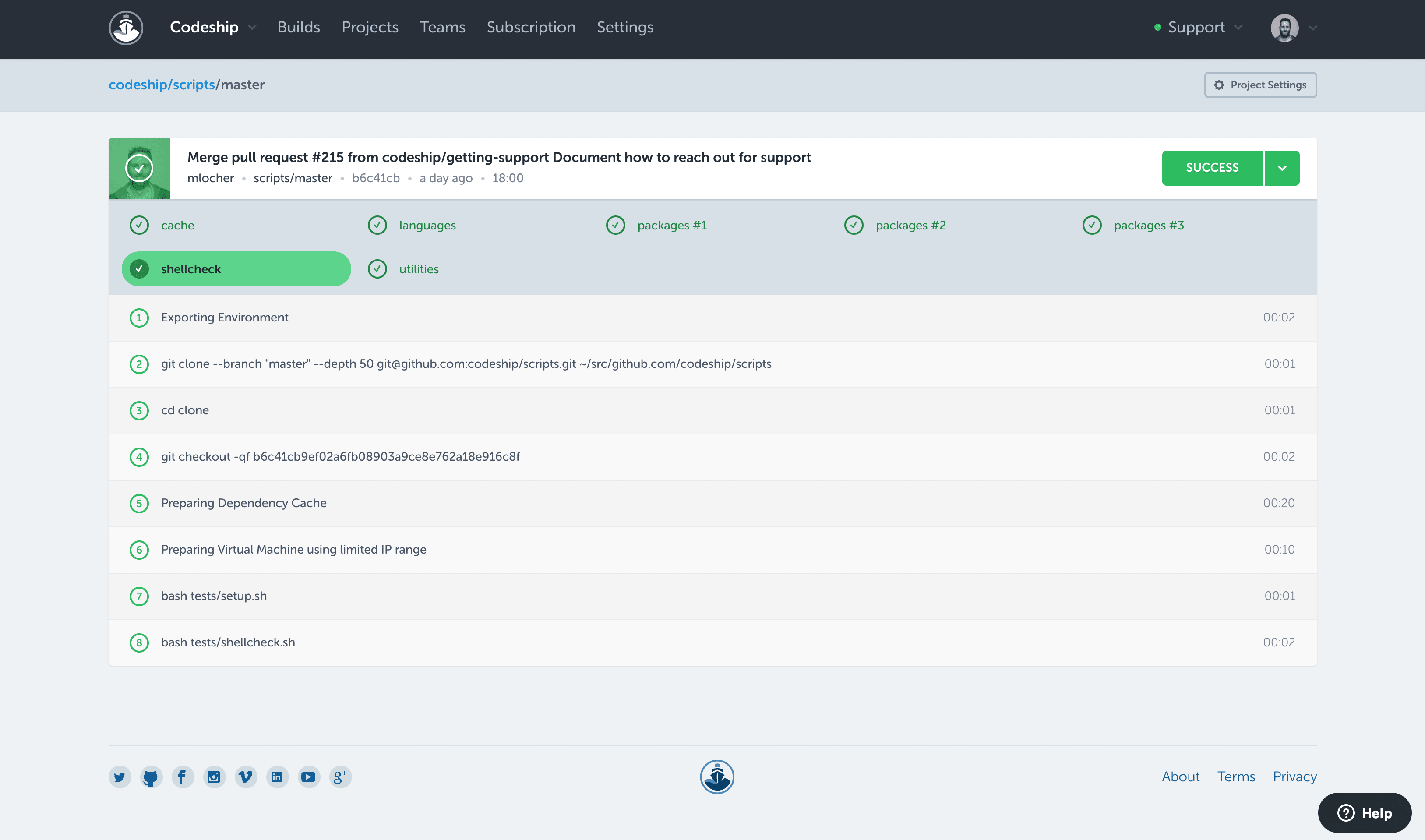
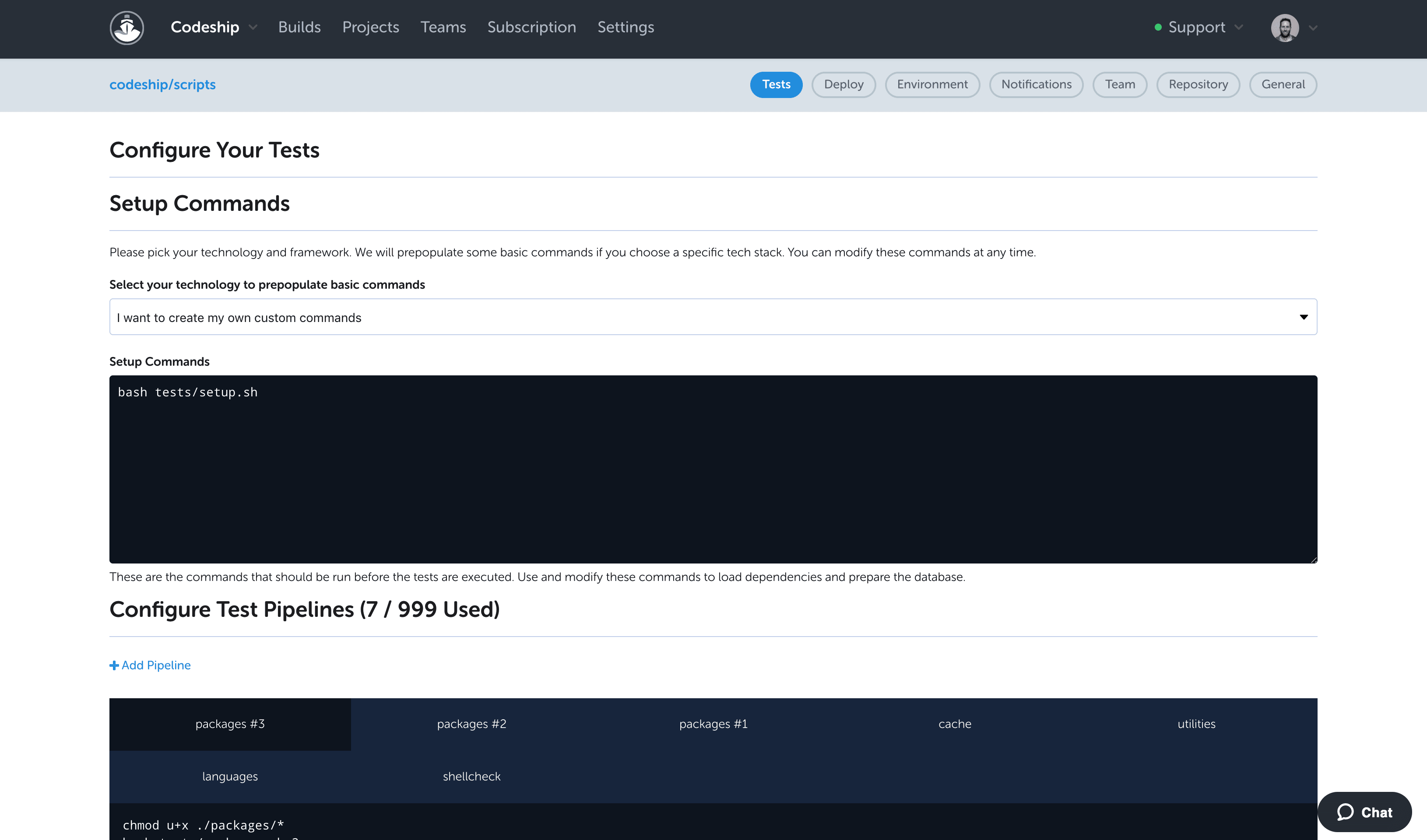
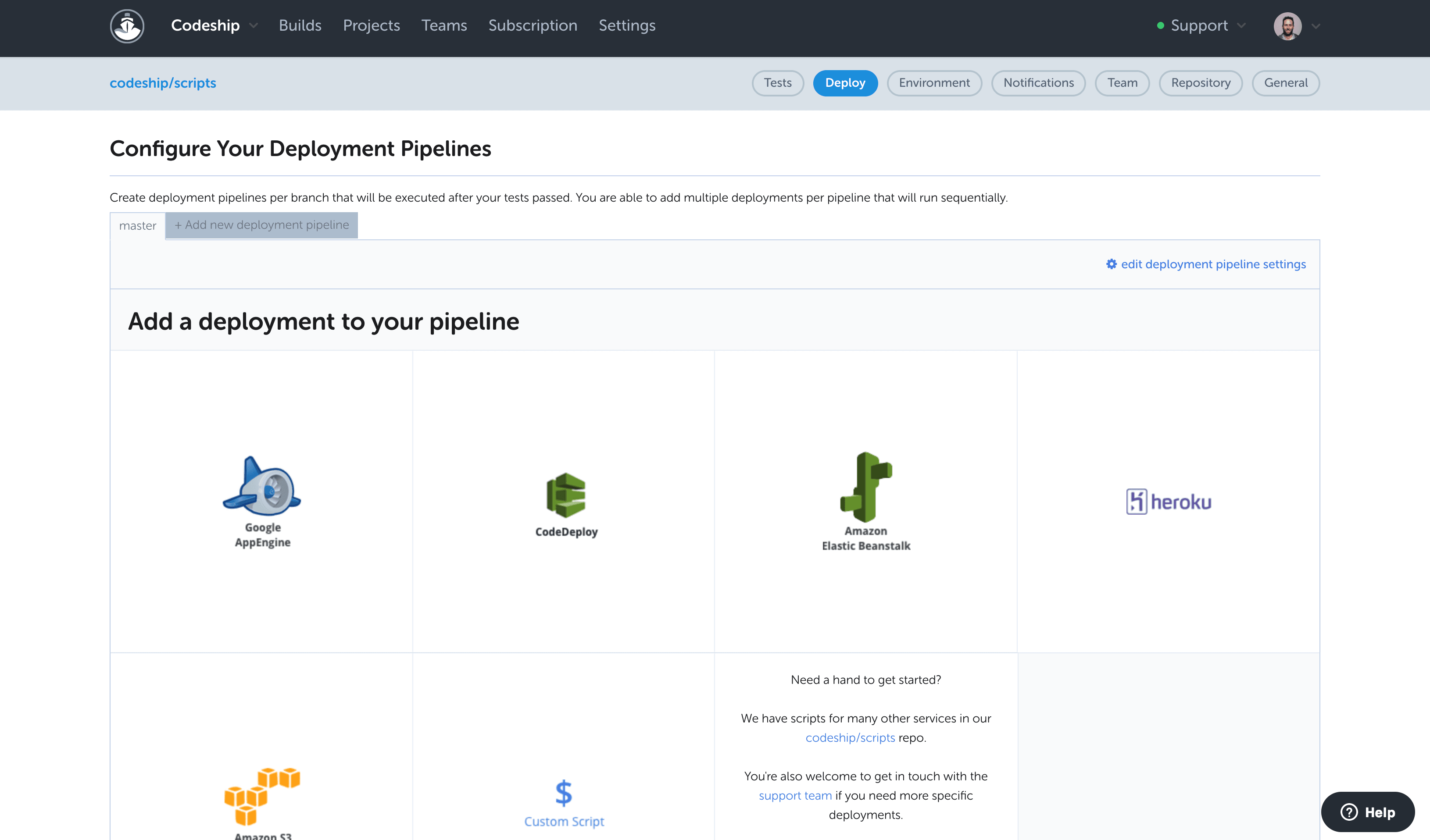
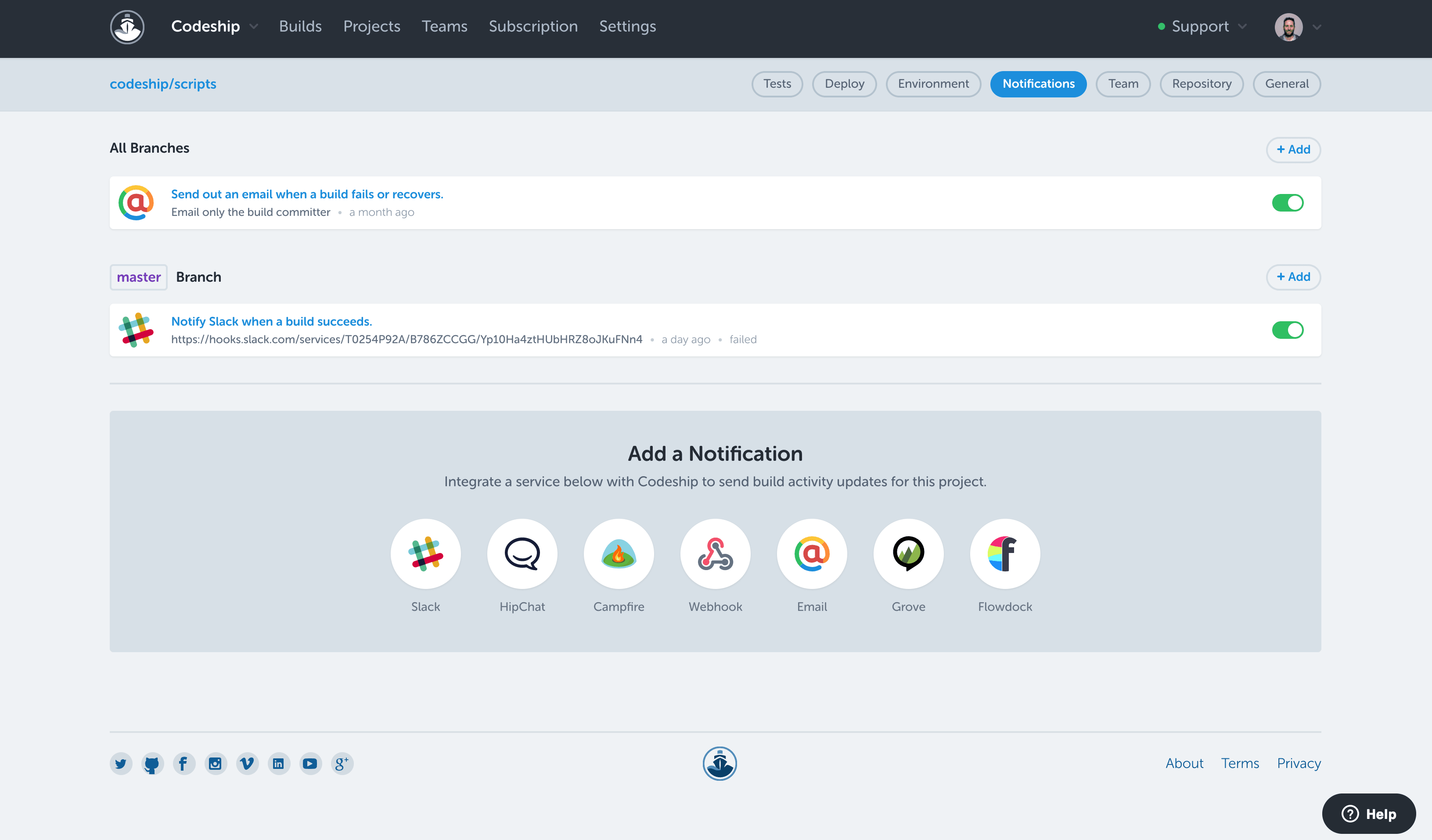
Screenshot of Get an overview of all your builds, identify failed builds easily and take action right from the dashboard.Screenshot of Information for a single build, inspect log files for each step and notice at a glance which pipeline and step are failing.Screenshot of Simply enter your setup and test commands, or choose from templates available for a wide range of stacks.Screenshot of Deploy to various web services without having to worry about the process. Simply choose your deployment target, which branch you want to deploy and off you go.Screenshot of We take care of all the complicated parts of the deployment. You simply fill in the blanks and you're all set.Screenshot of Get notifications for your builds on a multitude of services. You can also ping your own services to implement custom logic.