The EDB Postgres Advanced Server is an advanced deployment of the PostgreSQL relational database with greater features and Oracle compatibility, from EnterpriseDB headquartered in Bedford, Massachusetts.
N/A
PostgreSQL
Score 8.7 out of 10
N/A
PostgreSQL (alternately Postgres) is a free and open source object-relational database system boasting over 30 years of active development, reliability, feature robustness, and performance. It supports SQL and is designed to support various workloads flexibly.
N/A
Quixy
Score 9.9 out of 10
Small Businesses (1-50 employees)
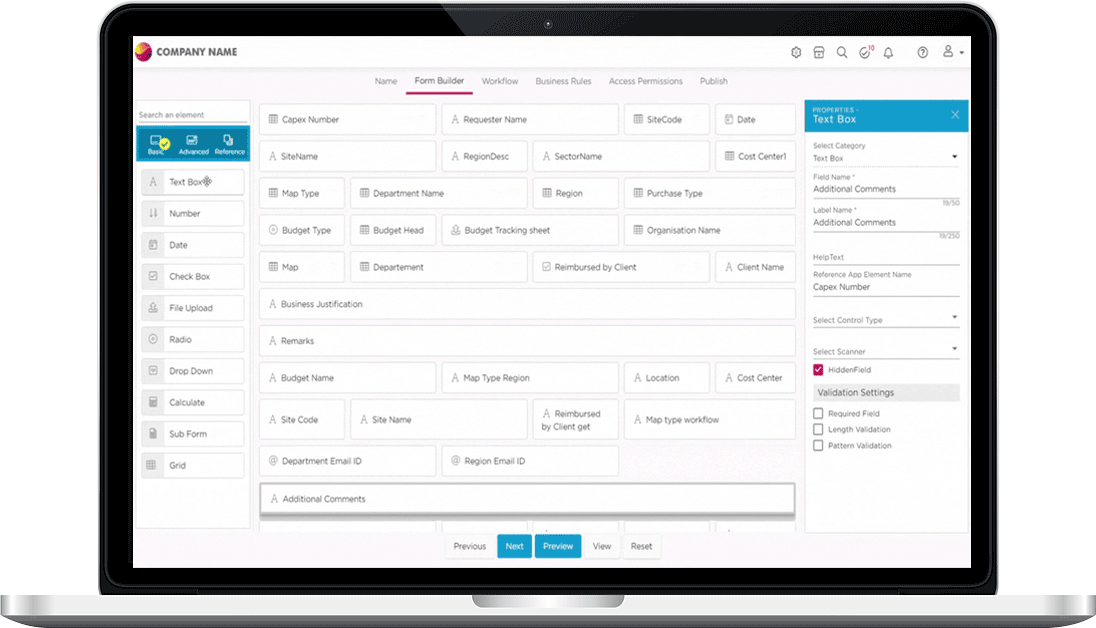
Enterprises can use Quixy's cloud-based no-code platform to enable their business users (citizen developers) to automate workflows and build simple to complex enterprise-grade applications for their custom needs. Quixy helps eliminate manual processes and turn ideas into applications making business more innovative, productive, and transparent. Users can start from scratch or customize pre-built apps from the Quixy app…
N/A
Pricing
EDB Postgres Advanced Server
PostgreSQL
Quixy
Editions & Modules
No answers on this topic
No answers on this topic
Enterprise
Contact Sales
Platform
Contact Sales
per month billed annually. This plan is suitable when the no. of users is high and the no. of apps/workflows is low.
Solution
Contact Sales
per month billed annually. This plan is suitable when the no. of users is high and the no. of apps/workflows is low.
Solution
Suitable when the no. of users is high and the no. of apps/workflows is low
Platform
Suitable when the no. of apps/workflows is high
Offerings
Pricing Offerings
EDB Postgres Advanced Server
PostgreSQL
Quixy
Free Trial
No
No
No
Free/Freemium Version
No
No
No
Premium Consulting/Integration Services
No
No
Yes
Entry-level Setup Fee
No setup fee
No setup fee
No setup fee
Additional Details
—
—
Solution
Suitable when the no. of users is high and the no. of apps/workflows is low
Platform
Suitable when the no. of apps/workflows is high
Enterprise
Suitable for bigger organizations looking for enterprise features
PPAS proved better for our customer's data-centric apps than Oracle in all but a few edge cases (encryption at rest and multi-TB database-tier backups) because it is simpler to install/maintain, runs nearly all Oracle-syntax SQL as well as ANSI SQL. PPAS has much more JSON …
It's great if you are using or wish to use PostgreSQL and need the added performance optimization, security features and developer and DBA tools. If you need compatibility with Oracle it's a must-have. There are many developer features that greatly assist dev teams in integrating and implementing complex middleware. It's great for optimizing complex database queries as well as for scaling. I would recommend Postgres Plus Advanced Server for any software development team that is hitting the limit of what PostgreSQL is capable of and wants to improve performance, security, and gain extra developer tools.
PostgreSQL is best used for structured data, and best when following relational database design principles. I would not use PostgreSQL for large unstructured data such as video, images, sound files, xml documents, web-pages, especially if these files have their own highly variable, internal structure.
Quixy BPM for managing business processes distinguishes itself through its user-friendly interface and the absence of any coding requirements. This makes it an ideal solution for companies looking to streamline their operations. Quixy BPM is suitable for businesses of all sizes and represents a cost-effective way to save time and effort.
PPAS Oracle compatibility, especially the PL/SQL syntax, has made migrating database-tier code very simple. Most Oracle packages do not need to be changed at all and those that do are generally for simple reasons like a reserved word in PPAS that is allowed in Oracle.
PPAS xDB, the multi-master replication tool, is simple and - most important - does not break with network or other interruptions. We have been able to configure and forget, which our customers could never do with other multi-master tools.
Most people had no idea that PPAS and PostgreSQL have full CRUD support for JSON. They think you need a specialized product and/or that JSON is read-only. Every organization that I have worked with is evaluating adding JSON to their relational model.
Documentation is excellent but spread out across many resources and can take a while to wade through—would benefit from having more intro level, getting started guides for various languages.
Ruby support is excellent but more Ruby examples and beginner-level documentation would be nice.
It is sometimes hard to find a community of users on StackOverflow so a larger community, and a dedicated forum with active members to answer questions and work through issues would be nice.
Postgresql is the best tool out there for relational data so I have to give it a high rating when it comes to analytics, data availability and consistency, so on and so forth. SQL is also a relatively consistent language so when it comes to building new tables and loading data in from the OLTP database, there are enough tools where we can perform ETL on a scalable basis.
Quixy has allowed us to focus on more important tasks, as the platform takes care of labor-intensive administrative work. The automation of various processes has been invaluable, as it has saved us a considerable amount of time and resources. Overall, Quixy has transformed our administrative work and has enabled us to allocate more resources to critical tasks, leading to better outcomes for our organization.
The data queries are relatively quick for a small to medium sized table. With complex joins, and a wide and deep table however, the performance of the query has room for improvement.
There are several companies that you can contract for technical support, like EnterpriseDB or Percona, both first level in expertise and commitment to the software.
But we do not have contracts with them, we have done all the way from googling to forums, and never have a problem that we cannot resolve or pass around. And for dozens of projects and more than 15 years now.
The online training is request based. Had there been recorded videos available online for potential users to benefit from, I could have rated it higher. The online documentation however is very helpful. The online documentation PDF is downloadable and allows users to pace their own learning. With examples and code snippets, the documentation is great starting point.
PPAS proved better for our customer's data-centric apps than Oracle in all but a few edge cases (encryption at rest and multi-TB database-tier backups) because it is simpler to install/maintain, runs nearly all Oracle-syntax SQL as well as ANSI SQL. PPAS has much more JSON capabilities (full CRUD vs. read-only in Oracle), simpler geospatial, simpler / more stable replication and datatypes that match developer expectations, such as BOOLEAN and ENUMs.
Although the competition between the different databases is increasingly aggressive in the sense that they provide many improvements, new functionalities, compatibility with complementary components or environments, in some cases it requires that it be followed within the same family of applications that performs the company that develops it and that is not all bad, but being able to adapt or configure different programs, applications or other environments developed by third parties apart is what gives PostgreSQL a certain advantage and this diversification in the components that can be joined with it, is the reason why it is a great option to choose.
While Excel is a powerful tool for organizing data and creating basic inventory spreadsheets, it lacks the automation and integration capabilities that Quixy provides. Also, we can integrate with other business systems, such as accounting and order fulfillment systems. So, we can actually have centralized system connected across several departments for automation.
Postgres Plus Advanced Server is quite complex and may take longer to implement certain things than simply using PostgreSQL depending on developer familiarity with the platform.
Getting up to speed can be daunting so again, there is an upfront cost in time spent learning the platform, besides the potential for extra time spent on a feature-by-feature basis.
The cost of Postgres Plus Advanced Server should be weighed against simply using PostgreSQL to decide which is the best solution for your business needs.
Easy to administer so our DevOps team has only ever used minimal time to setup, tune, and maintain.
Easy to interface with so our Engineering team has only ever used minimal time to query or modify the database. Getting the data is straightforward, what we do with it is the bigger concern.