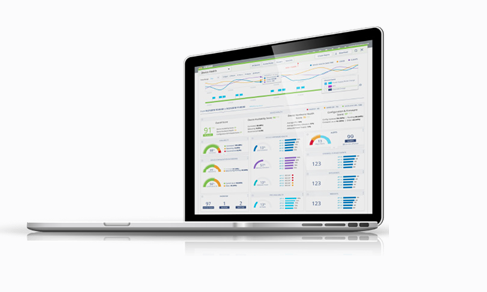
ExtremeCloud IQ provides unified management driven by Machine Learning (ML). It features configuration workflows, realtime and historical monitoring, comprehensive troubleshooting, and integrated network applications. Designed to take full advantage of Extreme’s end-to- end networking solutions, it delivers unified, full-stack management of access points, switches, and SD-WAN.
N/A
TeamCity
Score7.1 out of 10
N/A
TeamCity is a continuous integration server from Czeck company JetBrains.
ExtremeCloud IQ is definitely best suited for a mid/large-scale business. The tools provided for what you pay for would be mostly unnecessary for a small business - the pricing also would not condone the purchase for a small business. That said, we are more of a mid-sized district, and being able to manage this system with 120 APs deployed across 10 locations has been great. I'm the only person that purchases, configures, deploys and manages everything with ExtremeCloud IQ - and it doesn't take too much time to be able to do so. I'm certainly a fan of the product!
A de minimis incentive was given to thank the reviewer for their time. The incentive was not used to bias or drive a particular response, nor was the incentive contingent on a positive endorsement. TR verified that a representative sample of customers was invited. More Info
TeamCity is very quick and straightforward to get up and running. A new server and a handful of agents could be brought online in easily under an hour. The professional tier is completely free, full-featured, and offers a huge amount of growth potential. TeamCity does exceptionally well in a small-scale business or enterprise setting.
A de minimis incentive was given to thank the reviewer for their time. The incentive was not used to bias or drive a particular response, nor was the incentive contingent on a positive endorsement. More Info
GTAC support is excellent; they understand the issue and do not hesitate to help in detail.
The layout is very intuitive and easy to use, especially the templating of switch port types. It makes it simple to use context-based names so the purpose of the port can be understood.
The auto channel selection now works very well, including the SDR dual 5GHz mode.
A de minimis incentive was given to thank the reviewer for their time. The incentive was not used to bias or drive a particular response, nor was the incentive contingent on a positive endorsement. More Info
A de minimis incentive was given to thank the reviewer for their time. The incentive was not used to bias or drive a particular response, nor was the incentive contingent on a positive endorsement. More Info
A de minimis incentive was given to thank the reviewer for their time. The incentive was not used to bias or drive a particular response, nor was the incentive contingent on a positive endorsement. More Info
The customization is still fairly complex and is best managed by a dev support team. There is great flexibility, but with flexibility comes responsibility. It isn't always obvious to a developer how to make simple customizations.
Sometimes the process for dealing with errors in the process isn't obvious. Some paths to rerunning steps redo dependencies unnecessarily while other paths that don't are less obvious.
A de minimis incentive was given to thank the reviewer for their time. The incentive was not used to bias or drive a particular response, nor was the incentive contingent on a positive endorsement. More Info
Being a web platform, it is very easily accessible. The user interface is very simple, intuitive, and visually well-designed. The learning to use it was very quick and can be done even without specific user manuals. Access to the analytics and troubleshooting tools is also extremely intuitive and very well-crafted.
A de minimis incentive was given to thank the reviewer for their time. The incentive was not used to bias or drive a particular response, nor was the incentive contingent on a positive endorsement. TR verified that a representative sample of customers was invited. More Info
TeamCity runs really well, even when sharing a small instance with other applications. The user interface adequately conveys important information without being overly bloated, and it is snappy. There isn't any significant overhead to build agents or unit test runners that we have measured.
A de minimis incentive was given to thank the reviewer for their time. The incentive was not used to bias or drive a particular response, nor was the incentive contingent on a positive endorsement. More Info
A de minimis incentive was given to thank the reviewer for their time. The incentive was not used to bias or drive a particular response, nor was the incentive contingent on a positive endorsement. TR verified that a representative sample of customers was invited. More Info
TeamCity is a great on-premise Continuous Integration tool. Visual Studio Team Services (VSTS) is a hosted SAAS application in Microsoft's Cloud. VSTS is a Source Code Repository, Build and Release System, and Agile Project Management Platform - whereas TeamCity is a Build and Release System only. TeamCity's interface is easier to use than VSTS, and neither have a great deployment pipeline solution. But VSTS's natural integration with Microsoft products, Microsoft's Cloud, Integration with Azure Active Directory, and free, private, Source Code repository - offer additional features and capabilities not available with Team City alone.
A de minimis incentive was given to thank the reviewer for their time. The incentive was not used to bias or drive a particular response, nor was the incentive contingent on a positive endorsement. More Info
A de minimis incentive was given to thank the reviewer for their time. The incentive was not used to bias or drive a particular response, nor was the incentive contingent on a positive endorsement. More Info
TeamCity has greatly improved team efficiency by streamlining our production and pre-production pipelines. We moved to TeamCity after seeing other teams have more success with it than we had with other tools.
TeamCity has helped the reliability of our product by easily allowing us to integrate unit testing, as well as full integration testing. This was not possible with other tools given our corporate firewall.
TeamCity's ability to include Docker containers in the pipeline steps has been crucial in improving our efficiency and reliability.
A de minimis incentive was given to thank the reviewer for their time. The incentive was not used to bias or drive a particular response, nor was the incentive contingent on a positive endorsement. More Info