HashiCorp Consul is a tool for discovering and configuring services in the IT infrastructure. It provides service discovery, health checking, key/value stores and support for multiple data centers out of the box.
$0
always free
SolarWinds Kiwi CatTools
Score 8.5 out of 10
N/A
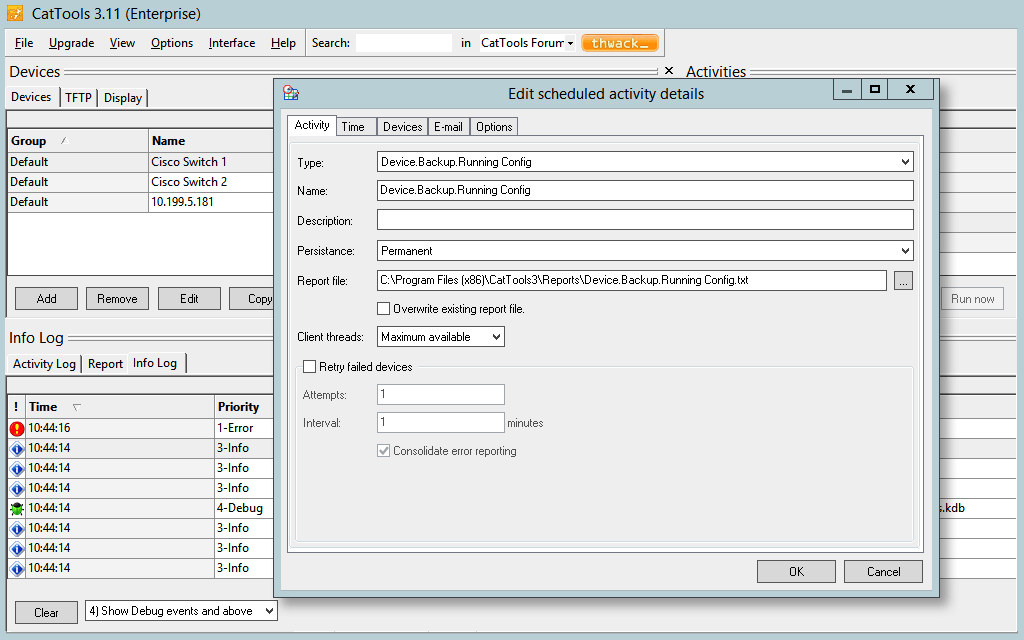
SolarWinds® Kiwi CatTools® is network automation tool designed to manage configurations on network devices such as routers, switches, and firewalls. It helps users work more efficiently by scheduling automatic backup activities and rolling out configuration changes to multiple devices at the same time. With native support for devices from dozens of manufacturers, Kiwi CatTools is designed to simplify network administration, configuration change alerting, and backup management.
$852
Per Instance
Pricing
HashiCorp Consul
SolarWinds Kiwi CatTools
Editions & Modules
Open Source (self-managed)
$0
always free
HCP Consul (Cloud)
$0.027/hr
Per Hour
Enterprise
Self-Managed Custom Deployments
One Time Price
$852
Per Instance
Offerings
Pricing Offerings
Consul
SolarWinds Kiwi CatTools
Free Trial
Yes
Yes
Free/Freemium Version
Yes
No
Premium Consulting/Integration Services
Yes
No
Entry-level Setup Fee
Optional
No setup fee
Additional Details
—
—
More Pricing Information
Community Pulse
HashiCorp Consul
SolarWinds Kiwi CatTools
Features
HashiCorp Consul
SolarWinds Kiwi CatTools
Configuration Management
Comparison of Configuration Management features of Product A and Product B
Consul can provide a light-weight, lightning-fast and robust solution for the following:
Network mesh
Service DNS
Global key-value store (values can be complex objects as well)
Utility for blue-green deployments
Service health checking
Consul can be used in any or a combination of these scenarios. Regardless if you are a network administrator or a regular software engineer, Consul can add value to your work.
Large-Scale Networks with Thousands of Devices that permit our enterprise with thousands of devices across multiple locations need a highly scalable solution, and A security-focused organization requires real-time monitoring of device configurations to detect and alert on unauthorized changes. and CatTools is lightweight and easy to set up, making it ideal for managing and resetting device configurations in a lab setting.
The GUI: The GUI interface for Consul has gotten a lot better over the years. Since Consul is so easy to interact with via API, this isn't a showstopper, but for those that are less command line inclined it's always nice to be able to refer them to an easy to use and understand web interface
It's chatty: Consul is extremely chatty. Sometimes it's particularly chatty at 2am with no indication as to why and eats up quite a bit of resources. Just be sure to provision your systems that typically take a heavy load with a little extra for Consul
Consul's API is extremely user friendly. While their web interface isn't quite as "mature", it's still pretty easily navigated for the average person. Together they make a pretty easy to pick up and use tool.
CatTools is simple to set up and administer. Anyone who can install a Windows application can quickly set up an automated backup of one or more devices. It does what it was designed to do.
I've never used paid support from HashiCorp, but I consider its support a good one, since they provide a lot of free resources for the community and there are good user groups supporting you on several sorts of issues. Also, HashiCorp is known as a company with a strong relationship with the community, that is easily noticed by the events HashiCorp promotes over the world.
The software is easy enough to set up and configure that even after using the product for years, we never had to contact support. We used some open source products before utilizing CatTools and could have used a speed dial to try and figure out the intricacies of the products.
Consul was easier to configure out of the box than Serf and gave us more initial options. Its easy to use tools and support were by far superior to Serf in many ways. Support alone was one of those areas that Serf could take an example from Consul to keep its customers happy.
Strengths:Cost-Effectiveness: CatTools is significantly more affordable than enterprise-grade tools like SolarWinds Network Configuration Manager (NCM) or Infoblox NetMRI. It is ideal for small to medium-sized businesses with tight budgets. Ease of Deployment: Kiwi CatTools is lightweight and easier to set up, while enterprise solutions often require substantial infrastructure and longer deployment times. Focus on Essentials: CatTools excels in its core functions, such as automated configuration backups, scheduled tasks, and essential compliance checks.
It contains a native web UI, which in contrast to its counterparts, is handy, very intuitive and - most importantly - very informative. It leaves no room for doubt about your services "forest" health. So, for that purpose, the learning curve was almost down to non-existent. Our team managed to work seamlessly with Consul being our services API
Our management staff had a difficult time understanding what Consul was really all about. For technical staff it is pretty simple to understand the huge value such a tool can pose to our suite of solutions, but once our management staff took the grasp of its valuable handy set of tools, we didn't take long to start using it and keeping track of our Swarm overall health, with was a constant concern for the entire company before.
For load balancing purposes, we were relying pretty much on guesses before we decided to use Consul. One would check a certain node overall health and decide if we would need to spring a new instance at AWS or Digital Ocean.