InterSystems IRIS vs. MongoDB

Overview
ProductRatingMost Used ByProduct SummaryStarting Price
InterSystems IRIS
Score 8.1 out of 10
N/A
InterSystems IRIS is a complete cloud-first data platform that includes a multi-model transactional data management engine, an application development platform, and interoperability engine, and an open analytics platform. It is is the next generation of InterSystems' data management software. It includes…N/A
MongoDB
Score 8.8 out of 10
N/A
MongoDB is an open source document-oriented database system. It is part of the NoSQL family of database systems. Instead of storing data in tables as is done in a "classical" relational database, MongoDB stores structured data as JSON-like documents with dynamic schemas (MongoDB calls the format BSON), making the integration of data in certain types of applications easier and faster.
$0
per month
Pricing
InterSystems IRISMongoDB
Editions & Modules
No answers on this topic
Shared
$0
per month
Serverless
$0.10million reads
million reads
Dedicated
$57
per month
Offerings
Pricing Offerings
InterSystems IRISMongoDB
Free Trial
YesYes
Free/Freemium Version
YesYes
Premium Consulting/Integration Services
NoNo
Entry-level Setup FeeOptionalNo setup fee
Additional DetailsFully managed, global cloud database on AWS, Azure, and GCP
More Pricing Information
Community Pulse
InterSystems IRISMongoDB
Considered Both Products
InterSystems IRIS
Chose InterSystems IRIS
Better integration of Intersystems solution
Better performances
Better support ofr developers
Chose InterSystems IRIS
Tibco was not originally planned to be used for HL7 Integrations and as such we had to create some very complicated processes in order for the messages to parse and validate appropriately. It was simply not built for this type of interoperability. Comparatively, InterSystems …
Chose InterSystems IRIS
My organizations use InterSystems IRIS and i think is a good bet.
Chose InterSystems IRIS
The database, integration engine, and load balancer are all in one place. This is advantageous because 1) there are no hidden costs and it is also far easier to set up the network configuration. 2) The sales engineers are very willing to help in any situation and they are also …
Chose InterSystems IRIS
This have best database management and security provider future

Time saving for complex database management
Chose InterSystems IRIS
InterSystems IRIS includes a wide array and assortment of otherwise stand-alone solutions. Having a single platform to support database interoperability, storage, and analytics, let alone Security and SQL tools is a great advantage over solutions that tackle a single aspect of …
Chose InterSystems IRIS
The best software on the market, the capacity for analysis, storage and security in the handling and storage of data, provides you with the certainty of increasing efficiency in all organizational processes, ensuring that you will have your information available at all times, …
Chose InterSystems IRIS
We are using InterSystems IRIS [especially] for database operations as the query performance is really good for [a large] amount of customer data. You can easily integrate for any application like web, desktop, and many more. It also provides BI functionality which is also very …
Chose InterSystems IRIS
Because [it's] a very powerful and efficient tool that has the ability to manage your data in a quick and reliable manner. It's easy to use especially if you work in the area of managing a large number of databases or simply need an extra hand. Inter Systems IRIS can provide …
Chose InterSystems IRIS
The process of migration and scaling due to heavy lifting is also easier, the speed of performance of IRIS is good and fast were able to get a high increase in query performance after our switch and [immense] amount of features integrated with the solution, from the web …
Chose InterSystems IRIS
InterSystems IRIS is more efficient than other applications therefore, it is preferred over the others. Moreover, it is more cost-effective than other applications like Microsoft SQL Server, therefore, many organizations such as small businesses can afford it. Lastly, …
Chose InterSystems IRIS
You definitely need to use it for a fast, solution-oriented experience.
Chose InterSystems IRIS
InterSystems IRIS has the flexibility and power to be more than just a databse engine. We are able to create our business processes and interface with out javascript front end. SQL Server has been useful through the Entity framework connecting both together has been the …
Chose InterSystems IRIS
New docker system is really good, performance improves at the cost of some breaking changes.
Chose InterSystems IRIS
I have always studied other databases, I cannot say if it is a problem for Brazilian colleges, however, after meeting IRIS / Caché, my concept of databases has changed. A much more robust and faster bank.
Now that I have had the opportunity to work with this database, there is …
Chose InterSystems IRIS
The only comparison I can make is that they are all database tools. I strongly believe that just the fact that IRIS is not so widespread and easy to find in research forums is the reason why it is not so "famous". The tool meets and meets all needs for any situation.
Chose InterSystems IRIS
InterSystems IRIS is the union of the best parts of Caché and Ensemble, with a lot of new implementations and some enhancements. IRIS have the same multidimensional database estruture as like Caché and works as an Integration tool like Ensemble.
Chose InterSystems IRIS
We did not consider alternatives; implemented InterSystems IRIS based on a corporate reference.
Chose InterSystems IRIS
Did not consider alternatives; we opted for the free trial and then decided to move ahead with a long-term plan with InterSystems IRIS.
Chose InterSystems IRIS
Did not try other alternatives
Chose InterSystems IRIS
They shared a set of limits:
- speed
- exhaustive memory consumption
MongoDB
Chose MongoDB
The environment I work in is somewhat unique in that we use both MySQL and MongoDB. However, each is used for specific purposes that the other is not well suited for. MongoDB is not a relational database like MySQL, so it serves as the perfect place to dump key bits of data for …
Chose MongoDB
We have [measured] the speed in reading/write operations in high load and finally select the winner = MongoDBWe have [not] too much data but in case there will be 10 [times] more we need Cassandra. Cassandra's storage engine provides constant-time writes no matter how big your …
Chose MongoDB
Both Couchbase and MongoDB are document-oriented NoSQL databases, so they have very similar features. While they do have some fundamental differences in terms of how they scale, shard, etc. the one key reason why we went with MongoDB is its availability and support from the …
Chose MongoDB
The flexible structure underlying MongoDB's construction is not found in other competitors; the ability to easily change the structure without affecting other stored documents. It is very ideal for projects that you cannot predict that the structure will change this way. Of …
Chose MongoDB
Implementing new features for application becomes simpler with MongoDB since you don't need to run database migration scripts just to for example add new fields to database only to store some extra data. This is especially good for the deployment phase. Only new version of …
Chose MongoDB
MongoDB is a robust and scalable db which offers a lot of cool features out of the box. Being open sourced and backed by a great community with developer tools like mongo compass , it was a no-brainer to go for it. It has connectors in almost all programming languages and is a …
Chose MongoDB
MongoDB is more of a general purpose nosql database, while elasticSearch is a search engine oriented nosql solution.
Percona Server for MongoDB is a more suitable solution for the enterprise field.
Chose MongoDB
I would say Cassandra is better than MongoDB since it has the backing of Facebook to it. Its inherent properties like versioning put it into the other category of columnar databases, but it's one of the NoSQL databases which you should definitely consider for your organization …
Chose MongoDB
MongoDB is the most reliable and fastest for storing document-based data. It has a place among the most popular DB's these days.
Chose MongoDB
This tool is only capable of reading real-time data very smoothly. The transition was also pretty easy and quick. Syntax is also very easy and comfortable to learn and use.

The main reason for selecting is that it works very fast under the Intellijet module environment and we …
Chose MongoDB
In our early development days we weighed NoSQL databases like MongoDB with RDBMS solutions like MySQL. We were more familiar with MySQL from past experience but also were wary of painful data migrations that slowed down development iterations and increased the risk of outages …
Chose MongoDB
Also, using DocumentDB, and both are good, each was chosen based on the developer's expertise. So take advantage of in-house skills.
Chose MongoDB
Snowflake and Redshift are much more mature and have been around longer. MongoDB is definitely much less expensive and if you are in a startup, this is an almost for-sure option. Redshift can be slow and Mongo is much faster. However, losing the relational database aspect could …
Chose MongoDB
I just felt MongoDB was easier to use and more cost-effective. Aggregation pipelines are great.
Chose MongoDB
It's very fast and easiest to use. Many companies are using this nowadays. It's helped to complete many software products very quickly so the year income has increased compared with last years. Many programmers are now leaning this tool as back end developers so that we changed …
Chose MongoDB
We selected MongoDB because of the following
  • Ease of deployment
  • Use and provisioning on their cloud
Chose MongoDB
MongoDB is our go-to database solution for any project, and the more we work with it the more we love it. Some say that NoSQL is pointless... Our developers wholeheartedly disagree, because they love working with it. Though both NoSQL and SQL have their purposes, in most …
Chose MongoDB
Your default choice should not be MongoDB in my opinion. Most user-facing systems are relational by nature so a well known and reliable SQL database would be easier to maintain and simpler to develop long term. If you highly value speed of development go with firebase. If you …
Chose MongoDB
It does not belong to certain cloud platforms. MongoDB is an independent program that works with any cloud platform including Amazon Web Services and the Google Cloud Platform. For companies who want to maintain a cloud agnostic structure, MongoDB is a great choice for NoSQL …
Chose MongoDB
We wanted to use free ware relational database for our need. MongoDB was perfect fit.
Chose MongoDB
MongoDB and Cassandra are both database system from the NoSQL family. MongoDB can be used in lots of use cases while Cassandra has a specific usage. There are some features that MongoDB provides efficiently while Cassandra doesn't and vice-versa. Like, you can update the data …
Chose MongoDB
We tend to choose MongoDB when we're faced with a particular situation: we know that we need a NoSQL database in general, and want an open-source implementation that allows us to prevent against platform lock-in. Amazon's new DocumentDB product even allows us to choose to use …
Features
InterSystems IRISMongoDB
NoSQL Databases
Comparison of NoSQL Databases features of Product A and Product B
InterSystems IRIS
-
Ratings
MongoDB
10.0
Ratings
16% above category average
Performance00 Ratings10.00 Ratings
Availability00 Ratings10.00 Ratings
Concurrency00 Ratings10.00 Ratings
Security00 Ratings10.00 Ratings
Scalability00 Ratings10.00 Ratings
Data model flexibility00 Ratings10.00 Ratings
Deployment model flexibility00 Ratings10.00 Ratings
Best Alternatives
InterSystems IRISMongoDB
Small Businesses
Google Cloud SQL
Google Cloud SQL
Score 8.7 out of 10
IBM Cloudant
IBM Cloudant
Score 7.4 out of 10
Medium-sized Companies
Google Cloud SQL
Google Cloud SQL
Score 8.7 out of 10
IBM Cloudant
IBM Cloudant
Score 7.4 out of 10
Enterprises
SAP IQ
SAP IQ
Score 6.0 out of 10
IBM Cloudant
IBM Cloudant
Score 7.4 out of 10
All AlternativesView all alternativesView all alternatives
User Ratings
InterSystems IRISMongoDB
Likelihood to Recommend
7.4
(0 ratings)
10.0
(0 ratings)
Likelihood to Renew
8.2
(0 ratings)
10.0
(0 ratings)
Usability
8.2
(0 ratings)
10.0
(0 ratings)
Availability
-
(0 ratings)
9.0
(0 ratings)
Support Rating
7.4
(0 ratings)
9.6
(0 ratings)
Implementation Rating
8.2
(0 ratings)
8.4
(0 ratings)
User Testimonials
InterSystems IRISMongoDB
Likelihood to Recommend
It is best suited in the scenario where a single interface is required for providing [a complete end-to-end] solution to the customers. You don't need [a] separate platform to write code or [perform] database operations. All you need is InterSystems IRIS software and you are done. You can also use analytics functionality which is one of the greatest [features] which many customers need for their solution[.]
Read full review
MongoDB [is] great at storing JSON data grouped into "collections". In this format, you can store any JSON documents and conveniently categorize them by collections. The JSON document contained in MongoDB is called binary JSON or BSON and, like any other document in this format, is unstructured. Therefore, unlike traditional DBMS, any kind of data can be stored in collections, and this flexibility is combined with the horizontal scalability of the database. It should be noted that MongoDB does not have links between documents and “collections” (this is partially compensated by the Database Reference - links in the DBMS, but this does not completely solve the problem). As a result, a situation arises in which there is a certain set of data that is not related to other information in the database, and there is no way to combine data from different documents. In SQL systems, this would be an elementary task.
Read full review
Pros
  • Connecting with mutliple vendor platforms and systems allowing us to consume and provide data as needed.
  • Allowed us to implement our own RESTful api engine to server data to our internal applications.
  • Setting up their recommendations for high availability allow us to perform server maintenance with minimal down time to our users.
Read full review
  • Easy to learn. When I picked up MongoDB for the first time, I had little background in database management or modeling. If you have a background in javascript (and JSON)... then you can figure out how to use MongoDB pretty fast.
  • Fast performance.
  • It's relatively easy to set up in certain environments because there are lots of ready-made solutions out there.
  • There's a lot of support in the existing ecosystem for it —, especially in the node.js realm.
  • Query syntax is pretty simple to grasp and utilize.
  • Aggregate functions are powerful.
  • Scaling options.
  • Documentation is quite good and versioned for each release.
Read full review
Cons
  • Enhanced documentation, more comprehensive and user-friendly documentation, including detailed tutorials and examples
  • Improving compatibility and integrations with others programming languages
  • Introducing tools and techniques to optimize the performance of ObjectScript applications, such as profiling tools, performance monitoring utilities, and code optimization guidelines
  • A better compatibility with Python libraries
Read full review
  • I love the idea of Map-Reduce native support in MongoDB. Admittedly I have not used it as much as I would like -- it always seems to trip me up.
  • Recent additions to the aggregation queries have helped reduce (no pun intended) my need to better wield the weapon that is Map-Reduce.
Read full review
Likelihood to Renew
No answers on this topic
MongoDB is one of the most famous non-relational databases in the world, there are famous active projects that use this database. I think that the same company that develops the database gives you the online induction totally free is something that really is very positive. Accounts with a first-class support to be able to relate the correct implementation of the database, in addition to teaching you the best practices to optimize your projects, I believe that with this decision it is more than obvious which is the best decision at the time of seeing with which database to work.
Read full review
Usability
The interface is very intuitive, the documentation is very good so it is not complicated to operate.
The security is complex, but you can create a special role to access and the user ONLY can operate with the part that it allows.
Also, you can examine the data very quick with the SQL Browser integrated.
Read full review
It is one of the reasons why we prefer it to store documents in a JSON-style format, to access the desired document very quickly regardless of its size, to be readable by human eyes, and to be easily scalable and manageable.
Read full review
Support Rating
The InterSystems WRC has always been helpful and responsive. The folks I have spoken with are always understanding of our needs and questions and regardless of if the question is simple or complex we are always met with the same professionalism and helpfulness every time. I have no hesitations contacting InterSystems for help!
Read full review
I have reached multiple times to the MongoDB community for the help and they have provided each and easy solution for every problem. Over the internet and on stack overflow many people responds over the challenges. Now this tool is very much used in every company and projects so internally many people are there to give a support.
Read full review
Implementation Rating
Will done based on a proper planning, so this will makes execution more easier and better.
Read full review
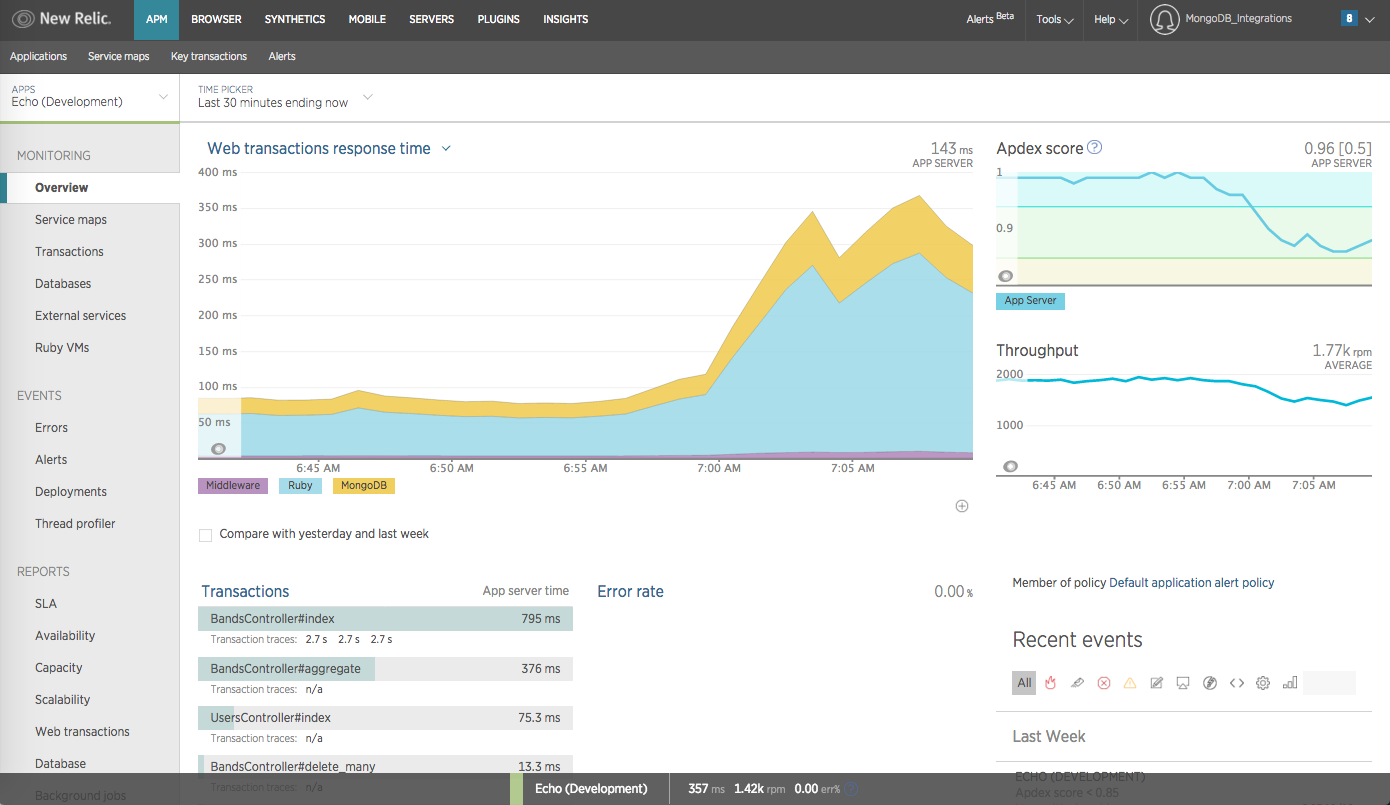
While the setup and configuration of MongoDB is pretty straight forward, having a vendor that performs automatic backups and scales the cluster automatically is very convenient. If you do not have a system administrator or DBA familiar with MongoDB on hand, it's a very good idea to use a 3rd party vendor that specializes in MongoDB hosting. The value is very well worth it over hosting it yourself since the cost is often reasonable among providers.
Read full review
Alternatives Considered
Tibco was not originally planned to be used for HL7 Integrations and as such we had to create some very complicated processes in order for the messages to parse and validate appropriately. It was simply not built for this type of interoperability. Comparatively, InterSystems IRIS for Health (HealthConnect) has out of the box HL7 features that would parse messages, offer a variety of validation options, simplified data lookups and transformation and reduced the amount of time it took to develop connections with out vendor systems. InterSystems IRIS also allows one to push just single files into production at a time so there is less of a chance of us pushing something that should not be in production yet as our previous system was set up to with TIBCO deployments
Read full review
The environment I work in is somewhat unique in that we use both MySQL and MongoDB. However, each is used for specific purposes that the other is not well suited for. MongoDB is not a relational database like MySQL, so it serves as the perfect place to dump key bits of data for quick retrieval later. This is something we can't easily do with MySQL. On this smaller database, MongoDB also lets us retrieve data more quickly with its fast and efficient querying.
Read full review
Return on Investment
  • Very Fast and scalable software to deal with big data flow, safe and robust.
  • The studio IDE is quite old fashion and lacks a few facilities
  • amazing for complex data consumption, its milyi-model capability wich allows multiple different models for a single set of codes.
Read full review
  • We can make more open and flexible systems due to its easy adaptation to new evolutions in web applications.
  • In the latest versions it offers support for different transactions and we could carry out real tests related to the concurrency of the application.
  • MongoDB allows you to have distributed clusters, which improves the speed of the queries by reducing the latency that exists between the database cluster and the service that executes the query.
Read full review
ScreenShots

MongoDB Screenshots

Screenshot of Screenshot of Screenshot of Screenshot of Screenshot of Screenshot of