ThreatDown (formerly Malwarebytes for Business), combines Malwarebytes' endpoint security capabilities in four bundles. The basic Core tier includes incident response, Next-gen AV, device control, vulnerability assessments, and the ability to block unwanted application.
$345
per year 5 endpoints (minimum)
Microsoft Defender for Cloud
Score8.7 out of 10
N/A
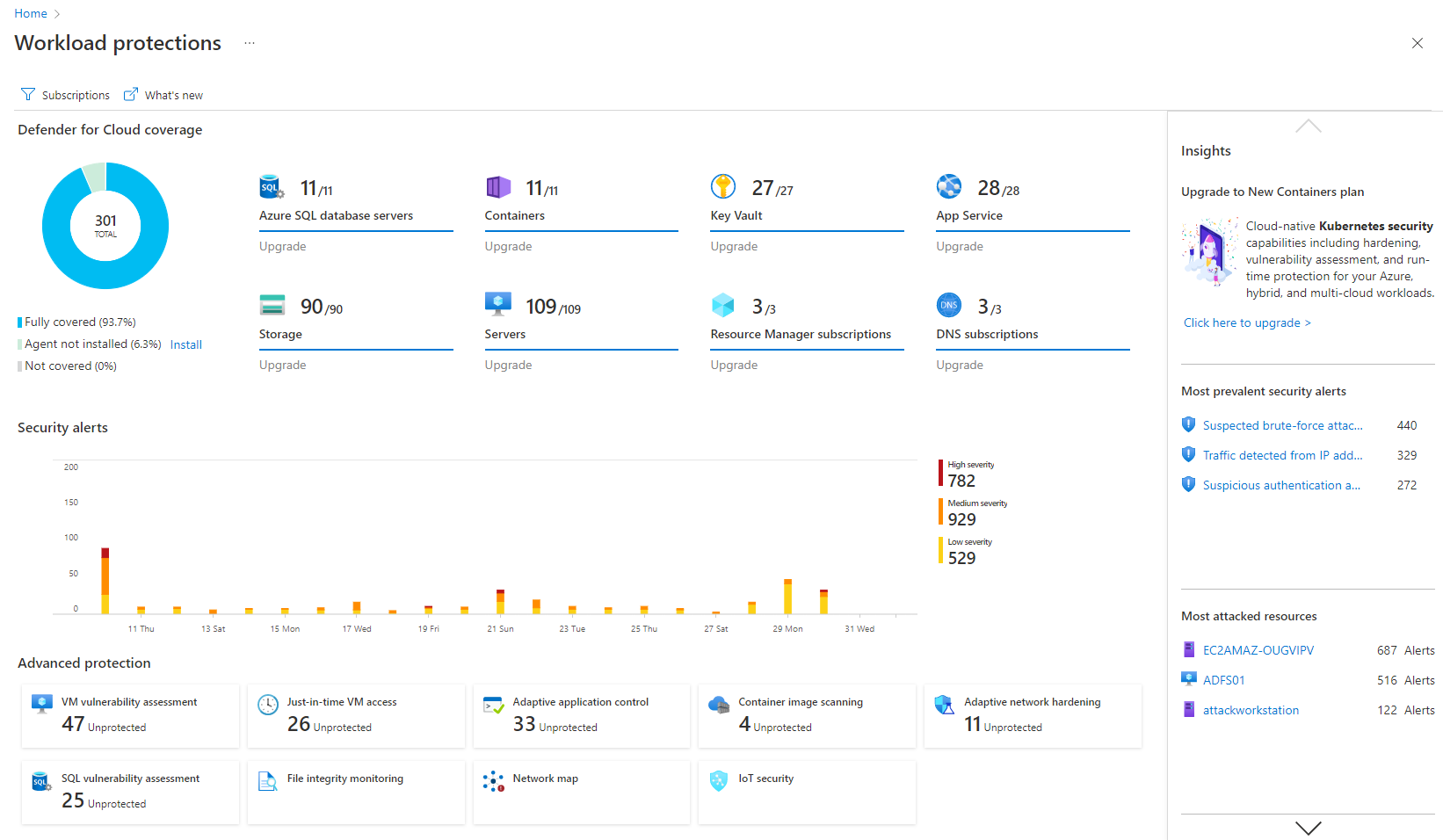
Microsoft Defender for Cloud is a Cloud Security Posture Management (CSPM) and Cloud Workload Protection Platform (CWPP) for Azure, on-premises, and multicloud (Amazon AWS and Google GCP) resources.
N/A
Pricing
ThreatDown, powered by Malwarebytes
Microsoft Defender for Cloud
Editions & Modules
Core
$345
per year per endpoint (minimum 5)
Advanced
$395
per year per endpoint (minimum 5)
Elite
$495
per year per endpoint (minimum 5)
Ultimate
$595
per year per endpoint (minimum 5)
No answers on this topic
Offerings
Pricing Offerings
ThreatDown, powered by Malwarebytes
Microsoft Defender for Cloud
Free Trial
Yes
Yes
Free/Freemium Version
No
No
Premium Consulting/Integration Services
No
No
Entry-level Setup Fee
No setup fee
No setup fee
Additional Details
Optional Add-Ons include server and mobile device protection. Server protection ranges from $129 to $179 per annum depending on service tier. Mobile security is $10 per device, no matter the service tier. A 10% discount is offered for choosing a two-year billing plan.
I think Malwarebytes is the best anti-malware company. I think it is well-suited for any situation and any device. I think Malwarebytes does the best on Windows and on MacOS. Also, Malwarebytes is always improving, and you can tell they are a company that stays on top of cybersecurity trends. If you have a tight budget or looking for the cheapest solution, then Malwarebytes may not be the solution for you. To clarify, I don't think Malwarebytes is that much more expensive compared to its closest competitors.
A de minimis incentive was given to thank the reviewer for their time. The incentive was not used to bias or drive a particular response, nor was the incentive contingent on a positive endorsement. More Info
I think it's good for cloud-native companies. A company that, from day zero, they're like, "We're going cloud, and this is how we're going to do it." They get it. It works well for them. Smaller organizations that are under X amount of resources- I don't know what that X might mean- but I feel like it plays well in smaller, more nimble organizations. If you're an older organization or if you're extremely large, it starts becoming a little difficult to manage at scale. And you have to sometimes throw bodies at the problem. Maybe not the most eloquent way of saying it, but that's what it feels like.
A de minimis incentive was given to thank the reviewer for their time. The incentive was not used to bias or drive a particular response, nor was the incentive contingent on a positive endorsement. More Info
Protects against malware - No matter how much training you give end users on social hacking, there is always a breach at some point.
Protects against ransomware - Ransomware could spell disaster for a company...it could literally shut the doors for good.
Centralized administration - Without a terrific centralized method to manage all the systems being protected, it would require an extra position just to maintain all endpoints.
A de minimis incentive was given to thank the reviewer for their time. The incentive was not used to bias or drive a particular response, nor was the incentive contingent on a positive endorsement. More Info
It's really well laid out, with an easy-to-use, accessible UI.
With Microsoft Defender for Cloud, it has everything you need with the Safelink attachment, the Safelink emails for URL, the way it scans those URLs and attachments within the product, and you're seeing the results. And that adds an extra layer of security for the user, so you feel comfortable knowing the product monitors those. That's something I really like about that product.
A de minimis incentive was given to thank the reviewer for their time. The incentive was not used to bias or drive a particular response, nor was the incentive contingent on a positive endorsement. More Info
Integrations with on-premise workloads can sometimes be challenging. Needs improvement and well standardised integration points
Vulnerability categories can be difficult to understand. It should allow teams to focus on critical findings and help them keep aside low-severity or suppressed vulnerabilities
Pricing can be improved as it can be over-priced for smaller businesses and would potentially affect their ROI due to the small scale
A de minimis incentive was given to thank the reviewer for their time. The incentive was not used to bias or drive a particular response, nor was the incentive contingent on a positive endorsement. More Info
When I first used the tool in my home systems MANY years ago, I wished for a Business version. I was once at a focus group for a major antivirus company, and one attendee’s feedback to “what could we do better?” was “buy out MalwareBytes and add it to your tool”. I’ve used the Business version since it first became available, and have continued to be a dedicated user through the many iterations and improvements
A de minimis incentive was given to thank the reviewer for their time. The incentive was not used to bias or drive a particular response, nor was the incentive contingent on a positive endorsement. More Info
It is a great product that integrates nicely when running an Azure platform and even multi-cloud environment. Not looking for point-solutions but a suite that answers most requirements. It is very comfortable being able to use KQL, workbooks and automation that is native to the azure platform
It simply works. It doesn't require the hand-holding and monitoring that some other solutions do. It's simple to deploy and maintain, and adding custom content such as Exceptions require minimal effort. I’ve had to add a few exceptions for internal-use, in-house-developed tools, but it’s quite simple to do so within the online interface
A de minimis incentive was given to thank the reviewer for their time. The incentive was not used to bias or drive a particular response, nor was the incentive contingent on a positive endorsement. More Info
My visibility is limited because I'm only doing very small pieces of what the overall org does. And also, we have limitations on what we're allowed to use. It's not like we get a new product as users or leadership level users, and everything is on, and we can just do whatever we want. We're very restricted in what we can use any tooling within the org because of the different levels of regulatory constraints we have, because of just the nature of who we are inherently. So that's why. I don't think it's necessarily the product. I think it's more or less of what we're able to do with the product.
A de minimis incentive was given to thank the reviewer for their time. The incentive was not used to bias or drive a particular response, nor was the incentive contingent on a positive endorsement. More Info
As I mentioned, we have only email support. Their phone support was very expensive. If we ever have any issues, we have to email them and wait for their response. In most cases, I have figured out the issue on my own. The software is very stable so we haven't used their support much.
A de minimis incentive was given to thank the reviewer for their time. The incentive was not used to bias or drive a particular response, nor was the incentive contingent on a positive endorsement. More Info
I first implemented this more than 10 years ago, when it required an in-site setup with SQL Server (or SQL Express), and even that was pretty easy. With the move to centralized web management some treats ago, it’s become even easier to deploy
A de minimis incentive was given to thank the reviewer for their time. The incentive was not used to bias or drive a particular response, nor was the incentive contingent on a positive endorsement. More Info
It's no contest. Cisco AMP, Umbrella and Endpoint use vast amounts of resources and provide little protection when compared with Malwarebytes. One client recently replaced Cisco with MWB and found over 7,300 vulnerabilities on 352 endpoints, including 120 listed as Critical and 7,180 listed as High, with CVE's dating back to 2008.
I believe Microsoft Defender for Cloud stacks up well against the other tools we looked at. It is native to the Azure platform and provides the same insights as the other tools. We selected Microsoft Defender for Cloud because it integrates well with the Azure resources and gives the needed insight, security alerts and recommendations.
A de minimis incentive was given to thank the reviewer for their time. The incentive was not used to bias or drive a particular response, nor was the incentive contingent on a positive endorsement. TR verified that a representative sample of customers was invited. More Info
The ease of remediation has saved our IT team a number of hours manually installing, for example, the free version of Malwarebytes to remove infections, and then cleaning the machine up. Being able to centrally send commands to clean the device is much more efficient.
The centralised management has also alerted us to infections on machines that we might not otherwise have known about, as the existing AV had not detected them, saving us potential data loss, or system damage.
A de minimis incentive was given to thank the reviewer for their time. The incentive was not used to bias or drive a particular response, nor was the incentive contingent on a positive endorsement. More Info
A de minimis incentive was given to thank the reviewer for their time. The incentive was not used to bias or drive a particular response, nor was the incentive contingent on a positive endorsement. More Info