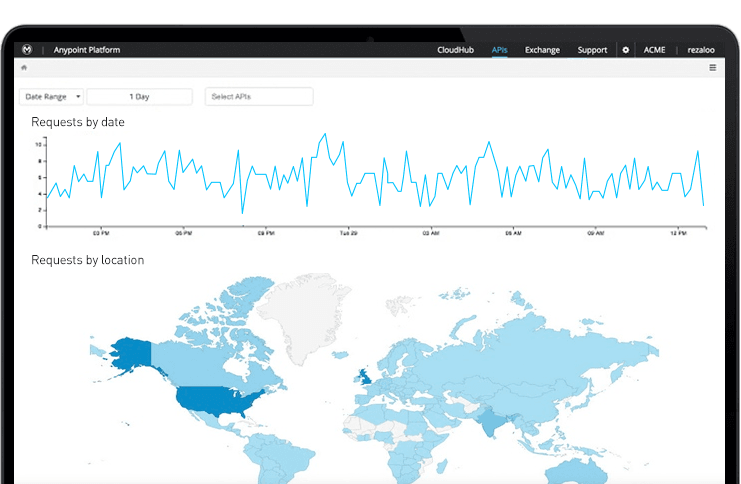
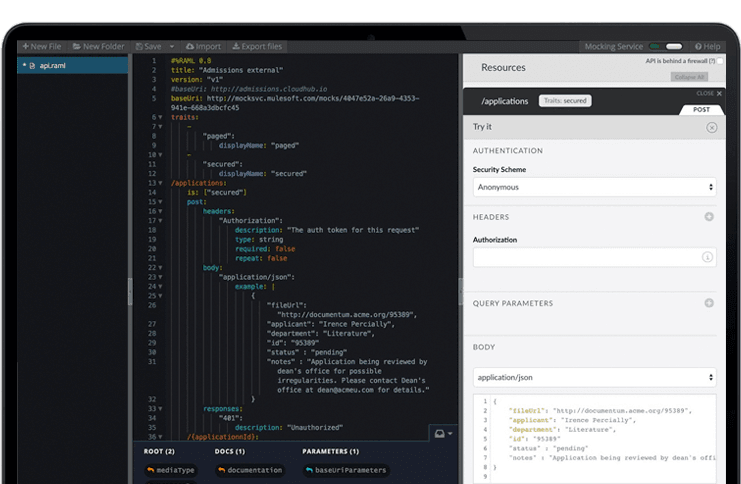
The Anypoint Platform developed by MuleSoft and acquired by Salesforce in early 2018 is designed to
connect apps, data, and devices anywhere, on-premises or in the cloud. This platform was built to
offer out-of-the-box connectors as well as tools that architects and developers can adopt quickly to
design, build and manage the entire lifecycle of their APIs, applications, and products.
N/A
Qlik Talend Cloud
Score 8.8 out of 10
N/A
The Qlik Talend Cloud suite of solutions offer data integration, data quality, application integration, and data governance that work with key data sources, targets, architectures, or methodologies to ensure business users always have trusted and accurate data.
N/A
Pricing
MuleSoft Anypoint Platform
Qlik Talend Cloud
Editions & Modules
No answers on this topic
No answers on this topic
Offerings
Pricing Offerings
Anypoint Platform
Qlik Talend Cloud
Free Trial
Yes
No
Free/Freemium Version
Yes
No
Premium Consulting/Integration Services
No
No
Entry-level Setup Fee
No setup fee
No setup fee
Additional Details
—
—
More Pricing Information
Community Pulse
MuleSoft Anypoint Platform
Qlik Talend Cloud
Features
MuleSoft Anypoint Platform
Qlik Talend Cloud
Cloud Data Integration
Comparison of Cloud Data Integration features of Product A and Product B
MuleSoft Anypoint Platform
7.0
12 Ratings
13% below category average
Qlik Talend Cloud
-
Ratings
Pre-built connectors
7.612 Ratings
00 Ratings
Connector modification
7.312 Ratings
00 Ratings
Support for real-time and batch integration
6.912 Ratings
00 Ratings
Data quality services
6.012 Ratings
00 Ratings
Data security features
6.612 Ratings
00 Ratings
Monitoring console
7.312 Ratings
00 Ratings
Data Source Connection
Comparison of Data Source Connection features of Product A and Product B
MuleSoft Anypoint Platform
-
Ratings
Qlik Talend Cloud
9.5
10 Ratings
14% above category average
Connect to traditional data sources
00 Ratings
10.010 Ratings
Connecto to Big Data and NoSQL
00 Ratings
9.09 Ratings
Data Transformations
Comparison of Data Transformations features of Product A and Product B
MuleSoft Anypoint Platform
-
Ratings
Qlik Talend Cloud
9.0
10 Ratings
11% above category average
Simple transformations
00 Ratings
9.010 Ratings
Complex transformations
00 Ratings
9.010 Ratings
Data Modeling
Comparison of Data Modeling features of Product A and Product B
MuleSoft Anypoint Platform
-
Ratings
Qlik Talend Cloud
9.0
10 Ratings
14% above category average
Data model creation
00 Ratings
9.09 Ratings
Metadata management
00 Ratings
10.09 Ratings
Business rules and workflow
00 Ratings
8.08 Ratings
Collaboration
00 Ratings
9.09 Ratings
Testing and debugging
00 Ratings
9.010 Ratings
Data Governance
Comparison of Data Governance features of Product A and Product B
MuleSoft Anypoint Platform is best tool in the market for developing APIs with complex structures communicating with various different types of applications including web applications as well as legacy applications. Also applications including database connectivity for fetching and updating data in the DB tables. I cant think of any scenario which MuleSoft Anypoint Platform could not be used for developing the integrations.
This tool fits all kinds of organizations and helps to integrate data between many applications. We can use this tool as data integration is a key feature for all organizations. It is also available in the cloud, which makes the integration more seamless. The firm can opt for the required tools when there are no data integration needs.
Talend Data Integration allows us to quickly build data integrations without a tremendous amount of custom coding (some Java and JavaScript knowledge is still required).
I like the UI and it's very intuitive. Jobs are visual, allowing the team members to see the flow of the data, without having to read through the Java code that is generated.
Has more features than what we really need so we're paying for more than we use. Sort of like paying for an Abrams tank when all we really need is a Toyota Corolla.
Not a value product, tends to be expensive.
Takes a while for developers to learn to use Mulesoft Anypoint.
There’s a lot of learning curve at the beginning when it comes to building the code and everything. In terms of usability, I’d say once you get used to it, it’s fine — but it’s not very easy during the initial stages.
We use Talend Data Integration day in and day out. It is the best and easiest tool to jump on to and use. We can build a basic integration super-fast. We could build basic integrations as fast as within the hour. It is also easy to build transformations and use Java to perform some operations.
Anypoint Platform support is very responsive. There is also a huge knowledge base and an active online forum where answers to most questions can be found. When needed support engages the engineering group so adequate solutions or workarounds are always provided.
Good support, specially when it relates to PROD environment. The support team has access to the product development team. Things are internally escalated to development team if there is a bug encountered. This helps the customer to get quick fix or patch designed for problem exceptions. I have also seen support showing their willingness to help develop custom connector for a newly available cloud based big data solution
Once we have moved all of our system integration APIs to the MuleSoft Anypoint Platform, we will need to communicate with a wide variety of external systems. All of our business and service logic is stored in the aforementioned core systems. Anypoint Platform (and all of our APIs) makes it easy to connect to various other platforms. In order to link to these many other systems, connectors and/or components are utilized, and they are simple to configure and integrate.
In comparison with the other ETLs I used, Talend is more flexible than Data Services (where you cannot create complex commands). It is similar to Datastage speaking about commands and interfaces. It is more user-friendly than ODI, which has a metadata point of view on its own, while Talend is more classic. It has both on-prem and cloud approaches, while Matillion is only cloud-based.
It’s only been a positive RoI with Talend given we’ve interfaced large datasets between critical on-Prem and cloud-native apps to efficiently run our business operations.