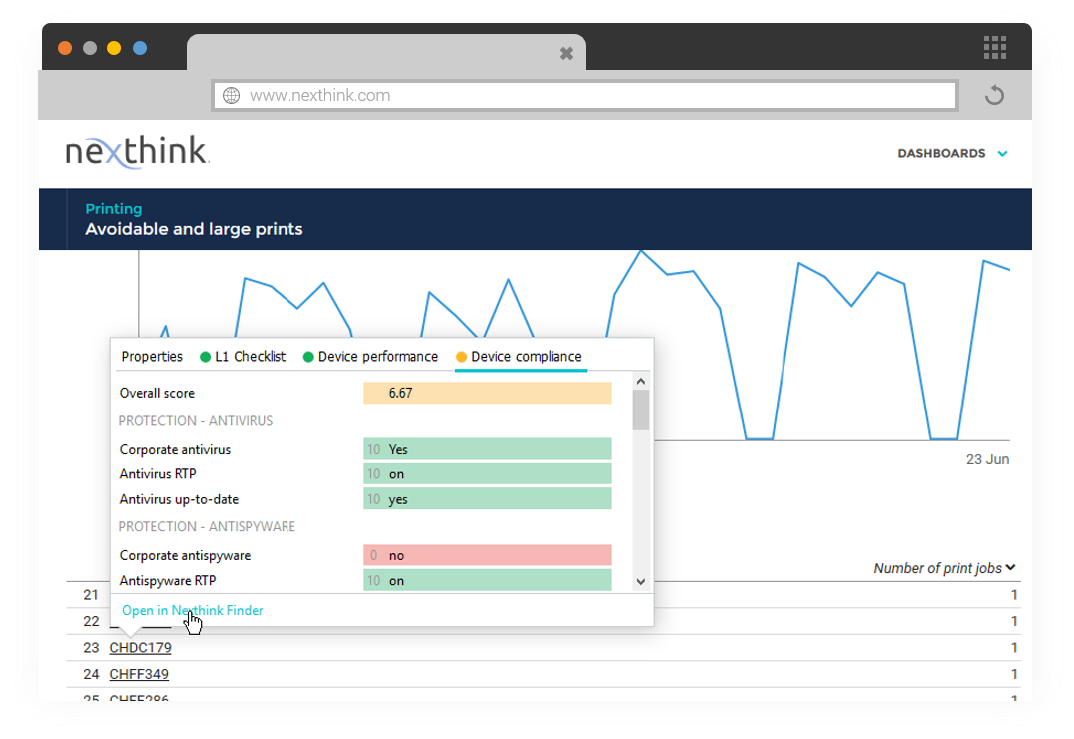
Nexthink Workplace Experience is a cloud-native platform allowing IT teams to manage the Digital Employee Experience (DEX) by providing insights across devices, applications, users, operating systems, locations and organizational units.
N/A
Red Hat Virtualization (discontinued)
Score 6.1 out of 10
N/A
Red Hat Virtualization (formerly Red Hat Enterprise Virtualization, broadly known as RHEV) is an enterprise level server and desktop virtualization solution. Red Hat Virtualization also contains the functionality of Red Hat Enterprise Virtualization for Desktop in later editions of the platform.
$999
Per Year Per Hypervisor
Pricing
Nexthink
Red Hat Virtualization (discontinued)
Editions & Modules
No answers on this topic
Standard
$999.00
Per Year Per Hypervisor
Premium
$1,499.00
Per Year Per Hypervisor
Offerings
Pricing Offerings
Nexthink
Red Hat Virtualization (discontinued)
Free Trial
No
No
Free/Freemium Version
No
No
Premium Consulting/Integration Services
Yes
No
Entry-level Setup Fee
Required
No setup fee
Additional Details
—
—
More Pricing Information
Community Pulse
Nexthink
Red Hat Virtualization (discontinued)
Features
Nexthink
Red Hat Virtualization (discontinued)
Server Virtualization
Comparison of Server Virtualization features of Product A and Product B
I've been managing desktops for 20+ years and Nexthink was the missing tool out of my toolbox. Just to give some perspective, if you were building and maintaining a house, Nexthink would be comparable to switching up from a hammer and nails and to full blown using a nailgun. Nexthink is a solution accelerator and a well thought out toolset to give you the customer experience at a glance. It allows for so much more visibility just with the default set of data points the Collector (agent) gathers, which is A LOT, and grants you the ability to gather even more data with remote actions. All of this evidence cuts how the "it could possibly be this" and "maybe it's that" discussions when you're troubleshooting an issue. It may not provide the exact answer all the time, but it gives you a "compass point" on where you need to start looking to resolve the issue. Also the service monitoring, activity monitoring, and critical event thresholds really empower the teams to know when a problem is happening and they can get ahead of it before the first call even reaches the Help Desk. Nexthink is a cornerstone tool in our environment for end user experience and I'm excited to see where the go next.
RHEV is well suited for organizations that need a cost-effective and flexible solution for their environment. As its vendor-independent software, easily install on any type of hardware. RHEV provides a GUI interface to manage the software, which makes the management of the software easier for the end-user. RHEV is best for non-production or less critical applications. RHEV can be easily integrated with other REDHAT software.
The on-premise solution can be slow at times and resource-demanding even on newer laptops. (This isn't the case with the cloud offering.)
Some useful features are only available to cloud customers.
Library pack configuration could be made easier, often these packs require some customization and it's not always clear how to get them up and running after importing.
1- RHVM API is pretty slow, especially after creating a VM it is not possible to retrieve the VM details (i.e VM's MAC Address) fast enough, where we need to place a pause in our Ansible Playbook, make the automation process slow.
2- RHV is still using collected to monitor the hypervisors which is deviating from Red Hat policy for other RHEL based applications to use PCP to monitor, which is richer in features.
3- It will be great if it is possible to patch the hypervisors using other tools such as satellite and not only via RHVM.
4- In the past Red Hat used to present patches in the z release (i.e. 4.3.z), and features in the y release (i.e 4. y), but starting from 4.4 that is mixed together wherein the Z release you get both patches and features, that is not good because that requires a lot of time to test when we patch as it includes features as well.
5- Engineering team has to be more reactive when new feature is requested.
Nexthink had better integration and a better user interface. 1E did not have the engagement capability which is so critical to many of the actions we complete using Nexthink. Nexthink had better trending data capabilities. 1E did not capture and hold data the way Nexthink does so all data assumes you are able to pull information from all systems at any time. with remote systems it is unlikely you will capture all systems at the same time so it makes any actions less effective. this review was performed 4 years ago so 1E may have addressed some of these limitations but Nexthink has also grown and continues to add and improve on their industry-leading capabilities.
RHEV is an excellent product, includes more features, is less expensive, and has rock solid reliability and is backed with the best Red Hat Support in the industry. RHEV uses KVM under the hood which is used by all the big players in the industry (AWS, Rackspace, etc) to lower their overall costs and improve efficiency and profits and that's why RHEV is an excellent solution!
SCCM proactive remediation: Automatically resolving hundreds of SCCM issues per month
Hardware: Identification of over $5m cost avoidance by seeing a lack of usage for 128GB SSDs - no need to upgrade to 256GB... coupled with OneDrive migration packs in the Nexthink library this is valuable.