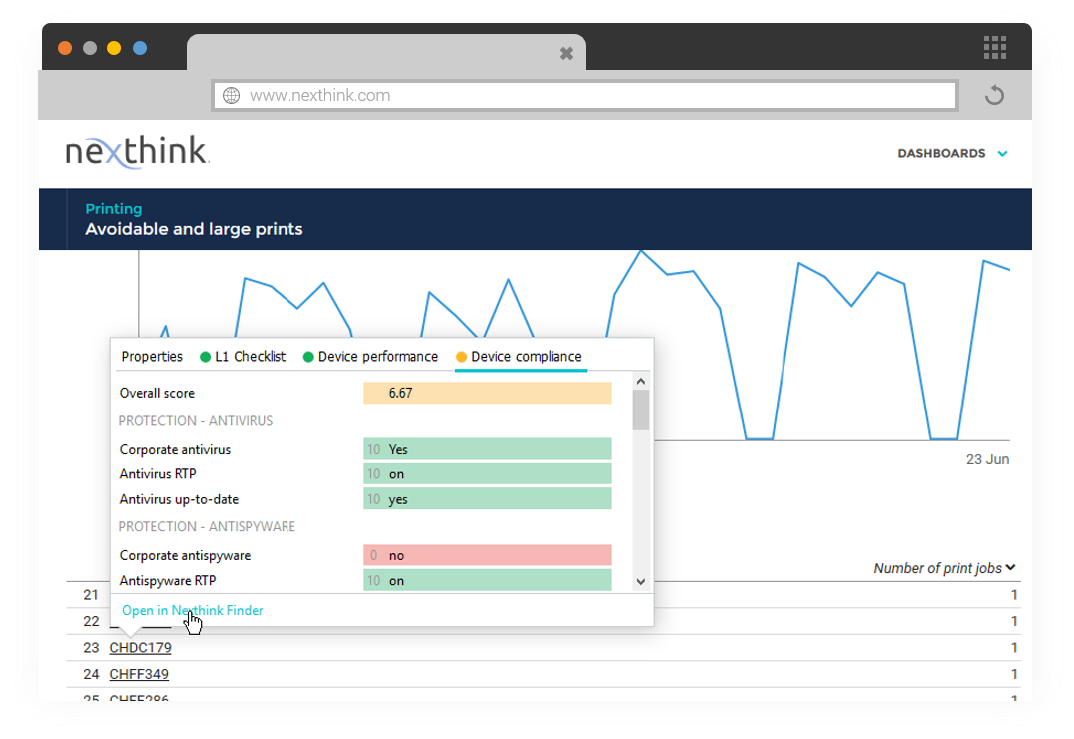
Nexthink Workplace Experience is a cloud-native platform allowing IT teams to manage the Digital Employee Experience (DEX) by providing insights across devices, applications, users, operating systems, locations and organizational units.
N/A
Request Metrics
Score 10.0 out of 10
N/A
Realtime website performance tests generated from real user experience on a website. Request Metrics gathers performance data from actual users, rather than a synthetic tests. Request Metrics is website performance monitoring, simplified for small high performance teams. There is no complicated query languages to learn or theoretical metrics to understand. The service provides reports that help keep a website running fast, and customers…
$37
per month
Pricing
Nexthink
Request Metrics
Editions & Modules
No answers on this topic
Essentials
$37
per month
Professional
$96
per month
Custom
Custom Pricing
Offerings
Pricing Offerings
Nexthink
Request Metrics
Free Trial
No
No
Free/Freemium Version
No
Yes
Premium Consulting/Integration Services
Yes
No
Entry-level Setup Fee
Required
Optional
Additional Details
—
—
More Pricing Information
Community Pulse
Nexthink
Request Metrics
Features
Nexthink
Request Metrics
Application Performance Management
Comparison of Application Performance Management features of Product A and Product B
I've been managing desktops for 20+ years and Nexthink was the missing tool out of my toolbox. Just to give some perspective, if you were building and maintaining a house, Nexthink would be comparable to switching up from a hammer and nails and to full blown using a nailgun. Nexthink is a solution accelerator and a well thought out toolset to give you the customer experience at a glance. It allows for so much more visibility just with the default set of data points the Collector (agent) gathers, which is A LOT, and grants you the ability to gather even more data with remote actions. All of this evidence cuts how the "it could possibly be this" and "maybe it's that" discussions when you're troubleshooting an issue. It may not provide the exact answer all the time, but it gives you a "compass point" on where you need to start looking to resolve the issue. Also the service monitoring, activity monitoring, and critical event thresholds really empower the teams to know when a problem is happening and they can get ahead of it before the first call even reaches the Help Desk. Nexthink is a cornerstone tool in our environment for end user experience and I'm excited to see where the go next.
Request Metrics is great for small web development teams that want to make fast web applications. It was quick for us to get started and we could use the reports right away without having to read through documentation. If you just need to get some performance metrics, Request Metrics is perfect. It would not be so good for a larger team or a complex backend application as it is pretty limited in what it can measure.
The on-premise solution can be slow at times and resource-demanding even on newer laptops. (This isn't the case with the cloud offering.)
Some useful features are only available to cloud customers.
Library pack configuration could be made easier, often these packs require some customization and it's not always clear how to get them up and running after importing.
Nexthink had better integration and a better user interface. 1E did not have the engagement capability which is so critical to many of the actions we complete using Nexthink. Nexthink had better trending data capabilities. 1E did not capture and hold data the way Nexthink does so all data assumes you are able to pull information from all systems at any time. with remote systems it is unlikely you will capture all systems at the same time so it makes any actions less effective. this review was performed 4 years ago so 1E may have addressed some of these limitations but Nexthink has also grown and continues to add and improve on their industry-leading capabilities.
We also consider Speedcurve and Calibre for monitoring. Speedcurve was really nice, but the reports were slow. We had to wait a lot to get information. It was also out of our budget and would require extra justification to use it. Calibre was also nice, but the numbers were based on synthetic rather than real user performance. We felt that this wasn't as helpful for us.
SCCM proactive remediation: Automatically resolving hundreds of SCCM issues per month
Hardware: Identification of over $5m cost avoidance by seeing a lack of usage for 128GB SSDs - no need to upgrade to 256GB... coupled with OneDrive migration packs in the Nexthink library this is valuable.