Oracle's Corporate Performance Management suite was acquired from Hyperion in 2007. Hyperion customers are encouraged to migrate to Oracle Fusion Cloud EPM.
N/A
Sage 100cloud
Score7.2 out of 10
Small Businesses (1-50 employees)
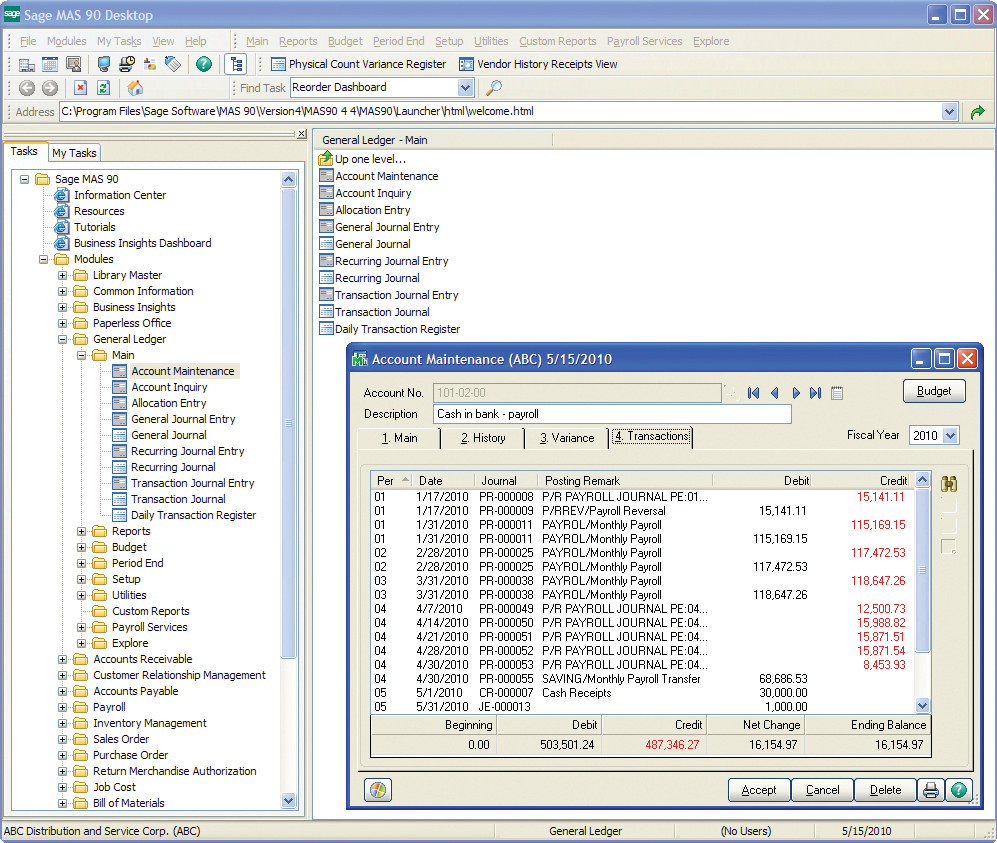
Sage 100 (or Sage 100cloud is a business management software offering a broad range of modules designed to meet the many needs of virtually any business. It encompasses financial operations and accounting, payroll, business intelligence, CRM, eBusiness, manufacturing and distribution.
Well suited: For use in multiple offices around the world. I was able to obtain financial reporting data from 5 foreign offices and then consolidate their data with 3 domestic USA offices to prepare a consolidated financial statement. Less Appropriate: Translating the financial value for consulting services could be a bit challenging because that required human interaction and judgement. It would have been great to be able to set up some software to be able to interpret this and let it run for all future project work revenue projection.
A de minimis incentive was given to thank the reviewer for their time. The incentive was not used to bias or drive a particular response, nor was the incentive contingent on a positive endorsement. TR verified that a representative sample of customers was invited. More Info
Sage 100 has been well suited for running the monthly accounts receivable and accounts payable aging reports. This helps us track our accounts that need to be collected and payments that need to be made. Our field operations team has been slow and unwanting to adopt the Sage Field Ops just because they're resistant to change and technology. It's less appropriate for really detailed accounting reports spanning for long periods of time with all accounts because it takes a very long time to run and process.
A de minimis incentive was given to thank the reviewer for their time. The incentive was not used to bias or drive a particular response, nor was the incentive contingent on a positive endorsement. More Info
This product handles budgeting by Employee and/or Position very well. It is highly flexible and allows Hyperion administrators the ability to develop a planning application that fits a variety of different business needs.
It is great at calculating benefits using business rules to automate the population of these fringe costs in the overall budget planning process. This greatly reduces user error.
It allows you to seed the operating budget based on changes to key drivers, such as percentage increases, flat dollar increases and more detailed changes using business rules.
Allows visibility into the plans for each unit across the organization, rolled up into an overall budget for the campus.
It handles the creation of budgets with multiple chartfield segments or dimensions, which most other budgeting systems cannot handle well. It can aggregate these very quickly.
A de minimis incentive was given to thank the reviewer for their time. The incentive was not used to bias or drive a particular response, nor was the incentive contingent on a positive endorsement. More Info
A de minimis incentive was given to thank the reviewer for their time. The incentive was not used to bias or drive a particular response, nor was the incentive contingent on a positive endorsement. More Info
One pain point for us is the consolidation and translation process. Needing to translate the data over and over again is frustrating and there is no visibility into how many users are running a translation. If multiple users attempt to translate the same data set, say goodbye to your performance but you have no way of knowing! (Unless you want to pull up a task audit which is not a very realistic expectation). It has the been the quickest way for us to bring the system to it's knees. The consolidation process performs in direct correlation to the complexity of the calculation/consolidation rules. So, while the product is extremely flexible, you still have to be careful how you design your rules and calculations to make sure that you do it on the smallest subset of data as possible to avoid large processing times. This makes sense, but requires some significant expertise that most organizations do not have in-house.
The Hyperion Financial Reporting product is ridiculously outdated and clunky to use. The interface for designing reports is not intuitive, and not easy to modify once a report is built. I think there must be a strategic decision to move away from it and go to something more like Oracle BI because I just can't understand why in the world they don't update the reporting product. It also requires a significant level of expertise to be able to use. Not a great solution at all if you want multiple end-users to create reports in something other than Excel. Nobody except the HFM admin (which I used to be) in our company even touches this module.
Another pain point is the amount of IT support that is required to run this thing, and again, specialized knowledge of Hyperion products and how they work is required for IT to adequately support it. This goes for application servers and the Oracle database that the applications are running on.
Sage 100 at times will simply not connect to our server, we get remote support & all is well but, that issue tends to happen 2-3X a year.
Other than the above, I really can't complain. Coming from a more custom U.V. type database that used a whole bunch of codes to navigate, I think Sage 100 is 10x easier to use.
A de minimis incentive was given to thank the reviewer for their time. The incentive was not used to bias or drive a particular response, nor was the incentive contingent on a positive endorsement. More Info
We're in the middle of the road because we are not sure that other products on the market fit the bill for what we need yet. Hyperion is expensive and burdensome from an administrator and maintenance standpoint, but it still seems to be the best solution for what we need. Show us an equally capable SaaS consolidation product and we'll talk again.
I would put this out to bid, if I were at the same organization. There have been a lot of improvements and changes in enterprise software and my preference would be to find a good web-based or cloud-based tool. Lower overall cost of ownership and improved efficiency would be my target criteria for a rebid of this.
A de minimis incentive was given to thank the reviewer for their time. The incentive was not used to bias or drive a particular response, nor was the incentive contingent on a positive endorsement. More Info
Overall Sage 100 has been pretty user friendly. If we have a question on anything, we are able to contact our implementation rep who helps us right away. Some of the Sage Field Operations may not be as intuitive for our field personnel to use. I wish the reports ran faster so that we could run and put together many reports quickly at once.
A de minimis incentive was given to thank the reviewer for their time. The incentive was not used to bias or drive a particular response, nor was the incentive contingent on a positive endorsement. More Info
The premium support team provides much needed dedicated customer service which we are after for what we have paid for this service. We are satisfied with the service and support and do not have any instance where there was an issue that requires escalation to get the right support team. Though the incidence of major issues that requires the premium support are less, we prefer to keep this as a safety net.
A de minimis incentive was given to thank the reviewer for their time. The incentive was not used to bias or drive a particular response, nor was the incentive contingent on a positive endorsement. More Info
A de minimis incentive was given to thank the reviewer for their time. The incentive was not used to bias or drive a particular response, nor was the incentive contingent on a positive endorsement. More Info
We had an advantage in implementing the tool in that our director of Ops had been part of the team implementing the ERP for other users so we knew what to expect and were able to avoid a lot of the challenges people sometimes face with implementations. However, the process still took far longer than desired.
A de minimis incentive was given to thank the reviewer for their time. The incentive was not used to bias or drive a particular response, nor was the incentive contingent on a positive endorsement. More Info
I use Oracle Hyperion Enterprise Performance Mangement because the company I work at requires me to use it in the Financial Planning sector as most of their data is stored in it. I am open minded and ready to use other performance management tools created by Oracle if my work permits.
A de minimis incentive was given to thank the reviewer for their time. The incentive was not used to bias or drive a particular response, nor was the incentive contingent on a positive endorsement. TR verified that a representative sample of customers was invited. More Info
I didn't choose Sage 100 ERP -- it was already in use when I started at the organization over five years ago. It has the same types of pros and cons as other big hulking software suites meant to power the infrastructure of corporations. It's slow, tough to customize, and doesn't connect well with other software. It does bring all the information into one place, which is great
A de minimis incentive was given to thank the reviewer for their time. The incentive was not used to bias or drive a particular response, nor was the incentive contingent on a positive endorsement. More Info
Oracle Hyperion allows us to automate and consolidate financial data that used to be performed manually in spreadsheets. From that perspective the ROI is huge.
Oracle Hyperion functionality is extensive and allows us to perform most functions for planning, consolidating and reporting on our financial data.
One negative with Oracle Hyperion is that it is complicated to implement and maintain. It takes expertise at all levels (infrastructure and management) to realize the benefits from it.
A de minimis incentive was given to thank the reviewer for their time. The incentive was not used to bias or drive a particular response, nor was the incentive contingent on a positive endorsement. More Info
Sage 100 overall had a very positive overall ROI for the business. All users were making decisions based on the same information and valuable time was no longer spent trying to analyze data from a number of sources.
Moving the warehouses to using Sage 100 reduced the operating expense of the distribution side of the business by 5% on an annual basis (~$100K).
A de minimis incentive was given to thank the reviewer for their time. The incentive was not used to bias or drive a particular response, nor was the incentive contingent on a positive endorsement. More Info