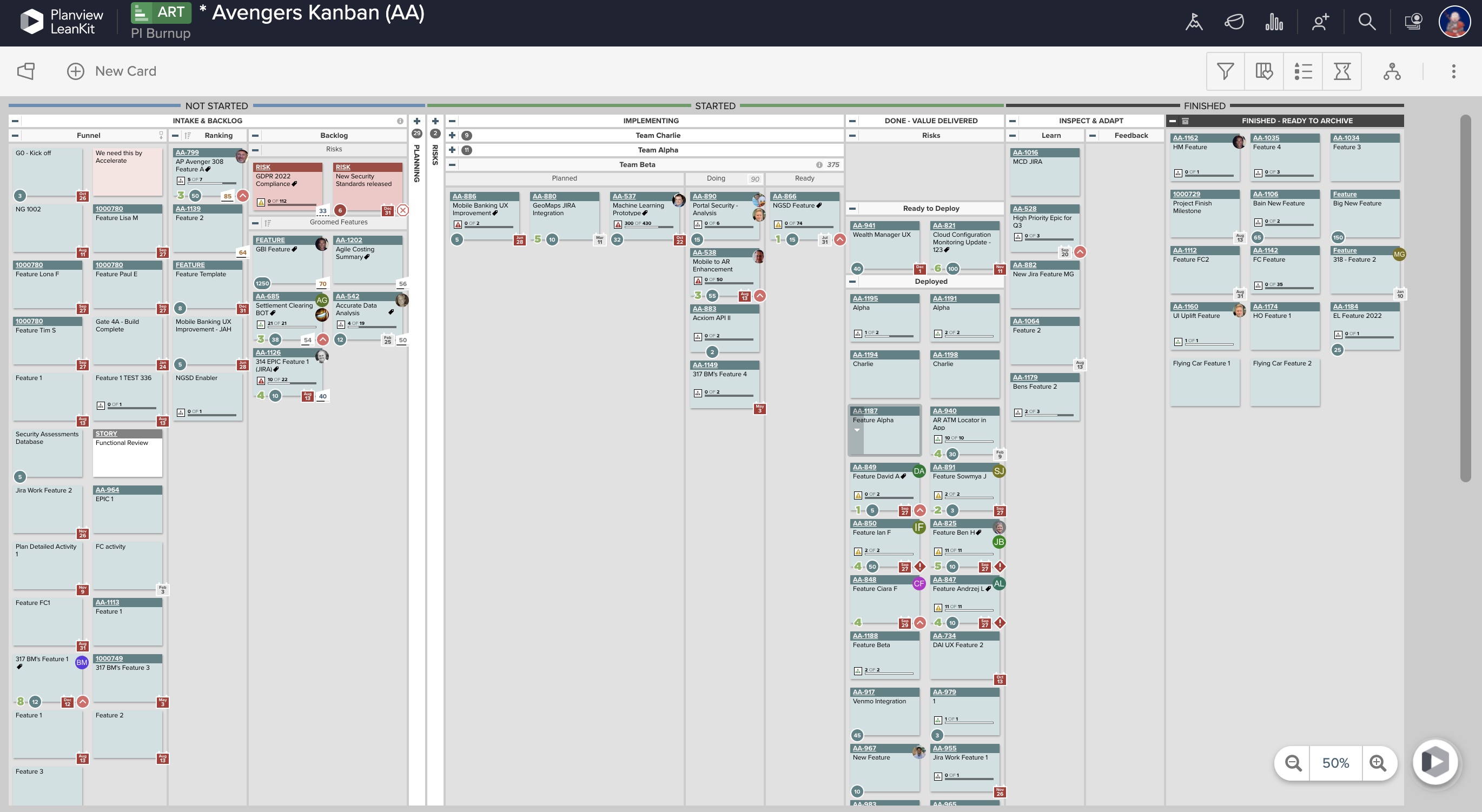
AgilePlace is a project management solution built around flexibility, data-driven analytics, and workflow automation. The software was acquired by Planview in December 2017 to expand that company's capabilities.
$19
per user, per month
Polarion ALM
Score 9.9 out of 10
N/A
Polarion ALM is an application requirement management software platform now owned and supported by Siemens since the 2015 acquisition. It is available on the cloud (Polarion X) and on-premise. Polarion connect teams and projects to improve application development processes with
a single, unified solution for requirements, coding, testing and release.
$42
per month per user
Pricing
Planview AgilePlace
Polarion ALM
Editions & Modules
Teams
$19
per user, per month
Scaled Teams
$29
per user, per month
Custom
Contact Sales for Quote
per user, per month
Polarion X Base
$42
per month per user
Polarion ALM
Contact Sales
one or more years per user/concurrent
Polarion Requirements
Contact Sales
one or more years per user/concurrent
Polarion QA
Contact Sales
one or more years per user/concurrent
Offerings
Pricing Offerings
Planview AgilePlace
Polarion ALM
Free Trial
Yes
Yes
Free/Freemium Version
No
No
Premium Consulting/Integration Services
No
Yes
Entry-level Setup Fee
No setup fee
Optional
Additional Details
All editions include unlimited boards.
—
More Pricing Information
Community Pulse
Planview AgilePlace
Polarion ALM
Features
Planview AgilePlace
Polarion ALM
Project Management
Comparison of Project Management features of Product A and Product B
Planview AgilePlace
7.4
25 Ratings
2% below category average
Polarion ALM
-
Ratings
Task Management
10.025 Ratings
00 Ratings
Resource Management
9.921 Ratings
00 Ratings
Gantt Charts
10.014 Ratings
00 Ratings
Scheduling
9.919 Ratings
00 Ratings
Support for Agile Methodology
9.220 Ratings
00 Ratings
Support for Waterfall Methodology
4.014 Ratings
00 Ratings
Document Management
6.57 Ratings
00 Ratings
Email integration
7.419 Ratings
00 Ratings
Mobile Access
2.114 Ratings
00 Ratings
Timesheet Tracking
6.44 Ratings
00 Ratings
Change request and Case Management
7.19 Ratings
00 Ratings
Visual planning tools
7.39 Ratings
00 Ratings
Agile Development
Comparison of Agile Development features of Product A and Product B
This tool enables the visual management needed in many offshore teams to easily and quickly see the pending work, work in progress and completed work.For teams that work with a waterfall methodology and do not have AGILE internalized, I believe there are other solutions from Planview or other providers.
The question is actually not trivial to answer in 200 words. To summarize, I can say that we have had consistently positive experiences with all customers where we have used Polarion ALM. The sector in which the customer operates only played a subordinate role. We use Polarion ALM in almost all sectors: Medical technology, pharmaceuticals, aerospace, agriculture, automotive and many others. It is also interesting to note that in the beginning we were mostly active in the development of products, systems or software. Over time, this has changed more and more for some customers and risk management or projects for lessons learned have taken up more space. This enabled us to banish a seemingly endless number of Excel lists. Who doesn't know this problem: at first there is only one Excel list on the drive. Day by day there are more. Some with a date in the file name. Others with an employee abbreviation. In the end, nobody can tell which is the current and complete list. The really good thing about Polarion ALM is that it is extremely flexible to use and the configuration determines what the project is used for in Polarion ALM. It is customizable to my situation and not rigid.
Polarion ALM provides a centralized repository for capturing and managing requirements. Teams can define, organize, and link requirements to other artifacts like test cases and development tasks.
Test Management:
Polarion ALM facilitates end-to-end test management. Teams can create detailed test cases, manage test execution, and track test results.
Traceability and Impact Analysis:
Polarion ALM ensures traceability across all phases of the development lifecycle. Users can establish links between requirements, test cases, development tasks, and other artifacts. This traceability helps in impact analysis, allowing teams to understand how changes in one area may affect other parts of the project.
Customization and Adaptability:
Polarion ALM is highly customizable to fit the unique needs of different organizations and industries. Users can create custom workflows, define custom fields, and adapt the tool to their specific development processes.
Ability to add more than 1 visual cue to the card. We use custom icons and sometimes more than 1 is appropriate but you have to choose which is most important since only 1 can be applied.
Better visibility to board access from the user administration screens. Currently have to run 1-2 reports to see this information. Would like to be able to click on a user within Configure Users and see what boards they have access to quickly.
More robust engine as far as the actual took is concerned. There are navigation components in trace to reporting which we feel can be improved especially when dealing with cross global accessing of the tool. It slows us down a bit so it's backend driven optimization as well as some front end "clunkiness" that can be improved.
Improve some filtering capabilities especially in creating custom reports and generally all around the ALM components of the tool.
As of the version we have, the ability to enhance replationship types in traceability is limited.
There is too much at stake to go into a new system. But with everything else being promised as far as newer more innovative products, the justification to not renew is a huge risk so that is not a concern
LeanKit isn't the best designed Kanban system I've seen, but overall it's pretty usable. The boards I've used are pretty complex, so it can be difficult to find things. I found that searching and filtering for specific cards was somewhat of a challenge. Dragging a card from one lane to another is kind of a fun way to get things done though.
Polarion ALM can be used individually and what I do with Polarion ALM is decided by my configuration. Lesson-learned, operational risk management, product, system or software development or customer management .... doesn't matter at all. I decide with my configuration what I will do with Polarion ALM. Of course, you can also use Polarion ALM out-of-the-box for your development because it comes with a large set of project templates.For this reason, I would also recommend not to just get started. A suitable consultant will show you the right templates and customize them according to your needs. Having Polarion ALM is like having a car. You know exactly how to operate the car. You've done it a thousand times before. The details are in the configuration: did I have a navigation system installed or not? Do I have a lane departure warning system or not? Do I have cruise control or not? Unlike when buying a vehicle, almost all functions are already available and can be used, usually at no extra cost. However, if something is missing, it can be obtained via the manufacturer's extension portal. Individual extensions are subject to a charge. Polarion ALM - easy to deploy and easy to use.
Every time I have reached out to the AgilePlace support team I have received a timely response in addition to professional & personal feedback. Their consultants are knowledgeable and the management team is happy to jump in and help when needed.
Originally, we had evaluated two other tools next to Planview LeanKit: Kanbantool and Kanbanflow. The latter was a close contestant for productive use, as it was also very customizable and a joy to work with and look at. It also had lower user fees and a mobile integration. In the end, we picked Planview LeanKit because of several reasons: Aesthetics: The look was much more clean and professional. Reporting: It was obvious from the start that we could use Planview LeanKit as a tool for improvement. API: We needed to integrate the Kanban into our central systems and Planview LeanKit API was (and still is) a way to do it. Card Headers: This sounds like a simple thing, but the headers above the titles fit our work perfectly and looked perfect, which helped the decision.
Polarion ALM has the best usability, extensibility and reactiv product management. The support is also very good compared to other companies. Or in other words it is closer to the customer. Codebeamer is for sure also a good ALM tool with a great feature set, but existing customers are often neglected. We will see, what PTC as the new owner of codebeamer will change at this point.