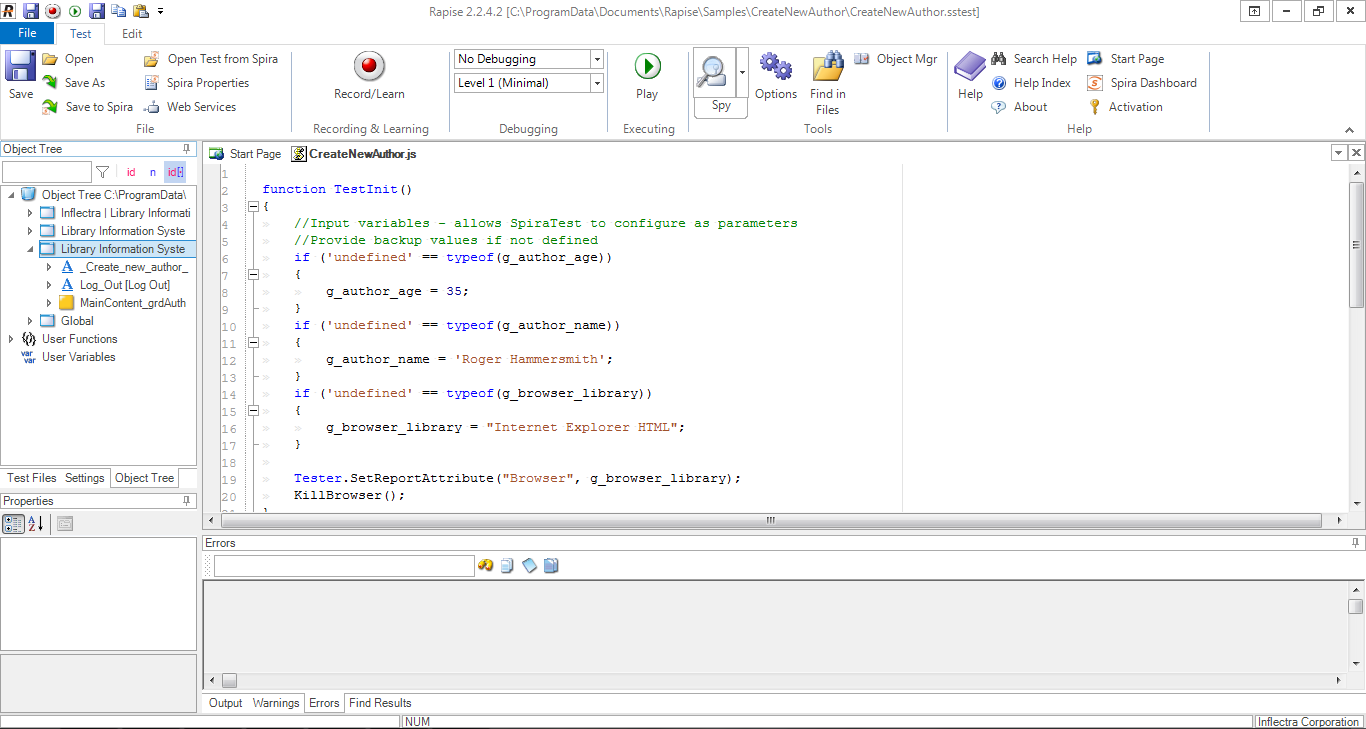
Rapise is a software testing platform that allows users to regression test web, desktop and mobile applications. Some key features include: Playback of Tests, Test Script Editing and Data Driven Testing.
$324
per month (1 license)
Selenium
Score 8.3 out of 10
N/A
Selenium is open source software for browser automation, primarily used for functional, load, or performance testing of applications.
N/A
Tidal by Redwood
Score 6.7 out of 10
N/A
Tidal Automation, from Redwood Software since the early 2023 acquisition, is an enterprise workload automation platform for automating and orchestrating cross-application, cross-platform workloads – in on-prem, cloud or hybrid environments – from one central point of control. Tidal is used to optimize mission-critical business processes, manage…
N/A
Pricing
Rapise
Selenium
Tidal by Redwood
Editions & Modules
No answers on this topic
No answers on this topic
No answers on this topic
Offerings
Pricing Offerings
Rapise
Selenium
Tidal by Redwood
Free Trial
Yes
No
No
Free/Freemium Version
No
No
No
Premium Consulting/Integration Services
No
No
No
Entry-level Setup Fee
No setup fee
No setup fee
No setup fee
Additional Details
Discount available for annual billing (up to 10%).
The main reason for choosing Rapise was that the other two options that we had tried at that time only served us for web applications and with Rapise we have greater versatility without changing the solution. In addition to the compatibility with other libraries that are …
The appropriate scenario to use Rapise is when we have a project that is considered from medium onwards, since Rapise will help us to define, develop and implement the testing phase in a reliable and efficient way. Also with Rapise we will not have to worry about the platform that we are using since it has great versatility and flexibility.
When you have to test the UI and how it behaves when certain actions are performed, you need something that can automate the browsers. This is where Selenium comes to the rescue. If you have to test APIs and not the frontend (UI), I would recommend going with other libraries that support HTTP Requests. Selenium is good only when you have no choice but to run the steps on a browser.
On coming to well suited experience while error handling and effortless recovery processes are crucial, Tidal performs exceptionally well. It can identify and fix automated issues, reducing downtime and interruptions. A smaller automation solution may be more cost-effective if a business primarily utilizes a single platform or uses a small number of applications that do not require complex integration.
Tidal Automation allows us to automate and schedule/ perform various tasks in a easy and effective manner. It is highly interactive and effective allowing nearly 4k -5k jobs to run a day.
Tidal is designed to be easily shareable and collaborative allowing multiple users to work at a particular time making work effective.
Tidal allows us to ensure that every event which is triggered is exactly when it's supposed to be regardless of other activities which are going as well.
It is user-friendly to generate the reports required of a particular object and allows us to test the codes perfectly well before executing in live environment.
For tests that require specific approaches it is necessary to have advanced knowledge of programming in javascrip, which sometimes the QA team does not have experience
Sometimes I have noticed that when using object dragging errors occur intermittently
The integration with some tools (Dynamics) is only with the basic functions from my point of view
Selenium is pretty user-friendly but sometimes tests tend to flake out. I'd say roughly one out of twenty tests yields a false positive.
Selenium software cannot read images. This is a minor negative because a free plug-in is available from alternate sources.
Slowness may be a minor factor with Selenium, though this is an issue with basically any testing software since waiting on a site to execute JavaScript requires the browser to wait for a particular action.
Still a bit slow when navigating. If you close a job you have to wait a few seconds to open another one. Even when you made no changes.
When viewing a job and make no changes, the "ok" button changes the last modified date as if you made a change. No big deal, but wastes time when troubleshooting a problem and looking into what jobs were changed last.
You can see the parameters column in the "job activity", but not in "Job definitions".
Can't search the parameters field in the filter.
Changing a variable name does not change it on the job. It still works because Tidal Automation uses the ID number. It just causes confusion when you see a variable on a job and can't find the variable under "Variables". On top of that, Tidal Automation does not show the ID column under "Variables" making it even more difficult to find the variable.
We love this product mainly because of its high customization abilities and the ease of use. Moreover, its free and can be learned easily through online communities and videos. The tests are more consistent and reliable as compared to Manual tests. It has enabled us to test a large number of features all in one go, which would have impossible through manual tests. The reports generated at the end of the tests are really helpful for the QA and the development teams to get a fair view of the application.
We are on the fence. The increased pricing for renewals is staggering. With new automation options like Microsoft's Power Automate and Event Driven Ansible on the field, there are other options now available.
For those who are unfamiliar with coding, there is a bit of a learning curve. There is plenty of helpful documentation and resources but it can take a little time to get the software up and running. Once you get the hang of how Selenium works, and what it can do, you realize how many things you can use it for, and how many processes you can automate.
The Selenium app has a pretty fat community of users. For the problems we are experiencing, we are primarily receiving support from these communities. In addition, there is widespread service support. Instant support is given to the problems we experience when we need Online support. We and our team are happy to provide this support, especially before important deployment processes
We did everything we needed to use it. Now we can execute our tests on different operational systems and browsers running few tests simultaneously. We also implemented Appium framework to execute our tests on mobile devices, such as iPhones, iPads, Android phones and tablets. We use SauceLabs for our test execution and Jenkins for continuous integration.
Having provided consulting services for years on Tidal by Redwood, I recommend going with a solutions partner or consultant to deploy it. I believe there are sizing and tuning guidelines that should be followed for environments of scale. I believe they are not critical when first lighting up the product, but if you are not aware of them you will encounter performance degradation after a few thousand job objects are added.
At the time of adoption, there were not many other alternatives that were even close to being competitive when it comes to browser testing. As far as I know now to this day, there is still little competition to Selenium for what it does. Any other browser-based testing still utilises Selenium to interact with the browser.
1. Tidal is good at processing large volume pf data and is cost effective. 2. Tidal can automate the scheduling of production objects, ensure that materials are delivered on time 3. Tidal Process large volumes of data which cannot be done everyday by running codes/scripts manually which does it with ease when required.
The primary objective of the institution is a service to the public, so everything that improves response times to the public helps us to achieve it.
As a department in charge of the development of systems and applications, our objective is fulfilled by delivering quality products and tools such as Rapise help us greatly
The return on investment can be more than justified by fulfilling the primary objectives