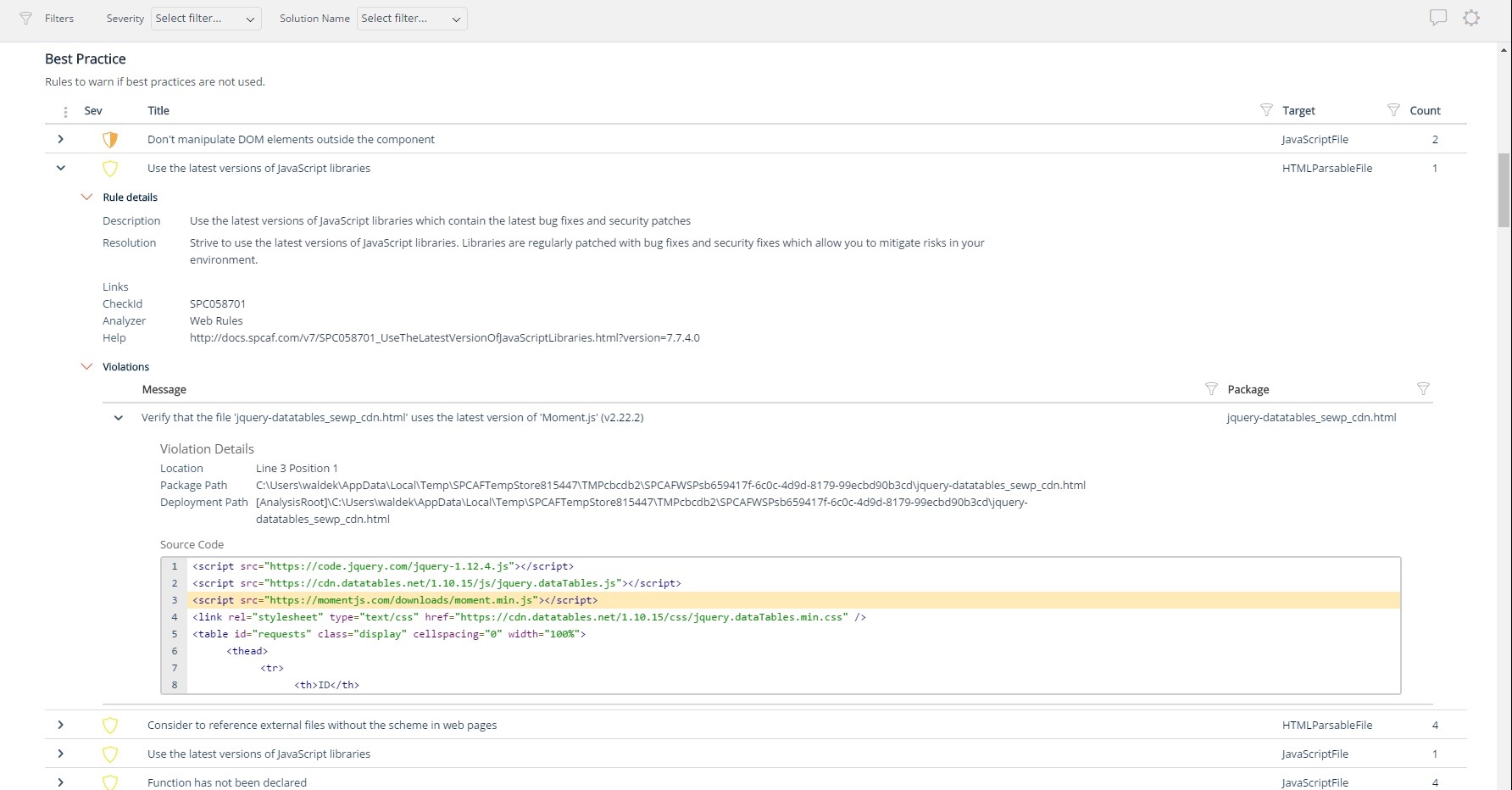
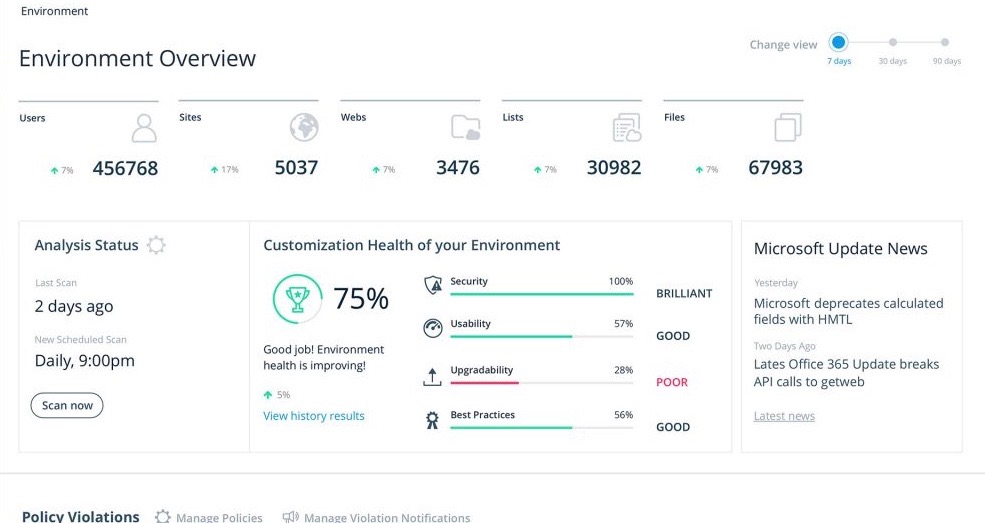
Many organizations that use Office 365 are exposed to security risks that they are unaware of. As they extend SharePoint to meet their business needs, they build applications using technologies that range from end-user Microsoft Flow to developer-focused SharePoint Framework. Unfortunately, all of these custom applications are capable of circumventing the security measures organizations have in place exposing the organization and its data to security…
N/A
SAP Access Control
Score8.8 out of 10
N/A
SAP Access control streamlines the process of managing and validating user access to applications and data with minimal support from IT, with the goal of giving employees the applications and services they need without exposing data and processes to unauthorized use.
For Microsoft shops that are doing custom development on the Microsoft cloud platform in Office 365 and Azure, the Rencore toolset is an absolute must, especially if you are involved in converting farm solutions to cloud, or just moving into cloud development for the first time.
Appropriate for SAP hrs hierarchy integration and can have multiple hierarchies of org structures adopted as alternative workflow support. Cons of access control are the logs of firefighter usage are still limited in depth and does not evolve to adop more cloud products which are coming at a plaster pace than the ac product as such.
Unique expert knowledge of their target platforms. Not many companies have such a unique position in their target market. Their employees have a deep understanding of SharePoint, Office 365 and Azure and also regularly advise Microsoft on these matters.
Community involvement and contribution to open source projects. Key employees at Rencore are considered thought leaders in their area of expertise and contribute to high profile Microsoft open source initiatives.
Rencore's unique position when it comes to code quality analysis in the SharePoint space sets it apart. There's really no alternative.
Platform governance is another Rencore strength. No other product provides the insights into your SharePoint Online environment with full auditing of not only configuration changes but also who changed which code where and when. Again no alternatives exist.
SAP Access Control ensures that our services are accessed by the right users since it send me alerts when an employee tries to access any application. That way, I am able to either authorize or cancel the request to safeguard of company data.
With SAP Access Control, it is easy to automate and monitor how our team access services and applications. SAP Access Control has an automatic feature that notifies me when employees access applications and services and the issues they are encountering.
In addition, SAP Access Control add security on employees login to ensure that their data on the applications are encrypted to never leak to cyber attackers.
A de minimis incentive was given to thank the reviewer for their time. The incentive was not used to bias or drive a particular response, nor was the incentive contingent on a positive endorsement. More Info
Rencore's product line is of course still a bit of a niche: SharePoint code quality is not something every organization on the planet is concerned with - although Rencore does much more than that.
We feel Rencore's marketing efforts are mainly targeted at technologists. There's a lot of other potential, especially for their platform governance product.
A de minimis incentive was given to thank the reviewer for their time. The incentive was not used to bias or drive a particular response, nor was the incentive contingent on a positive endorsement. More Info
This is a great tool for a medium to large sized company. SAP Access Control requires a great deal of SAP knowledge to use, but it is certainly information that can be learned. Their customer support is wonderful and easy to work with. The overall usability is great. I greatly recommend this software.
A de minimis incentive was given to thank the reviewer for their time. The incentive was not used to bias or drive a particular response, nor was the incentive contingent on a positive endorsement. More Info
This product fulfills all our requirements. We can use this for user management, role management, risk analysis, business role management, workflow management. Initial configuration takes a lot of effort. Otherwise it's a great product for the end user. SAP Access Control tool performance needs improvement, sometimes it slows down the processing time for requests.
A de minimis incentive was given to thank the reviewer for their time. The incentive was not used to bias or drive a particular response, nor was the incentive contingent on a positive endorsement. More Info
I don't know of any products that compete in the space and if there were any, they would not stand a chance against Rencore. Behind any good product is a team of highly skilled individuals, who all have the same goal, who are passionate what they do and lastly, are in it for the betterment of where they started; As Developers themselves. You can't buy that
Pricing was higher for the cloud version of the BTP service - IAG. SAP Access Control pretty much facilitates everything we are looking for as an enterprise with an efficient dollar cost ROI for the services we are looking for. Also, there were many features on the cloud version which came bundled with the license and we had to pay for them even though we did not actually use these products.
A de minimis incentive was given to thank the reviewer for their time. The incentive was not used to bias or drive a particular response, nor was the incentive contingent on a positive endorsement. More Info
The clear impact was the amount of time saved code reviewing or going through lines of code marked off by other tools that are not relevant. We cannot put a number on it since the project started off with the tool in place but based on the rules applied it could be as high as 20% of the project time.
Reducing risk of fraud. Implementing SAP Access Control allows analysis of every role assigned to a job on the organization. Through this analysis, weakness on roles are detected, corrected and monitored. As the users feel the change, they also feel that they are being monitored, preventing any intent to use his position and privileges to take personal advantage. So a major impact to organizations is to reduce the financial lost due to frauds.
Reducing cost for monitoring. Another positive impact is lowering the cost of monitoring. This is twofold: First, a rather small team can manage access management. Second, through the use of SAP Access Control the complete universe of roles and users can be monitored without increasing the cost for the continuous monitoring.
During transactions. The use of SAP Access Controls allows detection of transactions that, from an information security point of view, require some redesign. When SAP GCR is implemented, you make some discoveries such as: obsolete transactions, transactions with no authorization objects and the like. The transactions with these problems can be left out of the active roles, waiting for remediation of the issues found.
A de minimis incentive was given to thank the reviewer for their time. The incentive was not used to bias or drive a particular response, nor was the incentive contingent on a positive endorsement. TR verified that a representative sample of customers was invited. More Info