SAP Data Intelligence is presented by the vendor as a single solution to innovate with data. It provides data-driven innovation in the cloud, on premise, and through BYOL deployments. It is described by the vendor as the new evolution of the company's data orchestration and management solution running on Kubernetes, released by SAP in 2017 to deal with big data and complex data orchestration working across distributed landscapes and processing engine.
N/A
Snowflake
Score 8.7 out of 10
N/A
The Snowflake Cloud Data Platform is the eponymous data warehouse with, from the company in San Mateo, a cloud and SQL based DW that aims to allow users to unify, integrate, analyze, and share previously siloed data in secure, governed, and compliant ways. With it, users can securely access the Data Cloud to share live data with customers and business partners, and connect with other organizations doing business as data consumers, data providers, and data service providers.
N/A
Pricing
SAP Data Intelligence
Snowflake
Editions & Modules
No answers on this topic
No answers on this topic
Offerings
Pricing Offerings
SAP Data Intelligence
Snowflake
Free Trial
Yes
Yes
Free/Freemium Version
No
No
Premium Consulting/Integration Services
Yes
No
Entry-level Setup Fee
Optional
No setup fee
Additional Details
—
—
More Pricing Information
Community Pulse
SAP Data Intelligence
Snowflake
Considered Both Products
SAP Data Intelligence
Verified User
Professional
Chose SAP Data Intelligence
Since we are big on SAP ecosystem products in our IT landscape, it was natural for us to find a best possible solution from SAP product suite. However, we still explored the products available from Informatica product portfolio, we found using SAP Data Intelligence more prudent …
While Snowflake is more open to cloud eco system, SAP integrated well with SAP eco system products like SAP ECC or SAP S/4. So for people who have invested heavily in SAP eco system including SAP ECC or S/4, it makes sense to go with SAP DWC which is also evolving very rapidly. …
If you have an SAP products ecosystem in your IT landscape, it becomes a no-brainer to go ahead with an SAP Data Intelligence product for your data orchestration, data management, and advanced data analytics needs, such as data preparation for your AI/ML processes. It provides a seamless integration with other SAP products.
Snowflake is well suited when you have to store your data and you want easy scalability and increase or decrease the storage per your requirement. You can also control the computing cost, and if your computing cost is less than or equal to 10% of your storage cost, then you don't have to pay for computing, which makes it cost-effective as well.
Snowflake scales appropriately allowing you to manage expense for peak and off peak times for pulling and data retrieval and data centric processing jobs
Snowflake offers a marketplace solution that allows you to sell and subscribe to different data sources
Snowflake manages concurrency better in our trials than other premium competitors
Snowflake has little to no setup and ramp up time
Snowflake offers online training for various employee types
Data transfer speed tends to be slow when there is poor internet connection since SAP Data Intelligence don’t synchronize data while offline. However, this is not vendor fault, that’s why we have implemented robust wireless technology internet connection in our organization.
Do not force customers to renew for same or higher amount to avoid loosing unused credits. Already paid credits should not expire (at least within a reasonable time frame), independent of renewal deal size.
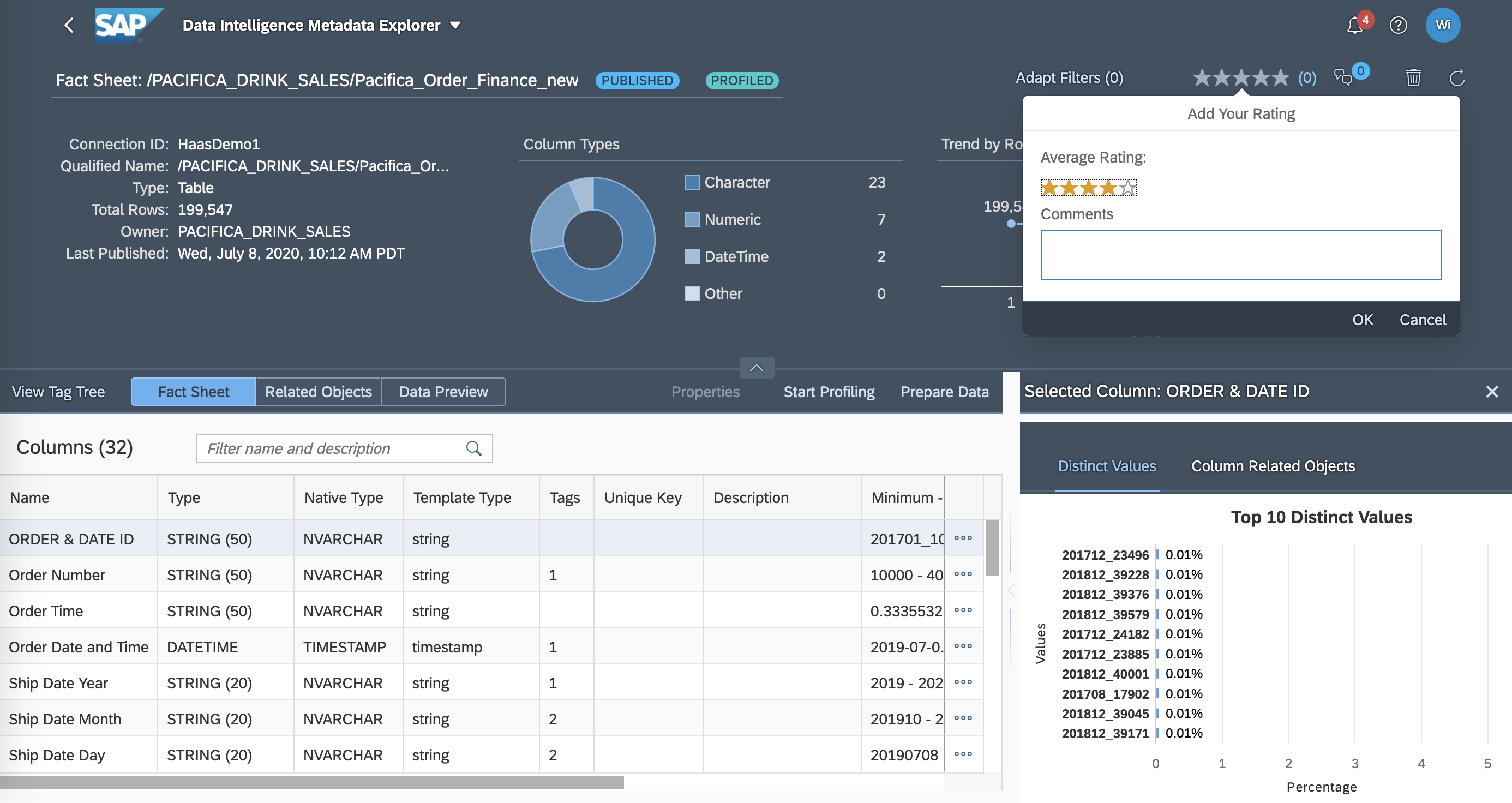
Allow collaborations among various personas with insights as ratings and comments on the datasets Reuse knowledges on the datasets for new users Next-Gen Data Management and Artificial Intelligence
SnowFlake is very cost effective and we also like the fact we can stop, start and spin up additional processing engines as we need to. We also like the fact that it's easy to connect our SQL IDEs to Snowflake and write our queries in the environment that we are used to
I think the troubleshooting process might be streamlined with improved error recording and tracing. A lot of information about issues and how to fix them is hidden away in the Kubernetes pods themselves. I'm not sure whether SAP Data Intelligence can fix this problem it may be connected to Kubernetes's design, in which case fixing it could need modifications inside Kubernetes itself.
Because the fact that you can query tons of data in a few seconds is incredible, it also gives you a lot of functions to format and transform data right in your query, which is ideal when building data models in BI tools like Power BI, it is available as a connector in the most used BI tools worldwide.
Initially we struggle to get help from SAP but then dedicated Dev angel was assigned to us and that simplify the overall support scenario. There is still room of improvement in documentation around SAP Data intelligence. We struggle a lot to initially understand the feature and required help around performance improvement area,
We have had terrific experiences with Snowflake support. They have drilled into queries and given us tremendous detail and helpful answers. In one case they even figured out how a particular product was interacting with Snowflake, via its queries, and gave us detail to go back to that product's vendor because the Snowflake support team identified a fault in its operation. We got it solved without lots of back-and-forth or finger-pointing because the Snowflake team gave such detailed information.
One of the reasons to pick SAP Data Intelligence is the speed and security it provides, in addition to the excellent support it provides. It is also compatible with all popular databases, which is another reason to choose it.
I have had the experience of using one more database management system at my previous workplace. What Snowflake provides is better user-friendly consoles, suggestions while writing a query, ease of access to connect to various BI platforms to analyze, [and a] more robust system to store a large amount of data. All these functionalities give the better edge to Snowflake.