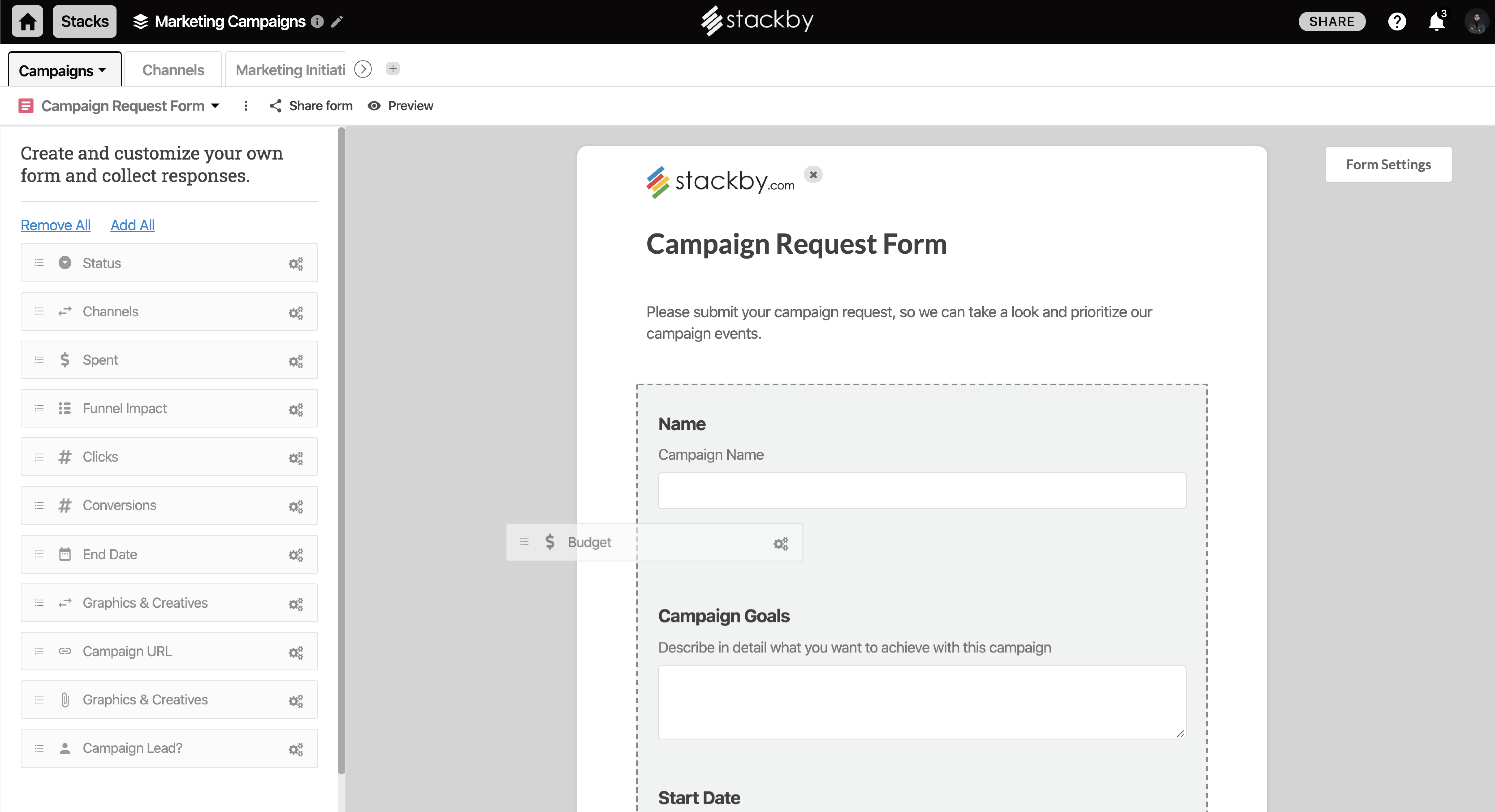
Stackby is designed to bring together the simplicity of spreadsheets, the functionality of databases and integrations with best business APIs to let anyone build their own tools, the way they want. No coding needed. Users can build a database from scratch, import data from pre-existing sources like spreadsheets or Google Sheets, or choose from over 100 pre-built templates across multiple categories. Stackby offers over 25 unique column types like text,…
$5
per month per user
TensorFlow
Score7.6 out of 10
N/A
TensorFlow is an open-source machine learning software library for numerical computation using data flow graphs. It was originally developed by Google.
Based on my experience, I can provide specific scenarios where Stackby is well suited and others where it may be less appropriate: Project Management: Stackby is an excellent choice for project management scenarios. Its ability to create custom databases, track tasks, assign responsibilities, and collaborate in real-time makes it highly effective for managing and monitoring project progress. CRM and Sales: Stackby is well suited for managing customer relationships and sales processes. Its customizable database structure allows for organizing customer information, tracking leads, managing deals, and generating reports. The ability to integrate with other tools further enhances its usefulness in CRM and sales workflows. Content Planning: Stackby is a great fit for content planning scenarios. Users can create databases to manage editorial calendars, track content ideas, assign tasks to team members, and monitor content performance. Collaboration features facilitate seamless content collaboration and ensure timely publishing.
TensorFlow is great for most deep learning purposes. This is especially true in two domains: 1. Computer vision: image classification, object detection and image generation via generative adversarial networks 2. Natural language processing: text classification and generation. The good community support often means that a lot of off-the-shelf models can be used to prove a concept or test an idea quickly. That, and Google's promotion of Colab means that ideas can be shared quite freely. Training, visualizing and debugging models is very easy in TensorFlow, compared to other platforms (especially the good old Caffe days). In terms of productionizing, it's a bit of a mixed bag. In our case, most of our feature building is performed via Apache Spark. This means having to convert Parquet (columnar optimized) files to a TensorFlow friendly format i.e., protobufs. The lack of good JVM bindings mean that our projects end up being a mix of Python and Scala. This makes it hard to reuse some of the tooling and support we wrote in Scala. This is where MXNet shines better (though its Scala API could do with more work).
A de minimis incentive was given to thank the reviewer for their time. The incentive was not used to bias or drive a particular response, nor was the incentive contingent on a positive endorsement. More Info
A de minimis incentive was given to thank the reviewer for their time. The incentive was not used to bias or drive a particular response, nor was the incentive contingent on a positive endorsement. More Info
Implement the same views available on desktop into the mobile app
Internal automations (like Airtable)
Ability to implement and display info as a dashboard (like Airtable)
Polish up the formatting of formulas, inputting them causes user frustration due to the formula input cursor jumping around
Better intelligence and ease of inputting data in bulk i.e have the fields automatically identify what data is being input and format appropriately (like Airtable does)
Theano is perhaps a bit faster and eats up less memory than TensorFlow on a given GPU, perhaps due to element-wise ops. Tensorflow wins for multi-GPU and “compilation” time.
Stackby is overall pretty easy to use, especially if you're used to something like Airtable or SmartSuite. Some of the pages seem like near exact clones (though they put their own creative spin on things). I'd prefer a slighty fresher interface (like SmartSuite), but I'm willing to sacrifice that for the better price and great customer service.
A de minimis incentive was given to thank the reviewer for their time. The incentive was not used to bias or drive a particular response, nor was the incentive contingent on a positive endorsement. More Info
Community support for TensorFlow is great. There's a huge community that truly loves the platform and there are many examples of development in TensorFlow. Often, when a new good technique is published, there will be a TensorFlow implementation not long after. This makes it quick to ally the latest techniques from academia straight to production-grade systems. Tooling around TensorFlow is also good. TensorBoard has been such a useful tool, I can't imagine how hard it would be to debug a deep neural network gone wrong without TensorBoard.
A de minimis incentive was given to thank the reviewer for their time. The incentive was not used to bias or drive a particular response, nor was the incentive contingent on a positive endorsement. More Info
A de minimis incentive was given to thank the reviewer for their time. The incentive was not used to bias or drive a particular response, nor was the incentive contingent on a positive endorsement. More Info
I have also tried Ora.Pm. Infinity has better graphical interface, but nowhere near as many features and the UI isn't as effective (i.e, moving around with keys). Grist has a much more technical interface and it comes from being more of a database/interactive spreadsheet vs Stackby. Grist has much more functionality in terms of formulas, but is much harder to learn to use and less other functionalities. Ora.PM is more of a test at a task management app, and doesn't compare - Stackby is much better.
Keras is built on top of TensorFlow, but it is much simpler to use and more Python style friendly, so if you don't want to focus on too many details or control and not focus on some advanced features, Keras is one of the best options, but as far as if you want to dig into more, for sure TensorFlow is the right choice
A de minimis incentive was given to thank the reviewer for their time. The incentive was not used to bias or drive a particular response, nor was the incentive contingent on a positive endorsement. More Info
A de minimis incentive was given to thank the reviewer for their time. The incentive was not used to bias or drive a particular response, nor was the incentive contingent on a positive endorsement. More Info