TrustRadius: an HG Insights company

What is Scifeon ELN & LIMS?

Scifeon ELN & LIMS is a modular, low-code digital platform designed to manage research and quality-control data across biotech, pharma, and CDMO/CRO environments. It combines Electronic Lab Notebook (ELN) and Laboratory Information Management System (LIMS) capabilities in a single environment, enabling scientists to capture, analyze, and share data.

Key Features

  • Integrated ELN & LIMS: Unified data capture, sample management, and process tracking across R&D and QC.
  • Instrument Connectivity: Automates data flow via flexible instrument integration and API support.
  • Compliance & Audit-Readiness: Designed to meet 21 CFR Part 11, GMP/GCLP, and ALCOA+ data integrity requirements.
  • Configurable Workflows: Adapts to unique lab processes without custom coding, reducing validation overhead.
  • Scalable Architecture: Supports rapid scale-up from pilot studies to regulated production environments.

Value Delivered

SAPPA Pilot Program
Scifeon offers the Scifeon Application Pilot Project Approach (SAPPA): a structured 90-day pilot that lets labs implement Scifeon on selected workflows in a live production environment. SAPPA allows organizations to evaluate system fit, ensure compliance, and build confidence before committing to full-scale deployment.

Free Trial
For labs exploring digital transformation, Scifeon also provides a free trial environment. This allows prospective users to experience the platform’s ELN, LIMS, and instrument integration features firsthand before engaging in SAPPA or a full implementation.

Scifeon helps labs reduce manual data handling, accelerate reporting, and improve audit readiness. Scifeon aims to help customers achieve up to 50% faster process execution and fewer compliance deviations through streamlined workflows and automated data capture.

Media

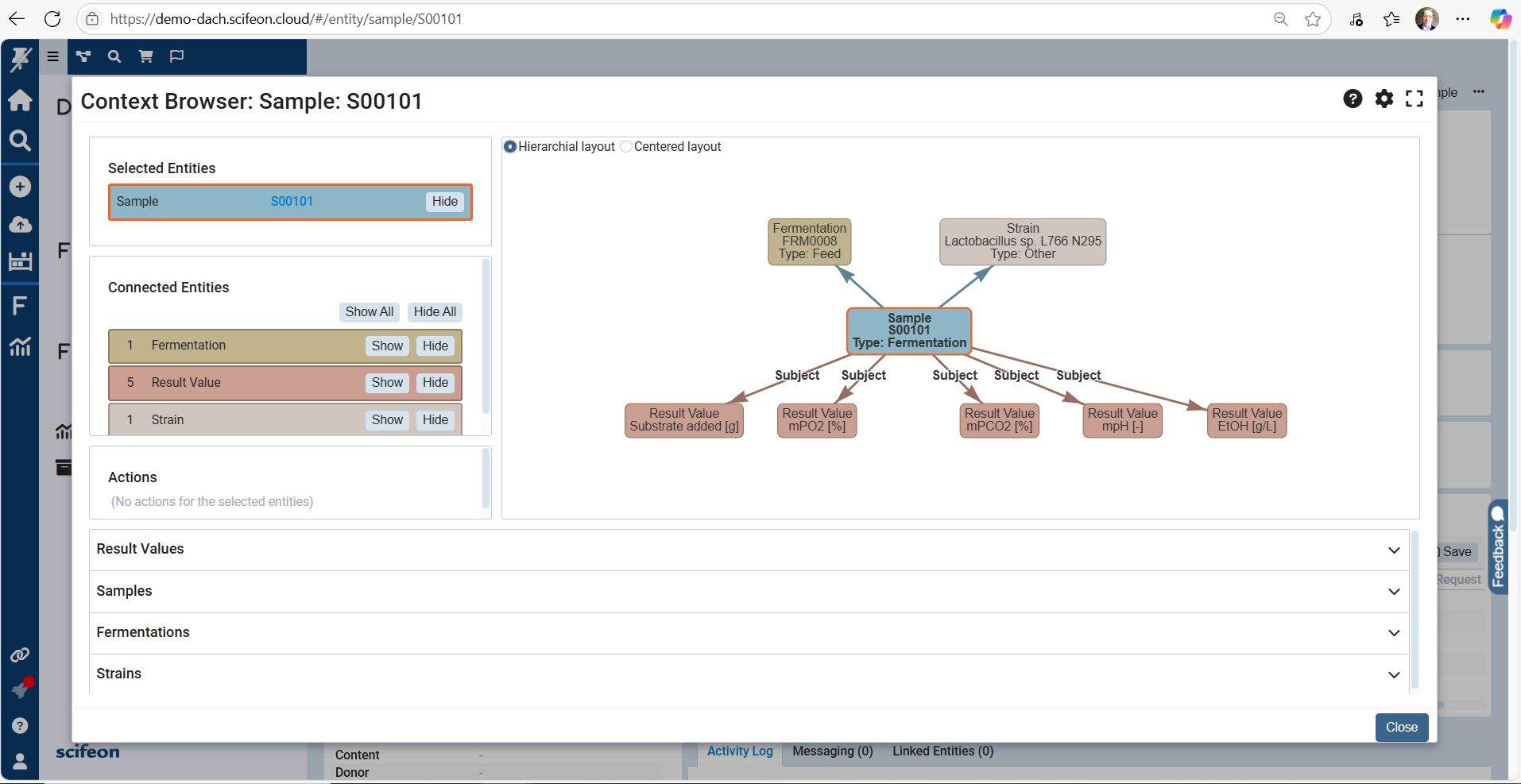
Screenshot of the Context Browser, which gives scientists and QC teams a clear, structured view of all laboratory data. Projects, experiments, samples, and results are organized in a single, connected interface, making it easy to navigate across workflows without losing context.

From a top-level project, users can drill down into experiments, linked samples, and raw measurements. Metadata, attached files, and audit trails are displayed side by side, ensuring that all relevant information is accessible at a glance. Integrated search and filtering functions make it simple to find specific datasets, compare results, or trace dependencies between workflows.

With the Context Browser, labs gain a transparent, FAIR-aligned data environment where relationships between experiments, samples, and results are visible and reusable — enabling faster decisions, smoother collaboration, and easier compliance.
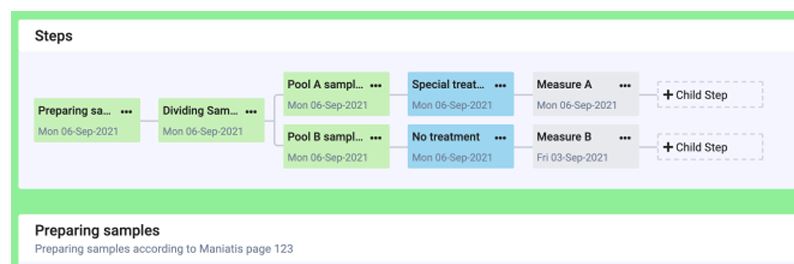
Screenshot of the Workflow Builder, a visual, drag-and-drop interface designed to configure laboratory workflows inside Scifeon without coding.
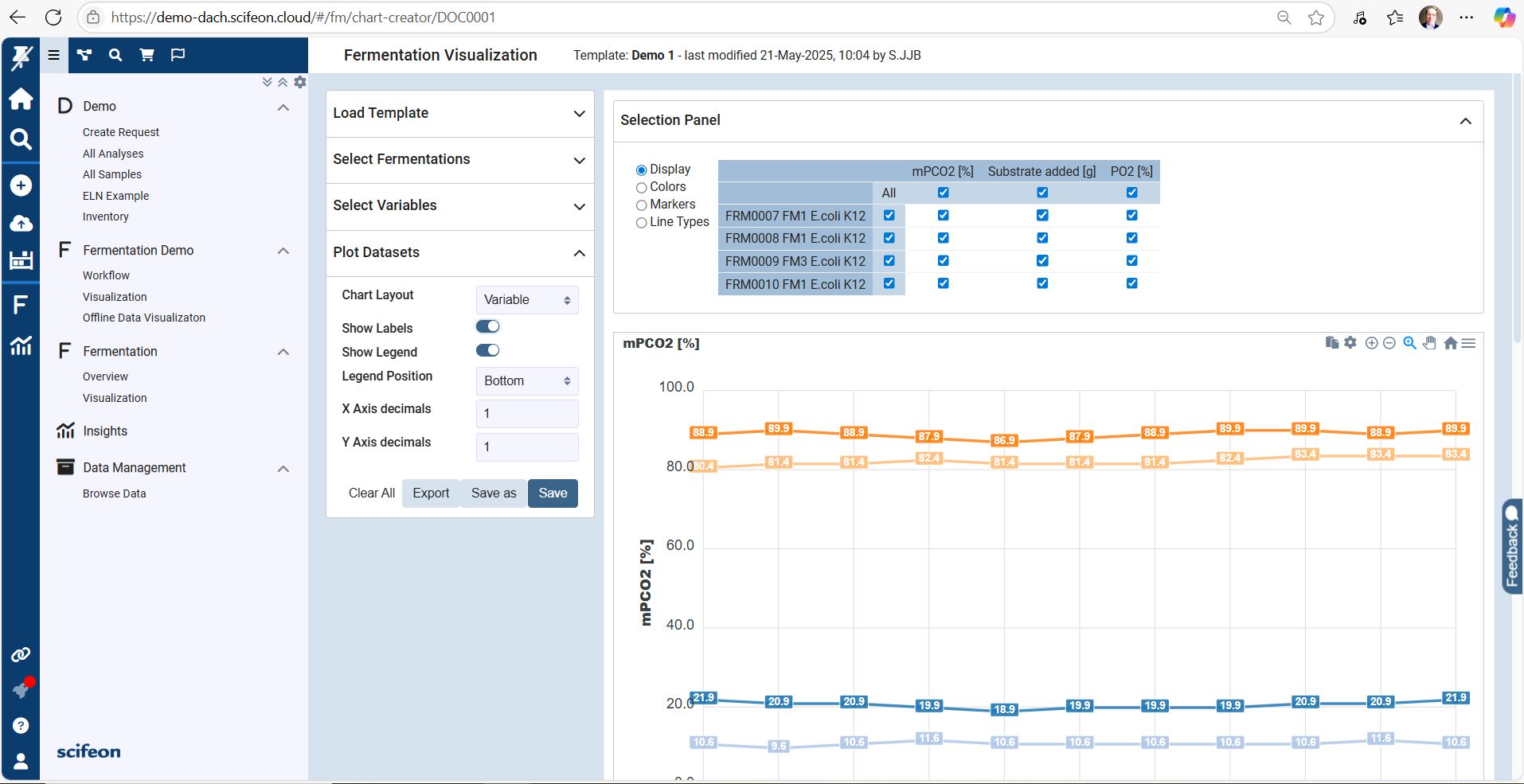
Screenshot of the Fermentation Visualization Dashboard

The Fermentation Visualization Dashboard provides a real-time overview of upstream and downstream fermentation data in a single, interactive interface. Scientists and process engineers can monitor critical parameters such as temperature, pH, dissolved oxygen, agitation speed, and feed rates directly as the process runs.

Key features visible in the dashboard screenshot:

Dynamic Time-Series Charts
Multiple parameters are plotted in synchronized graphs, enabling users to spot trends, deviations, and correlations across batches instantly.

Batch Comparison Mode
Overlay data from multiple fermentation runs to compare yields, stability, and process performance at a glance.

Live Instrument Integration
Data streams directly from connected bioreactors, ensuring the dashboard reflects the latest in-process values without manual uploads.

Interactive Data Exploration
Zoom, filter, and highlight specific segments of the fermentation process to investigate anomalies or optimization opportunities.

Compliance & Traceability
Linked audit trails and sample metadata support GMP, GCLP, and 21 CFR Part 11 compliance requirements.

Functional Impression

The dashboard turns complex fermentation datasets into intuitive, actionable insights. It supports faster decision-making, improves process reproducibility, and enables data-driven optimization — without leaving Scifeon’s platform.
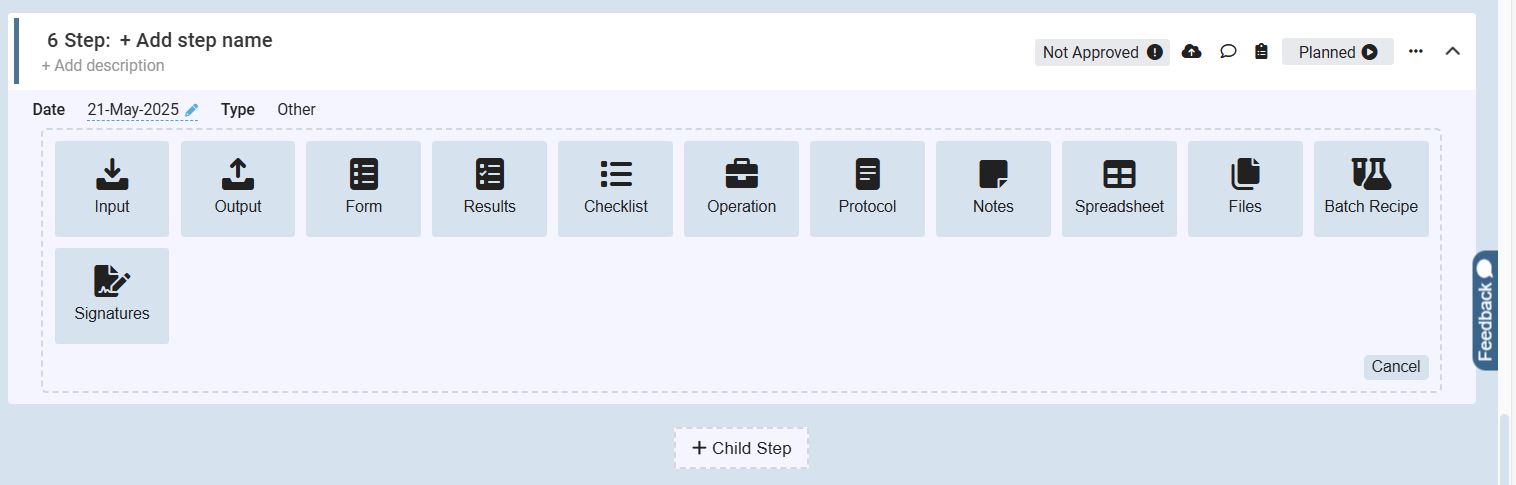
Screenshot of the Scifeon Workflow Builder – Adding Steps to a Workflow

The screenshot shows the step configuration interface within Scifeon’s Workflow Builder, where users define and customize individual steps in a laboratory process.

At the top, the user can name the step and add an optional description. Below, a wide range of predefined step types is available to choose from, making workflows flexible and modular. The visible options include:

Input – Add incoming data, parameters, or metadata

Output – Define resulting data, files, or reports

Form – Include structured data-entry forms for users

Results – Capture and manage experiment results

Checklist – Enforce step-by-step task confirmation

Operation – Represent a laboratory or process operation

Protocol – Attach or link standard operating procedures (SOPs)

Notes – Add contextual annotations or explanations

Spreadsheet – Integrate structured tabular data directly

Files – Upload or attach supporting documents

Batch Recipe – Define recipe parameters for batch processes

Signatures – Insert digital approval and sign-off steps

At the bottom, a “+ Child Step” button allows users to create nested steps within a larger workflow, making complex laboratory processes easy to structure.

The interface also displays controls for status tracking (“Planned” vs. “Not Approved”), adding comments, and attaching files, ensuring each workflow step stays traceable and compliant.

1 / 4

Screenshot of the Context Browser, which gives scientists and QC teams a clear, structured view of all laboratory data. Projects, experiments, samples, and results are organized in a single, connected interface, making it easy to navigate across workflows without losing context. From a top-level project, users can drill down into experiments, linked samples, and raw measurements. Metadata, attached files, and audit trails are displayed side by side, ensuring that all relevant information is accessible at a glance. Integrated search and filtering functions make it simple to find specific datasets, compare results, or trace dependencies between workflows. With the Context Browser, labs gain a transparent, FAIR-aligned data environment where relationships between experiments, samples, and results are visible and reusable — enabling faster decisions, smoother collaboration, and easier compliance.