Algolia offers AI-powered solutions to improve online search and discovery experiences, with tools for business teams and APIs for developers that help to improve user engagement and conversions across websites, apps, and e-commerce platforms.
$0
per month 10k search requests + 100k records
Honebi
Score 0.0 out of 10
Small Businesses (1-50 employees)
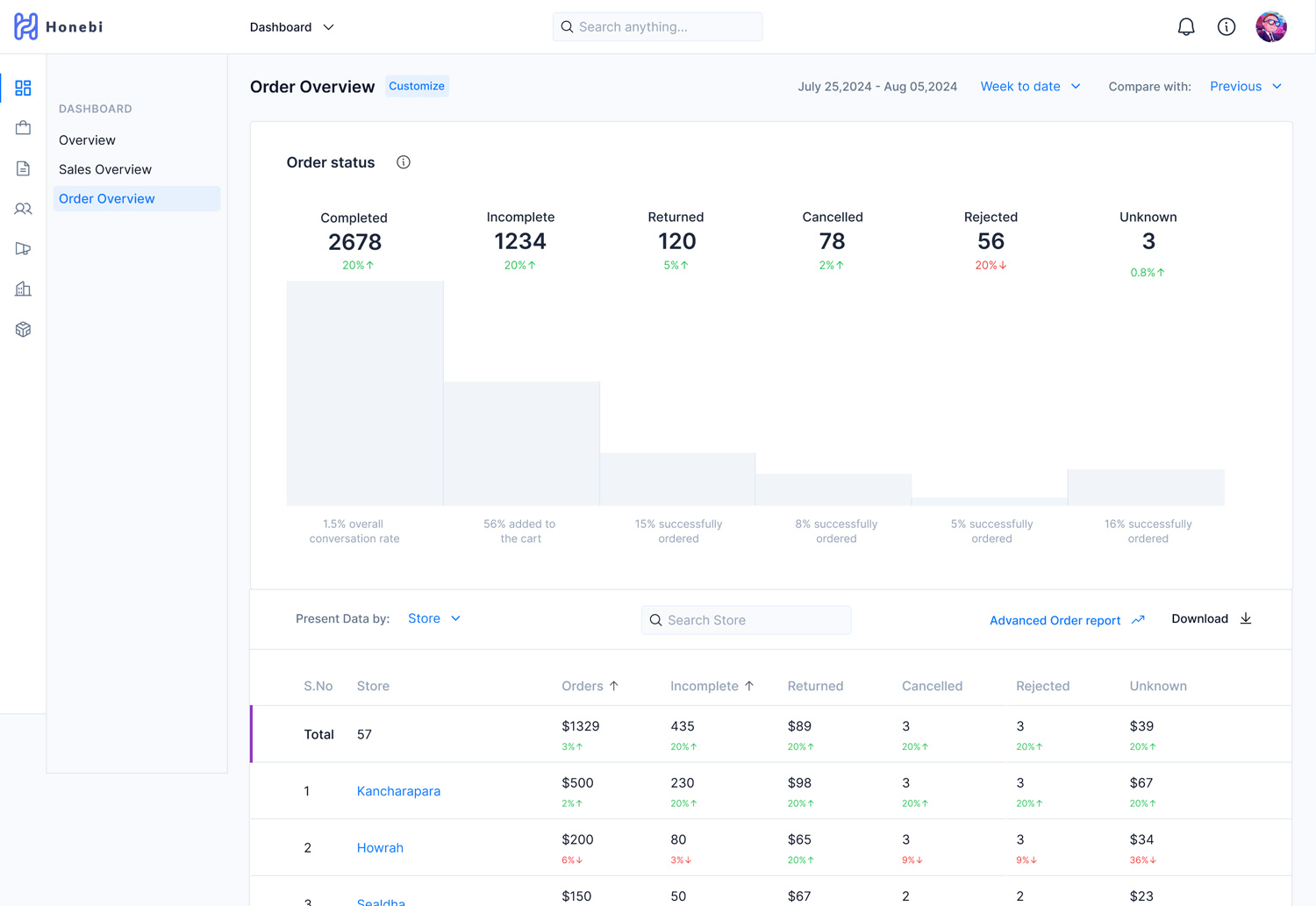
Honebi is a MACH-enabled digital commerce suite that offers a modular, headless, and API-first approach to commerce. This allows businesses to tailor the platform to their specific needs and integrate it with existing systems. Honebi's suite of commerce solutions is designed to enable businesses to thrive in the digital realm. In addition to its commerce engine, the suite provides a complete set of inbuilt tools, PIM, a storefront experience builder, OMS, and CMS, to facilitate an online…
N/A
Pricing
Algolia
Honebi
Editions & Modules
Build
Free
per month Up to 10,000 search requests + 1 Million records
Grow Plus
Free / Pay as you go
per month 10K searches/month & 100K records included; $1.75 per extra 1K searches, $0.40 per extra 1K records
Grow
Free / Pay as you go
per month 10K search requests & 100K records included; $0.50 per extra 1K searches, $0.40 per extra 1K records
Elevate
custom
per year
Elevate
Custom
per year Custom search requests and records — volume-based discounts available
No answers on this topic
Offerings
Pricing Offerings
Algolia
Honebi
Free Trial
Yes
No
Free/Freemium Version
Yes
No
Premium Consulting/Integration Services
Yes
Yes
Entry-level Setup Fee
Optional
Required
Additional Details
Pay as you go, scale instantly, or upgrade anytime for advanced features and capabilities.
We had several sales calls with Algolia to determine it was the right product for our client. Then when we entered into an agreement we had very detailed weekly onboarding sessions to teach us about the tool. The dashboard is very user friendly and there's so many different features. We're excited about the level of control we'll have with this tool compared to the default site search tools through a CMS like Drupal or Wordpress, or ElasticSearch via AWS. This is nice because we can see why a search is ranking a certain way right through the dashboard and will save us time from having to do trial and error to make the site search as relevant as possible. However, there are so many features that it can seem overwhelming to start at first. We are also one of the first clients using this in a non-ecommerce way so there were not as many uses cases we could reference. The tool is expensive but worth it so far.
Users get instant feedback as they type, even with complex filters like brand, model, price range, and financing eligibility. This speed significantly improves engagement and reduces bounce.
A user searching for “Camry 2020” or even “Camary 20” still sees relevant Toyota Camry listings from 2020. This reduces friction, especially on mobile where spelling errors are common.
Algolia handles multi-faceted filters efficiently. For example, a user can filter by location, transmission type, color, or inspection status without any lag.
We fine-tune the ranking of search results based on what matters to our business—like prioritizing cars with higher margins or better availability in key cities.
We can experiment with different ranking formulas or UI variations to improve KPIs like lead conversion or time-to-first-interaction.
Better integration of features (ex. synonyms feature is great but isn't respected by their re-ranking product)
Tooling to reduce spam search queries being triaged by system/logged to analytics panels
More automated summaries of analytics (ie. recommend synonyms to add, trends noticed in search volume in specific areas of site, easier ways to leverage API vs using website UI)
Algolia is a great tool, we didn't have to build a custom search platform (using Elasticsearch for example) for a while. It has great flexibility and the set of libraries and SDKs make using it really easy. However, there are two major blockers for our future: - Their pricing it's still a bit hard to predict (when you are used to other kind of metrics for usage) so I really recommend to take a look at it first. - Integrating it within a CI/CD pipeline is difficult to replicate staging/development environments based on Production.
Personally I find the Algolia integration not very complicated and the service super reactive. In terms of configuration, it's quite complete, at the end what matters is what we are able to index on Algolia. With rich data, the tool is amazing and a lot of things are possible.
Performance is always a major concern when integrating services with our client's websites. Our tests and real-world experience show that Algolia is highly performant. We have more extremely satisfied with the speed of both the search service APIs and the backend administrative and analytic interface.
It’s non existent. No tech support and no customer service… my application was blocked and is currently inactive causing huge business disruption, and I’m still waiting days later for a response to an issue which could be resolved very very quickly if only they would respond. Very poor from a company of that size
While AWS's offering is a typically cheaper solution, it requires a lot of work to gain any of the core features of Algolia. The cost of dev time and long-term maintenance would be more than the costs incurred with Algolia, which is why it made the most sense financially. On the engineering side, we could give our stakeholders access to Algolia to adjust the indices themselves, which would allow us to focus on other work.
Overall is a scalable tool as the environment and the backend functions are the same and many things are done directly on the tool so without the need of further specific developments. However some things could be improved such as documentation for integration that could help in doing whitelabel solutions
Users who had abandoned our product (attributing slow search speeds as the reason) returned to us thanks to Algolia
We used Algolia as our product's backbone to relaunch it, making it the center of all search on our platform which paid off massively.
Considering we relaunched our product, with Aloglia functioning as its engine, we got a lot of press coverage for our highly improved search speeds.
One negative would be how important it is to read the fine print when it comes to the technical documentation. As pricing is done on the basis of records and indexes, it is not made apparent that there is a size limit for your records or how quickly these numbers can increase for any particular use case. Be very wary of these as they can quite easily exceed your allotted budget for the product.