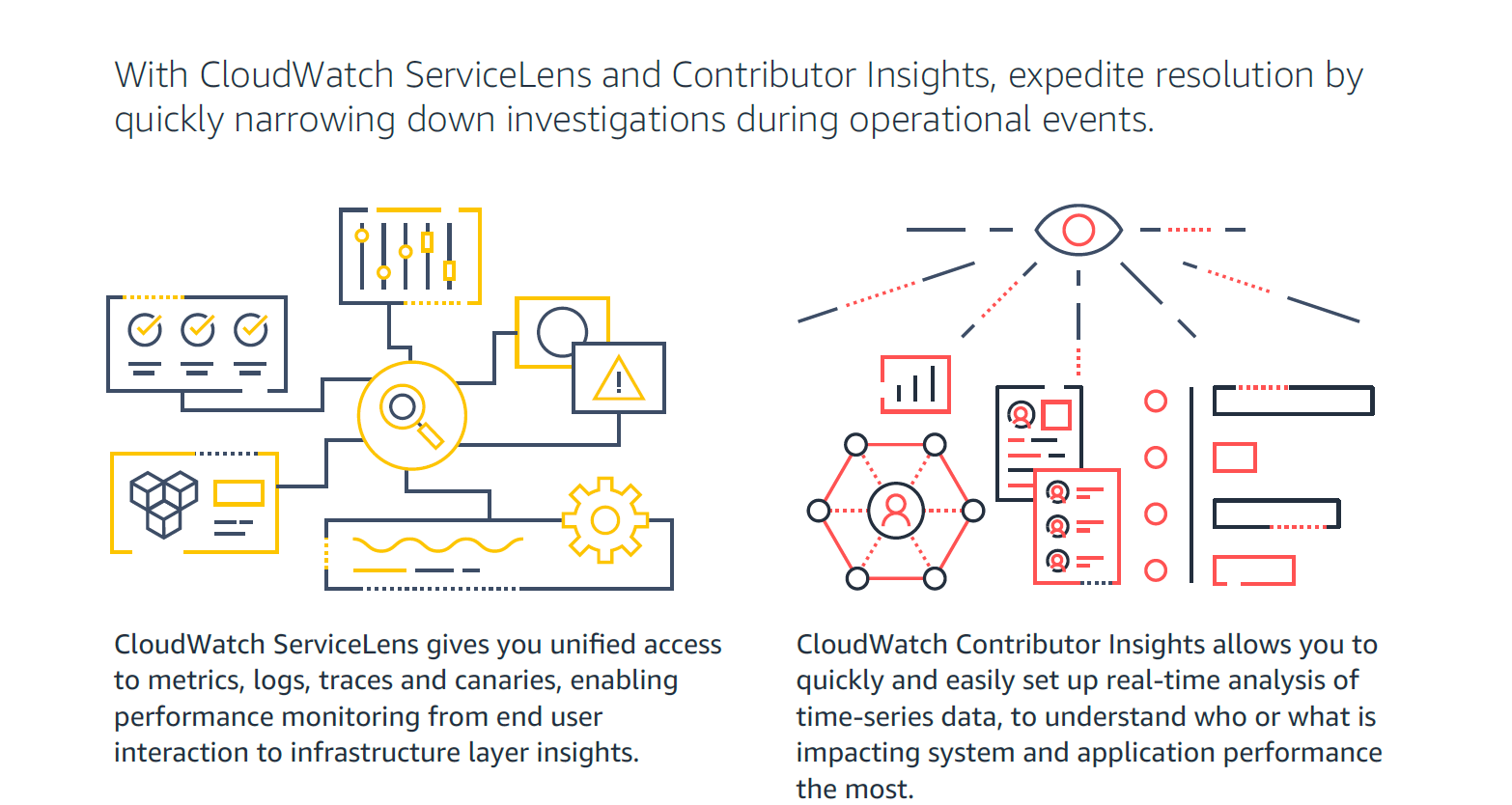
Amazon CloudWatch is a native AWS monitoring tool for AWS programs. It provides data collection and resource monitoring capabilities.
$0
per canary run
Ansible
Score 9.2 out of 10
N/A
The Red Hat Ansible Automation Platform (acquired by Red Hat in 2015) is a foundation for building and operating automation across an organization. The platform includes tools needed to implement enterprise-wide automation, and can automate resource provisioning, and IT environments and configuration of systems and devices. It can be used in a CI/CD process to provision the target environment and to then deploy the application on it.
$5,000
per year
Pricing
Amazon CloudWatch
Red Hat Ansible Automation Platform
Editions & Modules
Canaries
$0.0012
per canary run
Logs - Analyze (Logs Insights queries)
$0.005
per GB of data scanned
Over 1,000,000 Metrics
$0.02
per month
Contributor Insights - Matched Log Events
$0.02
per month per one million log events that match the rule
Logs - Store (Archival)
$0.03
per GB
Next 750,000 Metrics
$0.05
per month
Next 240,000 Metrics
$0.10
per month
Alarm - Standard Resolution (60 Sec)
$0.10
per month per alarm metric
First 10,000 Metrics
$0.30
per month
Alarm - High Resolution (10 Sec)
$0.30
per month per alarm metric
Alarm - Composite
$0.50
per month per alarm
Logs - Collect (Data Ingestion)
$0.50
per GB
Contributor Insights
$0.50
per month per rule
Events - Custom
$1.00
per million events
Events - Cross-account
$1.00
per million events
CloudWatch RUM
$1
per 100k events
Dashboard
$3.00
per month per dashboard
CloudWatch Evidently - Events
$5
per 1 million events
CloudWatch Evidently - Analysis Units
$7.50
per 1 million analysis units
Basic Tower
5,000
per year
Enterprise Tower
10,000
per year
Premium Tower
14,000
per year
Offerings
Pricing Offerings
Amazon CloudWatch
Ansible
Free Trial
Yes
No
Free/Freemium Version
Yes
No
Premium Consulting/Integration Services
Yes
No
Entry-level Setup Fee
No setup fee
No setup fee
Additional Details
With Amazon CloudWatch, there is no up-front commitment or minimum fee; you simply pay for what you use. You will be charged at the end of the month for your usage.
We thought about using Logstash for capturing our data. But we encountered several configuration issues, so as I mentioned before, if you're using AWS, the best way to do this is using the service they offer, as you don't encounter configuration problems. This is why I consider …
CloudWatch is incredibly cheap compared to New Relic and much more intuitive and easy to use than Nagios. It requires no setup, expertise, or otherwise extensive knowledge to use.
For out business we find that AWS Cloudwatch is good at providing real-time metrics for monitoring and analysing the performance and usage of our platform by customers. It is possible to create custom metrics from log events, such people adding items to a basket, checking out or abandoning their orders.
For automating the configuration of a multi-node, multi-domain (Storage, VM, Container) cluster, Ansible is still the best choice; however, it is not an easy task to achieve. Creating the infrastructure layer, i.e., creating network nodes, VMs, and K8s clusters, still can't be achieved via Ansible. Additionally, error handling remains complex to resolve.
It provides lot many out of the box dashboard to observe the health and usage of your cloud deployments. Few examples are CPU usage, Disk read/write, Network in/out etc.
It is possible to stream CloudWatch log data to Amazon Elasticsearch to process them almost real time.
If you have setup your code pipeline and wants to see the status, CloudWatch really helps. It can trigger lambda function when certain cloudWatch event happens and lambda can store the data to S3 or Athena which Quicksight can represent.
Debugging is easy, as it tells you exactly within your job where the job failed, even when jumping around several playbooks.
Ansible seems to integrate with everything, and the community is big enough that if you are unsure how to approach converting a process into a playbook, you can usually find something similar to what you are trying to do.
Security in AAP seems to be pretty straightforward. Easy to organize and identify who has what permissions or can only see the content based on the organization they belong to.
Memory metrics on EC2 are not available on CloudWatch. Depending on workloads if we need visibility on memory metrics we use Solarwinds Orion with the agent installed. For scalable workloads, this involves customization of images being used.
Visualization out of the box. But this can easily be addressed with other solutions such as Grafana.
By design, this is only used for AWS workloads so depending on your environment cannot be used as an all in one solution for your monitoring.
I can't think of any right now because I've heard about the Lightspeed and I'm really excited about that. Ansible has been really solid for us. We haven't had any issues. Maybe the upgrade process, but other than that, as coming from a user, it's awesome.
Even is if it's a great tool, we are looking to renew our licence for our production servers only. The product is very expensive to use, so we might look for a cheaper solution for our non-production servers. One of the solution we are looking, is AWX, free, and similar to AAP. This is be perfect for our non-production servers.
It's excellent at collecting logs. It's easy to set up. The viewing & querying part could be much better, though. The query syntax takes some time to get used to, & the examples are not helpful. Also, while being great, Log Insights requires manual picking of log streams to query across every time.
It's overall pretty easy to use foe all the applications I've mentioned before: configuring hosts, installing packages through tools like apt, applying yaml, making changes across wide groups of hosts, etc. Its not a 10 because of the inconveinience of the yaml setup, and the time to write is not worth it for something applied one time to only a few hosts
Great in almost every way compared to any other configuration management software. The only thing I wish for is python3 support. Other than that, YAML is much improved compared to the Ruby of Chef. The agentless nature is incredibly convenient for managing systems quickly, and if a member of your term has no terminal experience whatsoever they can still use the UI.
Support is effective, and we were able to get any problems that we couldn't get solved through community discussion forums solved for us by the AWS support team. For example, we were assisted in one instance where we were not sure about the best metrics to use in order to optimize an auto-scaling group on EC2. The support team was able to look at our metrics and give a useful recommendation on which metrics to use.
There is a lot of good documentation that Ansible and Red Hat provide which should help get someone started with making Ansible useful. But once you get to more complicated scenarios, you will benefit from learning from others. I have not used Red Hat support for work with Ansible, but many of the online resources are helpful.
Grafana is definitely a lot better and flexible in comparison with Amazon CloudWatch for visualisation, as it offers much more options and is versatile. VictoriaMetrics and Prometheus are time-series databases which can do almost everything cloudwatch can do in a better and cheaper way. Integrating Grafana with them will make it more capable Elasticsearch for log retention and querying will surpass cloudwatch log monitoring in both performance and speed
AAP compares favorably with Terraform and Power Automate. I don't have much experience with Terraform, but I find AAP and Ansible easier to use as well as having more capabilities. Power Platform is also an excellent automation tool that is user friendly but I feel that Ansible has more compatibility with a variety of technologies.
POSITIVE: currently used by the IT department and some others, but we want others to use it.
NEGATIVE: We need less technical output for the non-technical. It should be controllable or a setting within playbooks. We also need more graphical responses (non-technical).
POSITIVE: Always being updated and expanded (CaC, EDA, Policy as Code, execution environments, AI, etc..)