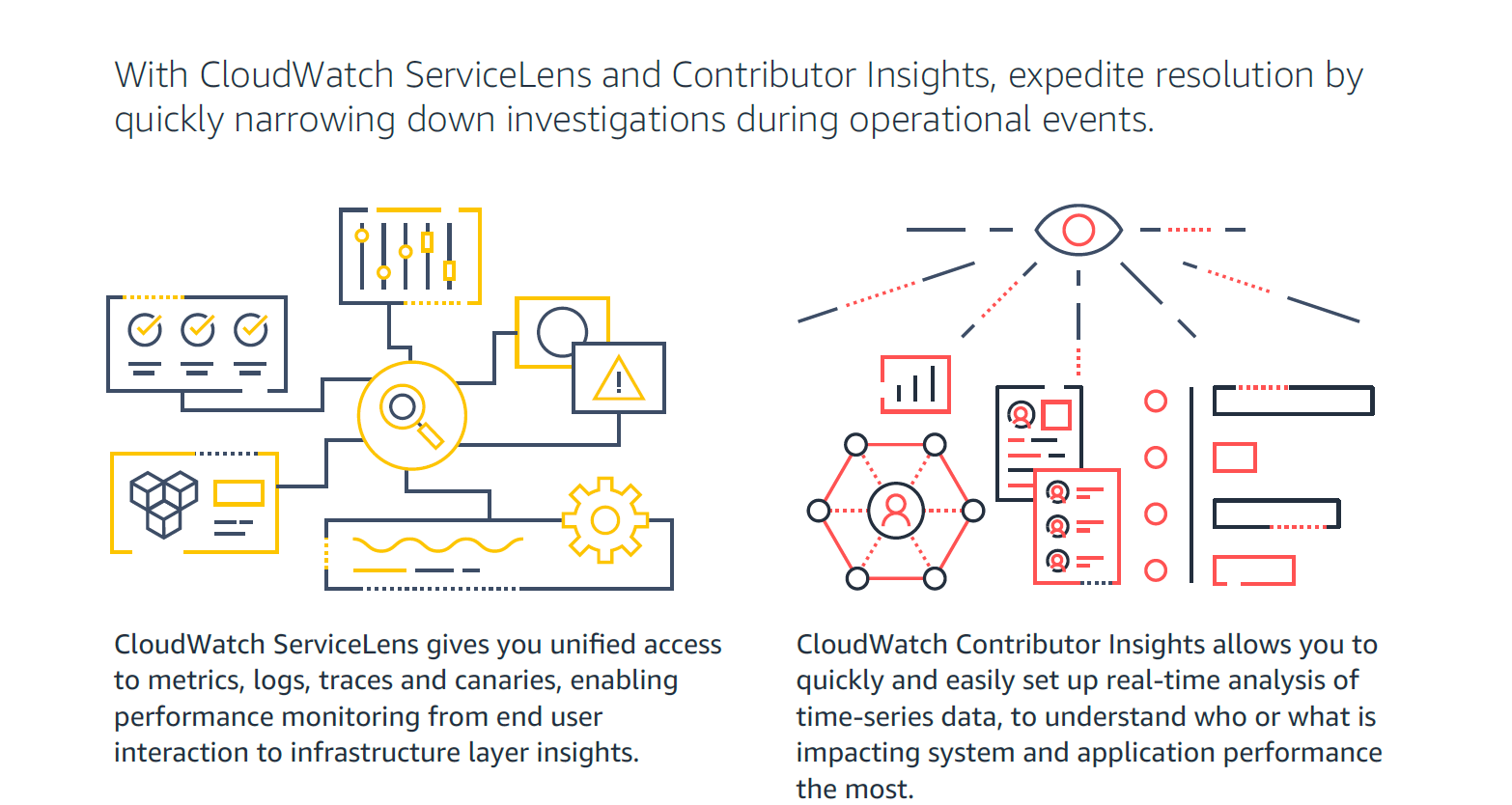
Amazon CloudWatch is a native AWS monitoring tool for AWS programs. It provides data collection and resource monitoring capabilities.
$0
per canary run
Red Hat OpenShift on IBM Cloud
Score 7.9 out of 10
N/A
Red Hat OpenShift on IBM Cloud is a comprehensive service that offers fully managed OpenShift clusters, on IBM Cloud platform. It is directly integrated into the same Kubernetes service that maintains 25 billion on-demand forecasts daily at The Weather Company.
N/A
Pricing
Amazon CloudWatch
Red Hat OpenShift on IBM Cloud
Editions & Modules
Canaries
$0.0012
per canary run
Logs - Analyze (Logs Insights queries)
$0.005
per GB of data scanned
Over 1,000,000 Metrics
$0.02
per month
Contributor Insights - Matched Log Events
$0.02
per month per one million log events that match the rule
Logs - Store (Archival)
$0.03
per GB
Next 750,000 Metrics
$0.05
per month
Next 240,000 Metrics
$0.10
per month
Alarm - Standard Resolution (60 Sec)
$0.10
per month per alarm metric
First 10,000 Metrics
$0.30
per month
Alarm - High Resolution (10 Sec)
$0.30
per month per alarm metric
Alarm - Composite
$0.50
per month per alarm
Logs - Collect (Data Ingestion)
$0.50
per GB
Contributor Insights
$0.50
per month per rule
Events - Custom
$1.00
per million events
Events - Cross-account
$1.00
per million events
CloudWatch RUM
$1
per 100k events
Dashboard
$3.00
per month per dashboard
CloudWatch Evidently - Events
$5
per 1 million events
CloudWatch Evidently - Analysis Units
$7.50
per 1 million analysis units
No answers on this topic
Offerings
Pricing Offerings
Amazon CloudWatch
Red Hat OpenShift on IBM Cloud
Free Trial
Yes
Yes
Free/Freemium Version
Yes
No
Premium Consulting/Integration Services
No
No
Entry-level Setup Fee
No setup fee
No setup fee
Additional Details
With Amazon CloudWatch, there is no up-front commitment or minimum fee; you simply pay for what you use. You will be charged at the end of the month for your usage.
—
More Pricing Information
Community Pulse
Amazon CloudWatch
Red Hat OpenShift on IBM Cloud
Considered Both Products
Amazon CloudWatch
Verified User
Anonymous
Chose Amazon CloudWatch
We use Cloudwatch for simpler monitoring, but these metrics and logs often feed into bigger ecosystems across our organization. The metrics and logs in Cloudwatch allow our developers quick and easy access to the data they need whilst easily integrating the same data into more …
Grafana is definitely a lot better and flexible in comparison with Amazon CloudWatch for visualisation, as it offers much more options and is versatile. VictoriaMetrics and Prometheus are time-series databases which can do almost everything cloudwatch can do in a better and …
In comparison to its competitors, Amazon CloudWatch is efficient, reliable, and has a fast response time, and it maximizes an application's life while also providing the best load balance and storage. The services that Amazon CloudWatch provides are far better and cheaper for …
We have also tested with SolarWinds NPM, and Zoho Monitors. They seemed to work fine and setup was not as involved as Amazon services, JSON, etc. However, the issue of upgrades made the other solutions incur more downtime overall for maintenance and software upgrades via the …
I think there is no alternative of [Amazon] CloudWatch service. However it provides lot of glue points which you can use to show different metrics, trigger events and update your dashboards.
I believe that CloudWatch is a better solution to use with AWS services and resources in terms of cost and ease of integration with AWS infrastructure services. But keep in mind that Elasticsearch is better at aggregating application-level metrics. We chose CloudWatch because of …
We found that CloudWatch is the best solution to use with AWS services in terms of cost and ease of integration with AWS infrastructure services. While Elasticsearch is better at aggregating application-level metrics, CloudWatch wins out in its capabilities to tightly integrate …
CloudWatch is the minimum viable product that is used as your baseline. Once you graduate beyond the basic needs, there is a wide range of tools from other AWS partners that go well above and beyond. However the cost of those tools is typically considerably more.
We thought about using Logstash for capturing our data. But we encountered several configuration issues, so as I mentioned before, if you're using AWS, the best way to do this is using the service they offer, as you don't encounter configuration problems. This is why I consider …
I think Amazon has put more efforts to develop AWS CloudWatch features to monitor each kind of AWS service you can use instead of Dynatrace One Agent that just can monitor some variables of Computing services and FaaS, unless Dynatrace One Agent integration with AWS CloudWatch …
Out of the box monitoring which compliments workloads implemented from infrastructure as code so we have standardized metrics across all our monitoring for our AWS workloads. Also incredibly easy to implement via the console which can be done in minutes oppose to hours of …
We choose Amazon CloudWatch because, first, we use AWS and we need a monitoring tool. That is why we considered CloudWatch as soon as we started deploying AWS services to our company. Second, CloudWatch is a great, handy tool to monitor our services. Its strength is obvious …
Currently, we only tried and used Cloud Watch, but for AWS it is perfect. Since this is an Amazon product monitoring Amazon services, integration is great. If we decide in the future to move away from AWS, we would reconsider changing alarm monitoring. AWS can be costly …
Amazon CloudWatch is fully integrated into your existing AWS account, and provides easy hooks into several different services to make a cohesive infrastructure. Unfortunately, using other services will not allow you to get into the weeds to do everything Amazon CloudWatch can …
CloudWatch is incredibly cheap compared to new relic and much more intuitive and easy to use than Nagios. It requires no setup, expertise, or otherwise extensive knowledge to use.
We used to use Miscosoft Azure, however when we came across Amazon CloudWatch, and all the features it can provide, it seemd no brainer to switch. We transitioned from Azure to CloudWatch within 2 years of using Azure, And may not go back. Hopefully Amazon will keep adding more …
Amazon CloudWatch is great in terms of the CloudWatch Logs feature, it integrates easily with other AWS services (CloudFormation, S3, Lambda, etc.) and is reasonably low cost, so it was a no-brainer for that area. For alerting, CloudWatch didn't offer much in the way of …
I feel that CloudWatch will always remain the backbone of log analytics, events, and alarms. However, we can use other products in conjunction with it for better log analytics and monitoring. In my organization, we also ingest logs from CloudWatch to Splunk and ELK. This way we …
1. The pricing is better than the other competitors. 2. We are already using other services being offered by IBM, so it makes better sense to utilize the IBM cloud red hat open shift. 3. Support is also valuable. 4. security is good. 5. constant updates on clusters. 6. cloud …
Both have unique benefits for different uses. Docker is great for smaller projects on a single host or small cluster, whereas OpenShift is ideal when you need a scalable, fully managed, and secure Kubernetes platform. OpenShift also offers a more fully featured web-based …
Red Hat OpenShift on IBM Cloud is best when it comes to security capabilities and hybrid scenarios. With Red Hat OpenShift on IBM Cloud we could provision new environments very quickly and in cost effective way. Customers could also use the cloud credits that they might have …
Red Hat OpenShift on IBM Cloud is a container application platform based on Kubernetes, that leverages our ability to start very quickly any containerized application developed with different languages, plus CI/CD, monitoring and logging and security.
I prefer RedHat OpenShift because with kubernetes there are tons more installations and work effort required to get applications ready to run in the containerized environment. RedHat OpenShift is faster and easier to get up and running.
Planning to do so late. The evaluation for more vendors is in the cooking, pending budget approval & assignment to the right top guns. With the recession looming, I do wish that this key project could get approved & more discoveries could be made soon as I wished before.
We evaluated a number of potential solutions and ultimately chose Red Hat OpenShift because it was compatible with our existing technology. Time and costs savings have been realized throughout the company since we implemented Red Hat OpenShift, and the IT department has been …
We are using IBM Cloud App ID as a simple method to get an OIDC provider for our applications, that are running within the OpenShift cluster. Also, IBM Cloud Object Storage is used within the workload to store data via an s3 compliant way. The IBM Cloud Container Registry is an …
Red hat Openshift had a better user interface by far. Amazon EKS's was so basic it was essentially useless. We had to use a separate tool called lens to get basic stuff done. Lens was buggy and didn't work as well though, even for basic functionality like updating a K8s secret.
For our particular use case, Red Hat OpenShift on IBM Cloud was very cost-competitive. We already had RHEL, OpenShift, and Ansible skills that translated to the service. From a feature and function perspective, most solutions have a parity but being open source and less chance …
For one of our banking clients, I have explored and played around the Kubernetes platform on IBM Cloud. In the process to deploy the application, I had to create the deployment artifacts, which was quite cumbersome. But then for one of the automotive clients I was asked to …
If you use any AWS services, CloudWatch is the natural choice to monitor & troubleshoot your workload. Thankfully, for most AWS services, CloudWatch is either built-in or very easy to set up. However, being proficient in browsing & tracking the log events would take some training & practice. Having some experienced people on the team would help immensely, especially in spreading the skill to the rest of the team.
RedHat OpenShift is not only suited for IBM Cloud but can run in ANY cloud. We installed in Azure Cloud, for example. It can also run on Linux servers or a Power 9 machine. It is built for multi-cloud or on-prem environments. IBM support provides such excellent guidance in the installation and configuration that no other product on the market can beat it.
It provides lot many out of the box dashboard to observe the health and usage of your cloud deployments. Few examples are CPU usage, Disk read/write, Network in/out etc.
It is possible to stream CloudWatch log data to Amazon Elasticsearch to process them almost real time.
If you have setup your code pipeline and wants to see the status, CloudWatch really helps. It can trigger lambda function when certain cloudWatch event happens and lambda can store the data to S3 or Athena which Quicksight can represent.
Memory metrics on EC2 are not available on CloudWatch. Depending on workloads if we need visibility on memory metrics we use Solarwinds Orion with the agent installed. For scalable workloads, this involves customization of images being used.
Visualization out of the box. But this can easily be addressed with other solutions such as Grafana.
By design, this is only used for AWS workloads so depending on your environment cannot be used as an all in one solution for your monitoring.
Although the tool itself is easy to integrate and is readily available for use, it has its limitations. The key limitations of cloudwatch are with respect to cost incurred on log retention and log querying. While for key use cases this is sufficient, for more advanced use cases, Amazon CloudWatch doesn't work out. Also, obviously it is tightly coupled with AWS, which makes you look away if you need a single tool for all monitoring
Support is effective, and we were able to get any problems that we couldn't get solved through community discussion forums solved for us by the AWS support team. For example, we were assisted in one instance where we were not sure about the best metrics to use in order to optimize an auto-scaling group on EC2. The support team was able to look at our metrics and give a useful recommendation on which metrics to use.
We use Cloudwatch for simpler monitoring, but these metrics and logs often feed into bigger ecosystems across our organization. The metrics and logs in Cloudwatch allow our developers quick and easy access to the data they need whilst easily integrating the same data into more prominent platforms for wider analysis, including Service desk support, SecOps, and ITOps monitoring within the organization.
We evaluated a number of potential solutions and ultimately chose Red Hat OpenShift because it was compatible with our existing technology. Time and costs savings have been realized throughout the company since we implemented Red Hat OpenShift, and the IT department has been freed up to focus on activities that are more valuable.