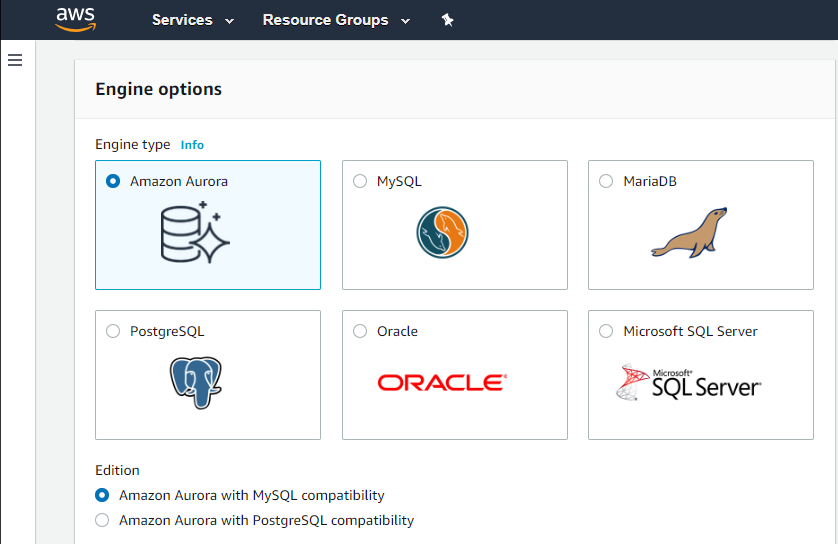
Amazon Relational Database Service (Amazon RDS) is a database-as-a-service (DBaaS) from Amazon Web Services.
N/A
Couchbase Server
Score 8.6 out of 10
N/A
Couchbase Server is a cloud-native, distributed database that fuses the strengths of relational databases such as SQL and ACID transactions with JSON flexibility and scale that defines NoSQL. It is available as a service in commercial clouds and supports hybrid and private cloud deployments.
N/A
Pricing
Amazon Relational Database Service (RDS)
Couchbase Server
Editions & Modules
Amazon RDS for PostgreSQL
$0.24 ($0.48)
per hour, R5 Large (R5 Extra Large)
Amazon RDS for MariaDB
$0.25 ($0.50)
per hour, R5 Large (R5 Extra Large)
Amazon RDS for MySQL
$0.29 ($0.58)
per hour, R5 Large (R5 Extra Large)
Amazon RDS for Oracle
$0.482 ($0.964)
per hour, R5 Large (R5 Extra Large)
Amazon RDS for SQL Server
$1.02 ($1.52)
per hour, R5 Large (R5 Extra Large)
No answers on this topic
Offerings
Pricing Offerings
Amazon RDS
Couchbase Server
Free Trial
No
Yes
Free/Freemium Version
No
Yes
Premium Consulting/Integration Services
No
Yes
Entry-level Setup Fee
Optional
Optional
Additional Details
—
—
More Pricing Information
Community Pulse
Amazon Relational Database Service (RDS)
Couchbase Server
Features
Amazon Relational Database Service (RDS)
Couchbase Server
NoSQL Databases
Comparison of NoSQL Databases features of Product A and Product B
If your application needs a relational data store and uses other AWS services, AWS RDS is a no-brainer. It offers all the traditional database features, makes it a snap to set up, creates cross-region replication, has advanced security, built-in monitoring, and much more at a very good price. You can also set up streaming to a data lake using various other AWS services on your RDS.
Best suited when edge devices have interrupted internet connection. And Couchbase provides reliable data transfer. If used for attachment Couchbase has a very poor offering. A hard limit of 20 MB is not okay. They have the best conflict resolution but not so great query language on Couchbase lite.
Automated Database Management: We use it for streamlining routine tasks like software patching and database backups.
Scalability on Demand: we use it to handle traffic spikes, scaling both vertically and horizontally.
Database Engine Compatibility: It works amazingly with multiple database engines used by different departments within our organization including MySQL, PostgreSQL, SQL Server, and Oracle.
Monitoring: It covers our extensive monitoring and logging, and also has great compatibility with Amazon CloudWatch
It is a little difficult to configure and connect to an RDS instance. The integration with ECS can be made more seamless.
Exploring features within RDS is not very easy and intuitive. Either a human friendly documentation should be added or the User Interface be made intuitive so that people can explore and find features on their own.
There should be tools to analyze cost and minimize it according to the usage.
The N1QL engine performs poorly compared to SQL engines due to the number of interactions needed, so if your use case involves the need for a lot of SQL-like query activity as opposed to the direct fetch of data in the form of a key/value map you may want to consider a RDBMS that has support for json data types so that you can more easily mix the use of relational and non-relational approaches to data access.
You have to be careful when using multiple capabilities (e.g. transactions with Sync Gateway) as you will typically run into problems where one technology may not operate correctly in combination with another.
There are quality problems with some newly released features, so be careful with being an early adopter unless you really need the capability. We somewhat desperately adopted the use of transactions, but went through multiple bughunt cycles with Couchbase working the kinks out.
We do renew our use of Amazon Relational Database Service. We don't have any problems faced with RDS in place. RDS has taken away lot of overhead of hosting database, managing the database and keeping a team just to manage database. Even the backup, security and recovery another overhead that has been taken away by RDS. So, we will keep on using RDS.
I rarely actually use Couchbase Server, I just stay up-to-date with the features that it provides. However, when the need arises for a NoSQL datastore, then I will strongly consider it as an option
I've been using AWS Relational Database Services in several projects in different environments and from the AWS products, maybe this one together to EC2 are my favourite. They deliver what they promise. Reliable, fast, easy and with a fair price (in comparison to commercial products which have obscure license agreements).
Couchbase has been quite a usable for our implementation. We had similar experience with our previous "trial" implementation, however it was short lived.
Couchbase has so far exceeded expectation. Our implementation team is more confident than ever before.
When we are Live for more than 6 months, I'm hoping to enhance this rating.
One of Couchbase’s greatest assets is its performance with large datasets. Properly set up with well-sized clusters, it is also highly reliable and scalable. User management could be better though, and security often feels like an afterthought. Couchbase has improved tremendously since we started using it, so I am sure that these issues will be ironed out.
I have only had good experiences in working with AWS support. I will admit that my experience comes from the benefit of having a premium tier of support but even working with free-tier accounts I have not had problems getting help with AWS products when needed. And most often, the docs do a pretty good job of explaining how to operate a service so a quick spin through the docs has been useful in solving problems.
I haven't had many opportunities to request support, I will look forward to better the rating. We have technical development and integration team who reach out directly to TAM at Couchbase.
Amazon Relational Database Service (RDS) stands out among similar products due to its seamless integration with other AWS services, automated backups, and multi-AZ deployments for high availability. Its support for various database engines, such as MySQL, PostgreSQL, and Oracle, provides flexibility. Additionally, RDS offers managed security features, including encryption and IAM integration, enhancing data protection. The pay-as-you-go pricing model makes it cost-effective. Overall, Amazon RDS excels in ease of use, scalability, and a comprehensive feature set, making it a top choice for organizations seeking a reliable and scalable managed relational database service in the cloud.
The Apache Cassandra was one type of product used in our company for a couple of use-cases. The Aerospike is something we [analyzed] not so long time ago as an interesting alternative, due to its performance characteristics. The Oracle Coherence was and is still being used for [the] distributed caching use-case, but it will be replaced eventually by Couchbase. Though each of these products [has] its own strengths and weaknesses, we prefer sticking to Couchbase because of [the] experience we have with this product and because it is cost-effective for our organization.
So far, the way that we mange and upgrade our clusters has be very smooth. It works like a dream when we use it in concert with AWS and their EC2 machines. Having access to powerful instances along side the Couchbase interface is amazing and allows us to do rebalances or maintenance without a worry