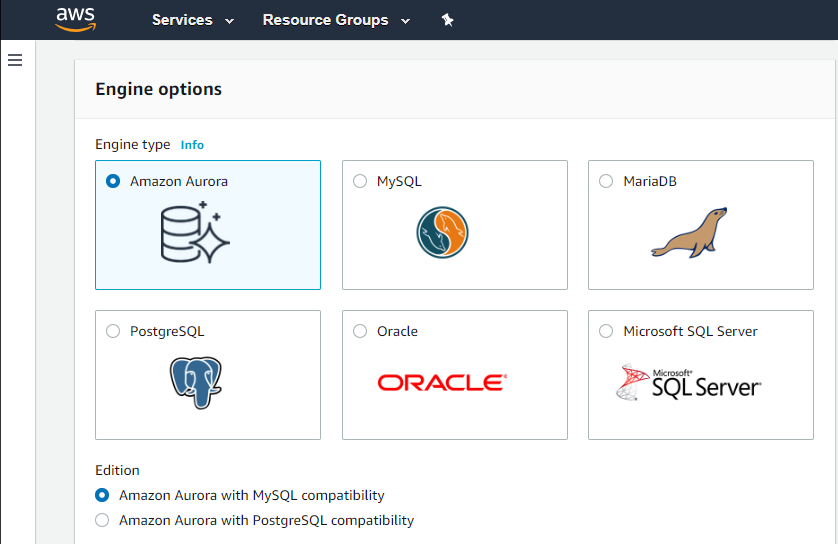
Amazon Relational Database Service (Amazon RDS) is a database-as-a-service (DBaaS) from Amazon Web Services.
N/A
SingleStore
Score8.2 out of 10
N/A
SingleStore aims to enable organizations to scale from one to one million customers, handling SQL, JSON, full text and vector workloads in one unified platform.
VP R&D, DevOps, and Products in Research & Development at Zoomd Technologies (Information Technology & Services, 51-200 employees)
Chose Amazon RDS
Running MySQL RDS was a simpler solution than running standalone MySQL servers as the semi-managed nature of RDS saved us the need to install, maintain, secure, and backup our database servers. Using MySQL RDS was in addition to running MongoDB Atlas workloads and allowed us to …
A de minimis incentive was given to thank the reviewer for their time. The incentive was not used to bias or drive a particular response, nor was the incentive contingent on a positive endorsement. TR verified that a representative sample of customers was invited. More Info
A de minimis incentive was given to thank the reviewer for their time. The incentive was not used to bias or drive a particular response, nor was the incentive contingent on a positive endorsement. More Info
If your application needs a relational data store and uses other AWS services, AWS RDS is a no-brainer. It offers all the traditional database features, makes it a snap to set up, creates cross-region replication, has advanced security, built-in monitoring, and much more at a very good price. You can also set up streaming to a data lake using various other AWS services on your RDS.
A de minimis incentive was given to thank the reviewer for their time. The incentive was not used to bias or drive a particular response, nor was the incentive contingent on a positive endorsement. More Info
Good for Applications needing instant insights on large, streaming datasets. Applications processing continuous data streams with low latency. When a multi-cloud, high-availability database is required When NOT to Use Small-scale applications with limited budgets Projects that do not require real-time analytics or distributed scaling Teams without experience in distributed databases and HTAP architectures.
A de minimis incentive was given to thank the reviewer for their time. The incentive was not used to bias or drive a particular response, nor was the incentive contingent on a positive endorsement. More Info
Automated Database Management: We use it for streamlining routine tasks like software patching and database backups.
Scalability on Demand: we use it to handle traffic spikes, scaling both vertically and horizontally.
Database Engine Compatibility: It works amazingly with multiple database engines used by different departments within our organization including MySQL, PostgreSQL, SQL Server, and Oracle.
Monitoring: It covers our extensive monitoring and logging, and also has great compatibility with Amazon CloudWatch
A de minimis incentive was given to thank the reviewer for their time. The incentive was not used to bias or drive a particular response, nor was the incentive contingent on a positive endorsement. TR verified that a representative sample of customers was invited. More Info
A de minimis incentive was given to thank the reviewer for their time. The incentive was not used to bias or drive a particular response, nor was the incentive contingent on a positive endorsement. More Info
It is a little difficult to configure and connect to an RDS instance. The integration with ECS can be made more seamless.
Exploring features within RDS is not very easy and intuitive. Either a human friendly documentation should be added or the User Interface be made intuitive so that people can explore and find features on their own.
There should be tools to analyze cost and minimize it according to the usage.
A de minimis incentive was given to thank the reviewer for their time. The incentive was not used to bias or drive a particular response, nor was the incentive contingent on a positive endorsement. TR verified that a representative sample of customers was invited. More Info
It does not release a patch to have back porting; it just releases a new version and stops support; it's difficult to keep up to that pace.
Support engineers lack expertise, but they seem to be improving organically.
Lacks enterprise CDC capability: Change data capture (CDC) is a process that tracks and records changes made to data in a database and then delivers those changes to other systems in real time.
For enterprise-level backup & restore capability, we had to implement our model via Velero snapshot backup.
A de minimis incentive was given to thank the reviewer for their time. The incentive was not used to bias or drive a particular response, nor was the incentive contingent on a positive endorsement. More Info
We do renew our use of Amazon Relational Database Service. We don't have any problems faced with RDS in place. RDS has taken away lot of overhead of hosting database, managing the database and keeping a team just to manage database. Even the backup, security and recovery another overhead that has been taken away by RDS. So, we will keep on using RDS.
A de minimis incentive was given to thank the reviewer for their time. The incentive was not used to bias or drive a particular response, nor was the incentive contingent on a positive endorsement. More Info
A de minimis incentive was given to thank the reviewer for their time. The incentive was not used to bias or drive a particular response, nor was the incentive contingent on a positive endorsement. TR verified that a representative sample of customers was invited. More Info
I've been using AWS Relational Database Services in several projects in different environments and from the AWS products, maybe this one together to EC2 are my favourite. They deliver what they promise. Reliable, fast, easy and with a fair price (in comparison to commercial products which have obscure license agreements).
A de minimis incentive was given to thank the reviewer for their time. The incentive was not used to bias or drive a particular response, nor was the incentive contingent on a positive endorsement. More Info
[Until it is] supported on AWS ECS containers, I will reserve a higher rating for SingleStore. Right now it works well on EC2 and serves our current purpose, [but] would look forward to seeing SingleStore respond to our urge of feature in a shorter time period with high quality and security.
A de minimis incentive was given to thank the reviewer for their time. The incentive was not used to bias or drive a particular response, nor was the incentive contingent on a positive endorsement. More Info
Solutions are based around a business needs and even when implementing such solution, real time insights are also followed through showing the updates the business are implementing while informing the end users as what is new with technology.
A de minimis incentive was given to thank the reviewer for their time. The incentive was not used to bias or drive a particular response, nor was the incentive contingent on a positive endorsement. More Info
SingleStore excels in real-time analytics and low-latency transactions, making it ideal for operational analytics and mixed workloads. Snowflake shines in batch analytics and data warehousing with strong scalability for large datasets. SingleStore offers faster data ingestion and query execution for real-time use cases, while Snowflake is better for complex analytical queries on historical data.
A de minimis incentive was given to thank the reviewer for their time. The incentive was not used to bias or drive a particular response, nor was the incentive contingent on a positive endorsement. More Info
I have only had good experiences in working with AWS support. I will admit that my experience comes from the benefit of having a premium tier of support but even working with free-tier accounts I have not had problems getting help with AWS products when needed. And most often, the docs do a pretty good job of explaining how to operate a service so a quick spin through the docs has been useful in solving problems.
A de minimis incentive was given to thank the reviewer for their time. The incentive was not used to bias or drive a particular response, nor was the incentive contingent on a positive endorsement. More Info
The support deep dives into our most complexed queries and bizarre issues that sometimes only we get comparing to other clients. Our special workload (thousands of Kafka pipelines + high concurrency of queries). The response match to the priority of the request, P1 gets immediate return call. Missing features are treated, they become a client request and being added to the roadmap after internal consideration on all client needs and priority. Bugs are patched quite fast, depends on the impact and feasible temporary workarounds. There is no issue that we haven't got a proper answer, resolution or reasoning
A de minimis incentive was given to thank the reviewer for their time. The incentive was not used to bias or drive a particular response, nor was the incentive contingent on a positive endorsement. More Info
A de minimis incentive was given to thank the reviewer for their time. The incentive was not used to bias or drive a particular response, nor was the incentive contingent on a positive endorsement. TR verified that a representative sample of customers was invited. More Info
A de minimis incentive was given to thank the reviewer for their time. The incentive was not used to bias or drive a particular response, nor was the incentive contingent on a positive endorsement. More Info
We allowed 2-3 months for a thorough evaluation. We saw pretty quickly that we were likely to pick SingleStore, so we ported some of our stored procedures to SingleStore in order to take a deeper look. Two SingleStore people worked closely with us to ensure that we did not have any blocking problems. It all went remarkably smoothly.
A de minimis incentive was given to thank the reviewer for their time. The incentive was not used to bias or drive a particular response, nor was the incentive contingent on a positive endorsement. More Info
Amazon Relational Database Service (RDS) stands out among similar products due to its seamless integration with other AWS services, automated backups, and multi-AZ deployments for high availability. Its support for various database engines, such as MySQL, PostgreSQL, and Oracle, provides flexibility. Additionally, RDS offers managed security features, including encryption and IAM integration, enhancing data protection. The pay-as-you-go pricing model makes it cost-effective. Overall, Amazon RDS excels in ease of use, scalability, and a comprehensive feature set, making it a top choice for organizations seeking a reliable and scalable managed relational database service in the cloud.
Greenplum is good in handling very large amount of data. Concurrency in Greenplum was a major problem. Features available in SingleStore like Pipelines and in memory features are not available in Greenplum. Gemfire was not scaling well like SingleStore. Support of both Greenplum and Gemfire was not good. Product team did not help us much like the ones in SingleStore who helped us getting started on our first cluster very fast.
A de minimis incentive was given to thank the reviewer for their time. The incentive was not used to bias or drive a particular response, nor was the incentive contingent on a positive endorsement. More Info
A de minimis incentive was given to thank the reviewer for their time. The incentive was not used to bias or drive a particular response, nor was the incentive contingent on a positive endorsement. More Info
A de minimis incentive was given to thank the reviewer for their time. The incentive was not used to bias or drive a particular response, nor was the incentive contingent on a positive endorsement. More Info
As the overall performance and functionality were expanded, we are able to deliver our data much faster than before, which increases the demand for data.
Metadata is available in the platform by default, like metadata on the pipelines. Also, the information schema has lots of metadata, making it easy to load our assets to the data catalog.