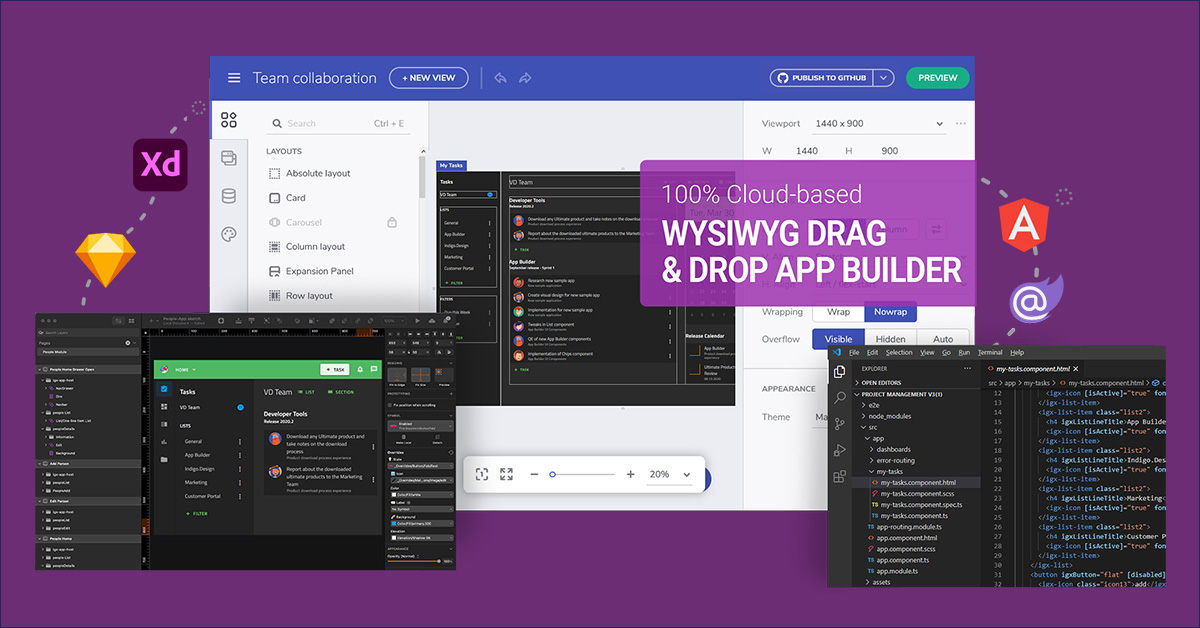
App Builder - Design and Build Real Apps Fast The brand-new App Builder aims to provide design
and development teams with a solution to help them deliver apps quickly and efficiently,
without losing focus on UX. Users can start an app from scratch or choose from a library of pre-built app templates or responsive screen layouts and then customize with a toolbox of 60+ UI controls to kick-start the next digital product design. If a design already exists in Sketch or Adobe…
$1,295
per year per user
Appian
Score 8.2 out of 10
N/A
Appian is a low-code development and business process management platform. It features drag-and-drop design for app building, automated work processes, unified data management, and cloud-based deployment.
$0
Flutter
Score 8.5 out of 10
N/A
Flutter is an open-source mobile application development framework created by Google. It is used to develop applications for Android and iOS, as well as being the primary method of creating applications for Google Fuchsia.
$0
Pricing
App Builder by Infragistics
Appian
Flutter by Google
Editions & Modules
Ignite UI
$1,295
per year per user
Infragistics Professional
$1,295
per year per user
Infragistics Ultimate
$1,495
per year per user
Appian Community Edition
$0
Application - Input-Only
$2
per month per user
Application - Infrequent
$9
per month per user
Application - Standard
$75
per month per user
Platform
Custom Quote Priced per user with unlimited apps.
minimum 100 users, no maximum
Unlimited
Custom Quote Priced per development with unlimited apps.
unlimited
Platform
Custom Quote Priced per user with unlimited apps.
Minimum 100, no maximum
Unlimited
Custom Quote Priced per development with unlimited apps.
Unlimited
No answers on this topic
Offerings
Pricing Offerings
App Builder
Appian
Flutter
Free Trial
Yes
Yes
No
Free/Freemium Version
No
Yes
Yes
Premium Consulting/Integration Services
No
Yes
No
Entry-level Setup Fee
No setup fee
No setup fee
No setup fee
Additional Details
This product is free to use for non-commercial, educational purposes for students in K-12 grades or University programs, and for educators to use in a classroom setting as examples/tools in their curriculum.
App Builder will be great where you have a small team with limited resources. Obviously this product is only good if you are starting a new project. I have used Radzen before which does almost the same thing using a database first approach, but it was a real pain as the application crashes a lot.
Appian works great for automating manual processes and integrating multiple systems through its toolset. It gives great flexibility for establishing rules for approvals, routings, escalations, and the like. Because of the low code toolset, it's very easy to deploy and make changes as needed as processes evolve and as the organization learns to utilize the system better. Minimal maintenance is required to support the applications build on the platform. Some of the automated testing integration with tools like Jenkins is limited so that may be an issue for some.
Flutter by Google is well suited where you have to make an app across multiple platforms like iOS, Android, Web, Desktop and you don't have the bandwidth to create multiple teams for the Native app. This makes sure you have a faster development and you don't have to worry about how your product will look across different platforms. It is also very smooth/fast in response, making it close to feel like a Native app, this makes it an easy pick for a Fintech product where speed matters. Flutter by Google also has a huge library of Components, which are well tested and developed by Google's Flutter by Google team itself, making the development even more fast since the majority of required components are already available.
Allows at a glance workflow documentation which assists in the need we have for information readiation.
Drag and drop interface for workflow development greatly speeds our apps time to market.
Using the advanced features of Appian, we are able to create working sites in a fraction of the time it would take to do so using "traditional" development.
Search issues when type ahead and database search are used in the same field.
Buttons implementation where user is require[d] to click on the button description - if clicks on the button outside that text - button will not work.
Problems with using certain off-the-shelf performance tools like WebLoad or Neoload. That is because of different dynamic variables being used internally in Appian - which these tools are unable to correlate. We are still investigating using other tools like Jmeter to overcome dynamic correlation problem for performance testing.
Occasionally updates to the Flutter SDK result in wide-sweeping changes that seem to not be thoroughly tested and considered. Flutter sometimes evolves too fast for its own good.
While the 3rd-party Flutter package ecosystem is vast and rich, 1st-party support for basic things (audio/video playback, battery information, Bluetooth services, etc.) are lacking. You are occasionally forced to rely on an open-source package for use-cases that other platforms have native support for.
Documentation, particularly around testing, is lacking. While there are some great docs, like the Dart Style Guide, many Flutter-focused support documents are lacking in quality and real-world usability.
Flutter allows you to architect an app however you want. While this is a great feature, it also adds complexity and leads to the current state of Flutter's state management, where there are 50+ options on how to organize your app, with very little official guidance or recommendations from the Flutter team. For a beginner, this can create decision paralysis.
We recently renewed our license with Appian. We are convinced that its flexibility, relative ease of use, the support they provide, there mobile advancements and their general willingness and desire to see us succeed all contributed to our reason to renew our agreement with Appian
Appian is a low code environment, because of this, a very good visual interface is required. Appian is providing a feature-rich dashboard [that] we can use for building the dashboards and other interfaces. Appian also provides patches and releases to enhance these features. A developer can start off development just by going through a basic course from the Appian learning community.
Flutter by Google is very easy to start with. The initial setup they provide is very helpful and easy to understand. The default project setup is also good and can be deployed to production without changing much. Flutter by Google provides a huge library of components, which are created and tested by their own team, making the development of application much faster and robust. Flutter by Google also has a huge community support where we can find components built by the community and we can contribute our own components as well, which helps in faster dev time. Applications developed using Flutter by Google are very smooth, almost feels like native, which helps in creating good impression on customers/clients.
Appian is one of the leading low code business automation platforms that support RPA, decision rules, case management, workflow automation, and machine learning all in a single bundle. But it is also harder to implement and replace the traditional business process.
As analyst I participated in a developer boot camp. At times it was hard to keep up but most of the time it made sense. Trainer took the time to explain and slowed pace down to answer questions etc.
Appian has enormously transformed and keeps on updating the product every quarter to meet the latest needs of the world with new innovations & technologies being integrated within the platform. What gives more pleasure than a product that keeps on continuous[ly] improv[ing]?
I have experience with react and React Native. I would say that the idea behind all those frameworks are quite similar. However, I found the javascript-based frameworks a bit more accessible as you could utilise your javascript knowledge. Here, Flutter works with its own language. This has advantages and disadvantages sometimes. I found the community around javascript frameworks bigger and therefore sometimes more helpful. However, Flutter does a good job here as well. I think the main argument for Flutter is its usability for less experienced developers. If you do not have knowledge in javascript or other programming languages then I think it is much easier to start with Flutter than with another framework like react. I think the package that you get form scratch is better than in the other frameworks were you have to set up and learn a lot more before you can start.
I believe it has negatively impacted our release dates. There may have been a misunderstanding as to the learning curve, even though it is "low code."
The look and feel of the applications created using Appian have uniformity and it's easier to have "reuse" between applications.
There is less developer control when it comes to features. I think this mainly has to do with the amount of plugins available. I would think there should be many more available plugins. But again, our use case is probably different than most others.
The rapid development capabilities of Flutter allow us to build apps we could not have previously considered commercially viable, opening new revenue streams.
Free and open licensing made adoption very easy (ie. free/low cost!).
In comparison to Qt, our time spent arguing with build tools and perfecting development environments has decreased substantially.