Axway's Amplify is a universal API management platform that unifies what tools are already in place to get digital products where they can be seen and used. Users can publish, validate, and govern APIs.
N/A
Anypoint Platform
Score 7.9 out of 10
N/A
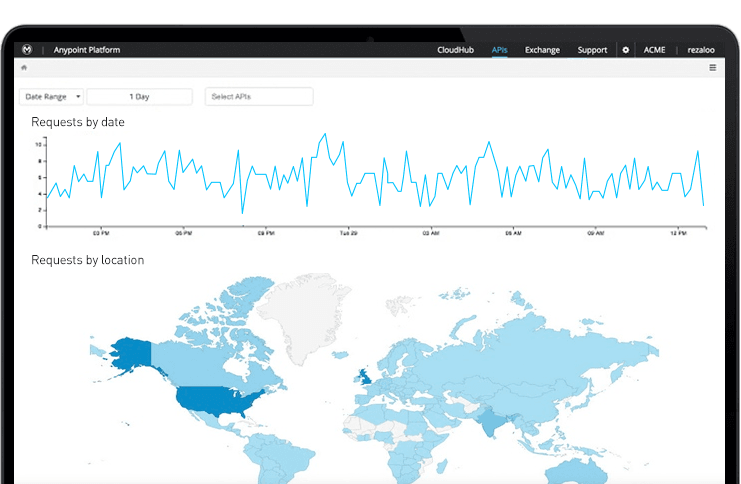
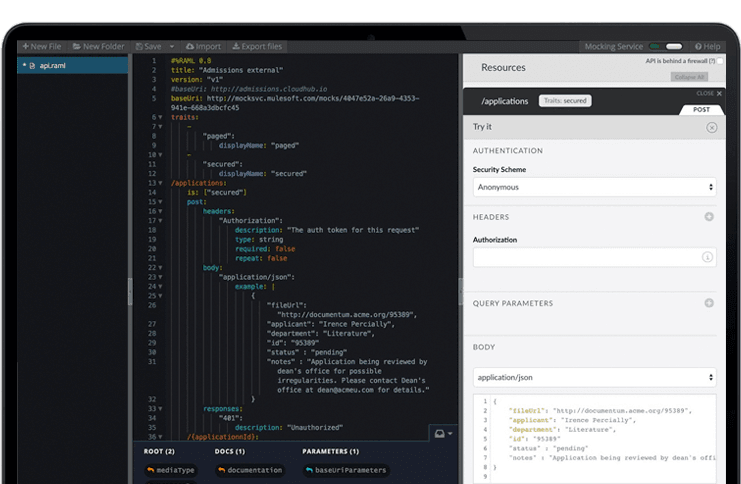
The Anypoint Platform developed by MuleSoft and acquired by Salesforce in early 2018 is designed to
connect apps, data, and devices anywhere, on-premises or in the cloud. This platform was built to
offer out-of-the-box connectors as well as tools that architects and developers can adopt quickly to
design, build and manage the entire lifecycle of their APIs, applications, and products.
N/A
WSO2 API Manager
Score 9.4 out of 10
Enterprise companies (1,001+ employees)
WSO2 API Manager makes it possible for developers to both develop and manage APIs of different types. Unlike solutions which focus only on managing API proxies, WSO2 API Manager provides tools to develop APIs by integrating different systems as well. It supports a variety of API types from REST, SOAP, GraphQL, WebSockets, WebHooks, SSEs and gRPC APIs with specialized policies and governance for each different type. Being fully open source, its architecture and extensibility…
It enables customers to expose their APIs in a very simple and fast way. It can be used by non-expert developers. It is compliant with all major connection and data representation world standard.
WSO2 API Manager
No answer on this topic
Features
Axway AMPLIFY Platform
MuleSoft Anypoint Platform
WSO2 API Manager
API Management
Comparison of API Management features of Product A and Product B
Axway AMPLIFY Platform
10.0
1 Ratings
17% above category average
MuleSoft Anypoint Platform
-
Ratings
WSO2 API Manager
8.8
4 Ratings
4% above category average
API access control
10.01 Ratings
00 Ratings
9.54 Ratings
Rate limits and usage policies
10.01 Ratings
00 Ratings
9.54 Ratings
API usage data
10.01 Ratings
00 Ratings
8.04 Ratings
API user onboarding
10.01 Ratings
00 Ratings
8.04 Ratings
API versioning
10.01 Ratings
00 Ratings
9.04 Ratings
Usage billing and payments
10.01 Ratings
00 Ratings
9.04 Ratings
API monitoring and logging
10.01 Ratings
00 Ratings
8.54 Ratings
Cloud Data Integration
Comparison of Cloud Data Integration features of Product A and Product B
It's a great application to backup your data automatically to the cloud and then access later. The automatic restore of certain folders is handy and one less thing to worry about when you're setting up a new PC again. I haven't really encountered any issues with Syncplicity to have any thoughts where it could be improved or where it wouldn't work.
MuleSoft Anypoint Platform is best tool in the market for developing APIs with complex structures communicating with various different types of applications including web applications as well as legacy applications. Also applications including database connectivity for fetching and updating data in the DB tables. I cant think of any scenario which MuleSoft Anypoint Platform could not be used for developing the integrations.
It's free! No argument can win a fight with that! And it's the only reason I gave it a 5. If you have no money to spend, and a simple environment you'll have a nice product. But free does come with a price. After 5 years we're still struggling with ports, and analytics (it just won't work without any errors caused by some configuration somewhere). An API Manager should work out of the box. The only configuration expertise that any developer wants to invest in, is the configuration of API's. Not the product itself... Anyone who've seen the training material, just for installing this thing will agree that this is not the way to go. Of all the API Managers out there (we've tried 4), WSO2 is the only one were you need to know how this dragon of a java application works internally. Did I already mention the humongous amount of config files?
I would appreciate it if it backed up more than just Desktop, Favorites and Documents by default. I'm not sure if this was something chosen by my employer, but it would be nice if the whole profile folder was backed up by default, so my pictures, music, and videos folders were included.
Has more features than what we really need so we're paying for more than we use. Sort of like paying for an Abrams tank when all we really need is a Toyota Corolla.
Not a value product, tends to be expensive.
Takes a while for developers to learn to use Mulesoft Anypoint.
It offers a wide range of powerful tools for API management, data integration, B2B integration, and more. Strong security features and compliance support add significant value. Flexibility to integrate across various environments (cloud and on-premise) enhances usability for diverse infrastructures.
There’s a lot of learning curve at the beginning when it comes to building the code and everything. In terms of usability, I’d say once you get used to it, it’s fine — but it’s not very easy during the initial stages.
Anypoint Platform support is very responsive. There is also a huge knowledge base and an active online forum where answers to most questions can be found. When needed support engages the engineering group so adequate solutions or workarounds are always provided.
I use CrashPlan for my personal PC at home. I think both products have their pluses and minuses. Both products allow you to backup your selected data to the cloud. CrashPlan doesn't easily allow for file sharing (CrashPlan isn't really a collaboration tool as much as it is a backup tool). Both products have easy restore options. However Syncplicity automatically restoring certain data when syncing with a new PC is very handy and a feature that CrashPlan doesn't offer
Once we have moved all of our system integration APIs to the MuleSoft Anypoint Platform, we will need to communicate with a wide variety of external systems. All of our business and service logic is stored in the aforementioned core systems. Anypoint Platform (and all of our APIs) makes it easy to connect to various other platforms. In order to link to these many other systems, connectors and/or components are utilized, and they are simple to configure and integrate.
Providing better capabilities comparing the overall API lifecycle management, especially the availability of API Integration layer and a strong identity layer of their own which provides an end-to-end API ecosystem that would be advantageous in terms of a large software development initiative.
We've moved away from legacy SOAP services where nobody knew what services was used by who. WSO2 eliminated at least 90% of time spend on any service.
Creating API's (or actually creating the API Management layer...) is so simple that new developers can get away with it in no time. Again, real time gainer.
Since creating API's is so simple, developers are very fast in adopting a kind of "Domain thinking". In comparison with Azure API Manager: Azure does not demand knowledge of "how" the product works, but it's definitely more difficult to get an API up and running in Azure. And for some reason, azure does not promote clean domain driven architecture. Domain Driven architecture is the greatest time saver strategy possible. And WSO2 fits nicely in there.