The Microsoft Azure App Service is a PaaS that enables users to build, deploy, and scale web apps and APIs, a fully managed service with built-in infrastructure maintenance, security patching, and scaling. Includes Azure Web Apps, Azure Mobile Apps, Azure API Apps, allowing developers to use popular frameworks including .NET, .NET Core, Java, Node.js, Python, PHP, and Ruby.
$9.49
per month
Progress Telerik
Score9.4 out of 10
N/A
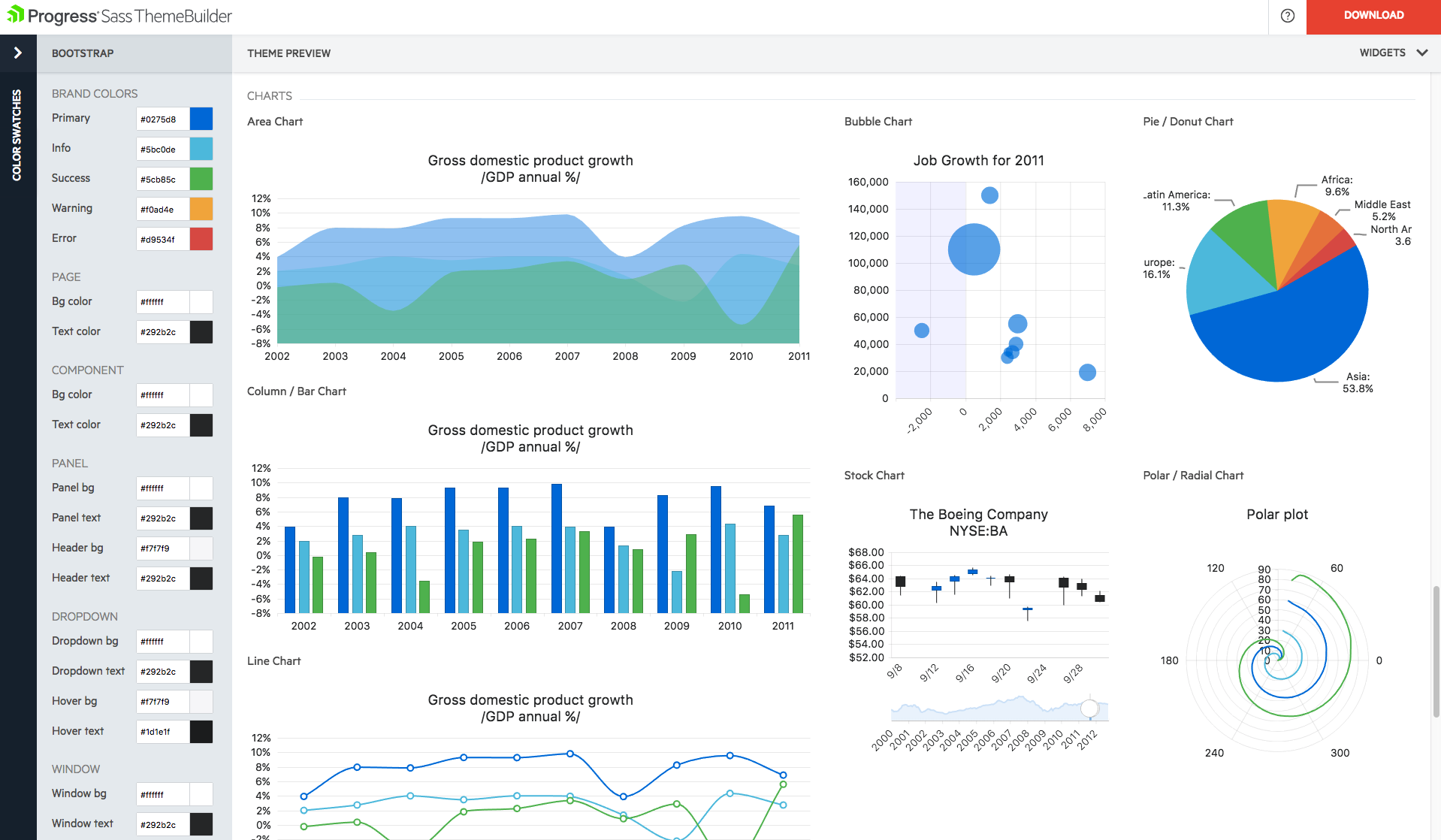
With Telerik UI libraries, Progress aims to equip .NET ninjas with a full arsenal of weapons, helping to create beautiful, modern and future-proof applications quickly and intuitively. The vendor states that with its over 1,250 UI components for all .NET platforms, as well as various themes, skins and customization options, Telerik users report cutting development time by up to 50 percent. Web
$999
per developer, royalty-free
Pricing
Azure App Service
Progress Telerik
Editions & Modules
Shared Environment for dev/test
$9.49
per month
Basic Dedicated environment for dev/test
$54.75
per month
Standard Run production workloads
$73
per month
Premium Enhanced performance and scale
$146
per month
Individual Product Licence
$999
per developer, royalty-free
DevCraft UI
$1,299
per developer, royalty-free
DevCraft Complete
$1,499
per developer, royalty-free
DevCraft Ultimate
$2,199
per developer, royalty-free
Offerings
Pricing Offerings
Azure App Service
Progress Telerik
Free Trial
Yes
Yes
Free/Freemium Version
No
No
Premium Consulting/Integration Services
No
Yes
Entry-level Setup Fee
No setup fee
No setup fee
Additional Details
Free and Shared (preview) plans are ideal for testing applications in a managed Azure environment. Basic, Standard and Premium plans are for production workloads and run on dedicated Virtual Machine instances. Each instance can support multiple applications and domains.
—
More Pricing Information
Community Pulse
Azure App Service
Progress Telerik
Considered Both Products
Microsoft
No answer on this topic
Progress Software
Verified User
Chose Progress Telerik
Rapid development and easy integration with applications.
A de minimis incentive was given to thank the reviewer for their time. The incentive was not used to bias or drive a particular response, nor was the incentive contingent on a positive endorsement. More Info
You may easily deploy your apps to Azure App Service if they were written in Visual Studio IDE (typically.NET applications). With a few clicks of the mouse, you may already deploy your application to a remote server using the Visual Studio IDE. As a result of the portal's bulk and complexity, I propose Heroku for less-experienced developers.
A de minimis incentive was given to thank the reviewer for their time. The incentive was not used to bias or drive a particular response, nor was the incentive contingent on a positive endorsement. More Info
We have used the Telerik UI controls for our Admin user experience. We found that this lead to consistent user experience, with feature rich functions already provided. Effectively this meant that hour for hour, using the Telerik UI improved productivity in creating screens with more functions than using the default controls in ASP.NET. At this point most of our focus with the Telerik controls is User Interface oriented.
A de minimis incentive was given to thank the reviewer for their time. The incentive was not used to bias or drive a particular response, nor was the incentive contingent on a positive endorsement. More Info
A de minimis incentive was given to thank the reviewer for their time. The incentive was not used to bias or drive a particular response, nor was the incentive contingent on a positive endorsement. More Info
You may wind up putting a lot of eggs in one basket--not necessarily a con but something to keep in mind (most of your data will likely be managed and processed through Microsoft products/services if you fully commit to Azure App Service).
Learning new technology. If you're moving from on-premises to Azure App Service (or any cloud solutions), you'll likely have to rethink how things are done to achieve the same end results (and/or resources may become expensive quickly).
A de minimis incentive was given to thank the reviewer for their time. The incentive was not used to bias or drive a particular response, nor was the incentive contingent on a positive endorsement. More Info
A de minimis incentive was given to thank the reviewer for their time. The incentive was not used to bias or drive a particular response, nor was the incentive contingent on a positive endorsement. More Info
The Telerik UI has become part of our staple development tools. We can not be as productive without the feature set available to us in the Telerik UI ASP.NET AJAX control package.
I have given this rating because Azure App Service performs very well in terms of speed, reliability, and reducing overhead, and improves overall team productivity, with a little scope for improvement in complex testing scenarios and configurations, scalability concerns in a large setup, and similar tracking and audit needs.
A de minimis incentive was given to thank the reviewer for their time. The incentive was not used to bias or drive a particular response, nor was the incentive contingent on a positive endorsement. More Info
Progress Telerik UI is very usable and one of the best tools to use by the front-end development engineers in our team. It has helped us to improve the overall design of our existing and new applications. Also, the time to build applications has also been reduced effectively and we are able to focus on other areas of improvement to deliver a better user experience for our customers.
A de minimis incentive was given to thank the reviewer for their time. The incentive was not used to bias or drive a particular response, nor was the incentive contingent on a positive endorsement. More Info
Microsoft has always been known for providing a high standard in terms of customer support and Azure App Service (and as a matter of fact the whole Azure Platform) is no exception. Azure App Service never caused us any issues and we only contacted their customer support for questions regarding server locations and pricing. I feel pretty satisfied with how they treat their customers.
A de minimis incentive was given to thank the reviewer for their time. The incentive was not used to bias or drive a particular response, nor was the incentive contingent on a positive endorsement. More Info
Telerik UI support is what you are paying for. If something does not work you ask them for an example of how to solve your use case. The SEO on their sites is awesome and so well bedded into Google. The videos are good, [they're] not used much but their examples and DoJo examples make all the difference.
A de minimis incentive was given to thank the reviewer for their time. The incentive was not used to bias or drive a particular response, nor was the incentive contingent on a positive endorsement. More Info
When we chose it, we did so because of its integration with Microsoft applications; now we need to integrate with AI, and Azure doesn't offer a good integration. That is the main reason to change it. It is still great to develop Windows- and Microsoft-based applications, but if we need to integrate with AI, Google wins by far.
A de minimis incentive was given to thank the reviewer for their time. The incentive was not used to bias or drive a particular response, nor was the incentive contingent on a positive endorsement. More Info
Progress Telerik UI provides a large amount of language support, demos, and documentation. While the competition is still great in their own right, Progress Telerik UI has provided enough resources to cover a number of current and future projects without having to expand to other libraries.
A de minimis incentive was given to thank the reviewer for their time. The incentive was not used to bias or drive a particular response, nor was the incentive contingent on a positive endorsement. More Info
Deployment of ASP.NET apps at the organization has been sped up.
An option to offer access to the version control system on a third platform so that we could easily deploy our apps.
Because of Azure App Service's scalability capabilities, the costs of running the services are kept to a minimum. As a result, we may save hundreds of dollars each month compared to the expenses of traditional servers by using fewer resources during slack periods.
A de minimis incentive was given to thank the reviewer for their time. The incentive was not used to bias or drive a particular response, nor was the incentive contingent on a positive endorsement. More Info
A de minimis incentive was given to thank the reviewer for their time. The incentive was not used to bias or drive a particular response, nor was the incentive contingent on a positive endorsement. More Info