Microsoft's Azure Machine Learning is and end-to-end data science and analytics solution that helps professional data scientists to prepare data, develop experiments, and deploy models in the cloud. It replaces the Azure Machine Learning Workbench.
$0
per month
SAP Data Intelligence
Score 8.7 out of 10
N/A
SAP Data Intelligence is presented by the vendor as a single solution to innovate with data. It provides data-driven innovation in the cloud, on premise, and through BYOL deployments. It is described by the vendor as the new evolution of the company's data orchestration and management solution running on Kubernetes, released by SAP in 2017 to deal with big data and complex data orchestration working across distributed landscapes and processing engine.
N/A
Talend Data Fabric
Score 10.0 out of 10
N/A
The Talend Data Fabric helps organizations to achieve and maintain complete, trustworthy, and uncompromised data, so that they can stay in control, mitigate risk, and drive value.
As we are implementing and using SAP 4HANA platform in other related projects, we have seen an advantage in utilizing SAP Data Intelligence. Also, with improved ETL pipelines and migration functionalities implemented, we have considered the financial aspect of the platform - …
If you have an SAP products ecosystem in your IT landscape, it becomes a no-brainer to go ahead with an SAP Data Intelligence product for your data orchestration, data management, and advanced data analytics needs, such as data preparation for your AI/ML processes. It provides a seamless integration with other SAP products.
Truly trusted contact center where the effective solution is always guaranteed. It is not a one-off fix to a specific data integration or management problem. It is a permanent and scalable solution to manage all of your data under a unified environment. Easy to use, great performance, used it for our internal data warehouse. Easy to build and connect to our data sources such as Salesforce, Netsuite, and Marketo.
User friendliness: This is by far the most user friendly tool I've seen in analytics. You don't need to know how to code at all! Just create a few blocks, connect a few lines and you are capable of running a boosted decision tree with a very high R squared!
Speed: Azure ML is a cloud based tool, so processing is not made with your computer, making the reliability and speed top notch!
Cost: If you don't know how to code, this is by far the cheapest machine learning tool out there. I believe it costs less than $15/month. If you know how to code, then R is free.
Connectivity: It is super easy to embed R or Python codes on Azure ML. So if you want to do more advanced stuff, or use a model that is not yet available on Azure ML, you can simply paste the code on R or Python there!
Microsoft environment: Many many companies rely on the Microsoft suite. And Azure ML connects perfectly with Excel, CSV and Access files.
It supports a wide variety of connectors (Systems/endpoints)
It provides great flexibility for developers as it not only has a lot of predefined ready to use the function but also provides the ability to use complex java code within the platform. Great tool if you have good developers available.
Data transfer speed tends to be slow when there is poor internet connection since SAP Data Intelligence don’t synchronize data while offline. However, this is not vendor fault, that’s why we have implemented robust wireless technology internet connection in our organization.
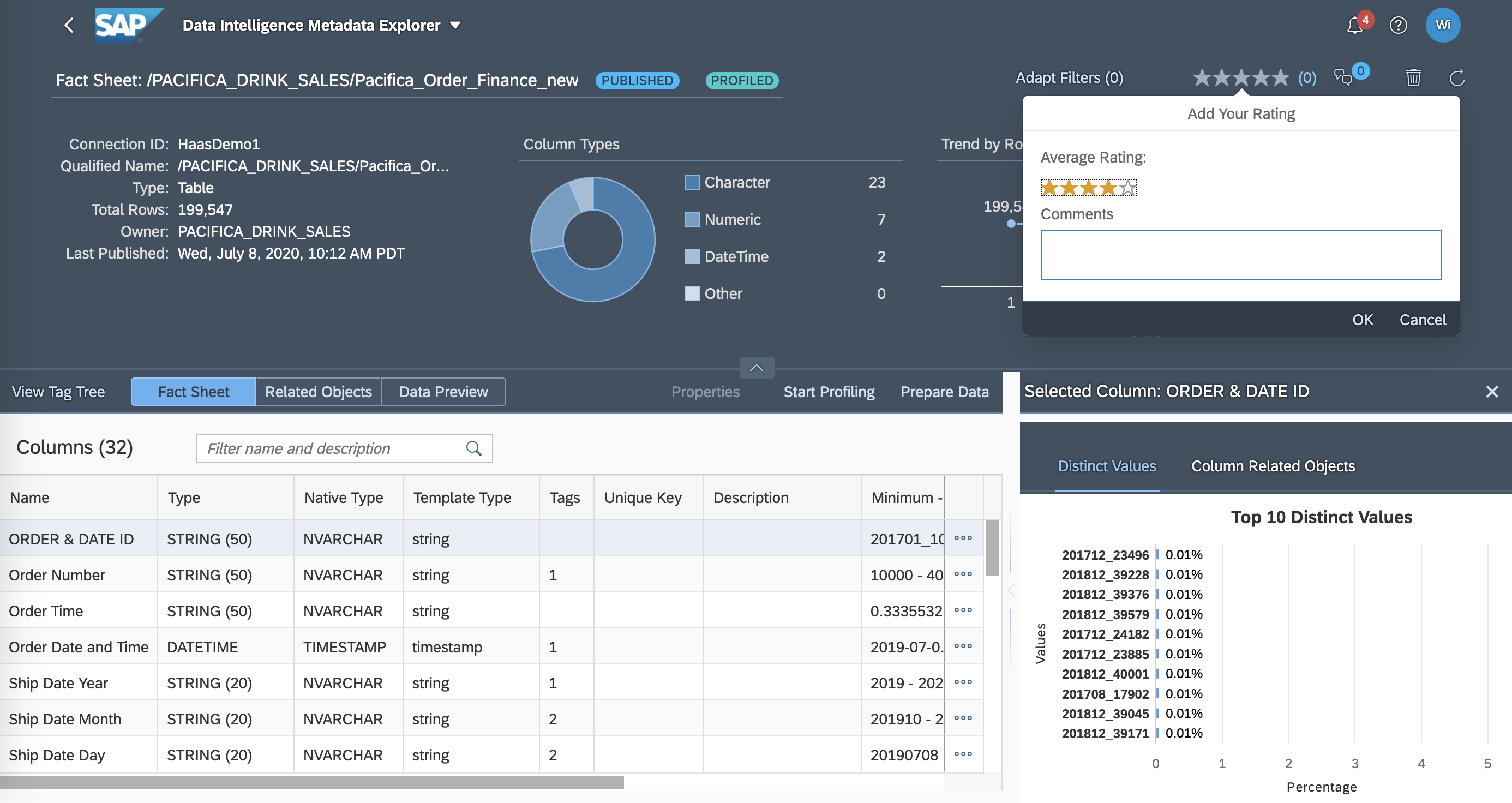
Allow collaborations among various personas with insights as ratings and comments on the datasets Reuse knowledges on the datasets for new users Next-Gen Data Management and Artificial Intelligence
I think the troubleshooting process might be streamlined with improved error recording and tracing. A lot of information about issues and how to fix them is hidden away in the Kubernetes pods themselves. I'm not sure whether SAP Data Intelligence can fix this problem it may be connected to Kubernetes's design, in which case fixing it could need modifications inside Kubernetes itself.
At this moment the usability of Talend Data Quality is optimal, too bad I cannot say the same in the first three months, it was always a problem due to its steep learning curve, but what matters is being able to use it effectively at this precise moment.
Initially we struggle to get help from SAP but then dedicated Dev angel was assigned to us and that simplify the overall support scenario. There is still room of improvement in documentation around SAP Data intelligence. We struggle a lot to initially understand the feature and required help around performance improvement area,
Talend Data Quality gave us direct help in the learning process and prevented us from taking many more months to adapt and I appreciate this from the heart, I think that thanks to the support we can have very detailed reports that help increase the use of Talend Data Quality in the company.
It is easier to learn, it has a very cost effective license for use, it has native build and created for Azure cloud services, and that makes it perfect when compared against the alternatives. As a Microsoft tool, it has been built to contain many visual features and improved usability even for non-specialist users.
One of the reasons to pick SAP Data Intelligence is the speed and security it provides, in addition to the excellent support it provides. It is also compatible with all popular databases, which is another reason to choose it.
The engine with which it works to process a lot of information is striking, the comparison also being the connectors it has for different RDBMS, which other tools do not count as they are GNU licenses or community editions. The friendly and intuitive environment is what catches the eye. that's why I choose Talend over any other tool
Productivity: Instead of coding and recoding, Azure ML helped my organization to get to meaningful results faster;
Cost: Azure ML can save hundreds (or even thousands) of dollars for an organization, since the license costs around $15/month per seat.
Focus on insights and not on statistics: Since running a model is so easy, analysts can focus more on recommendations and insights, rather than statistical details