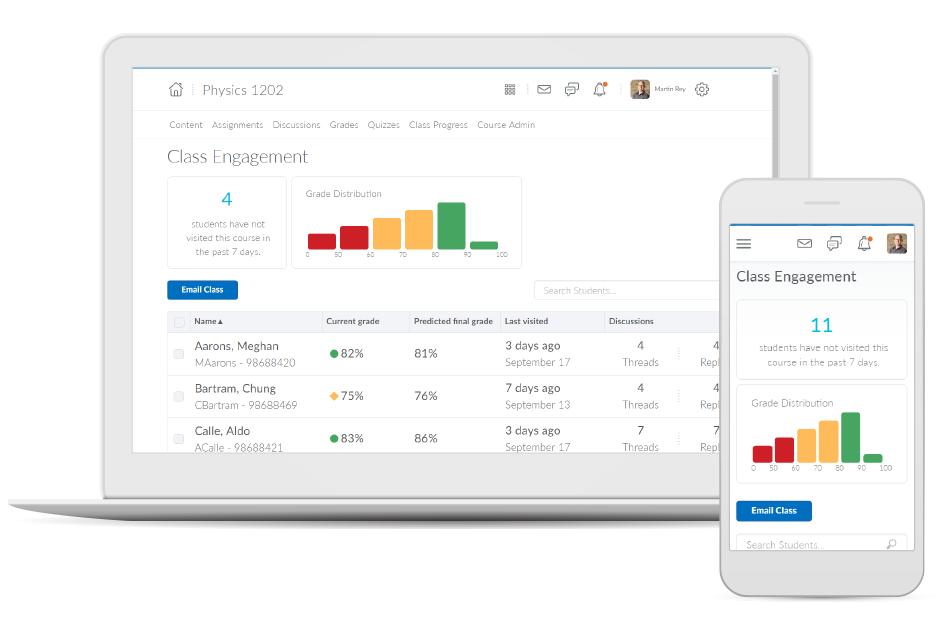
Brightspace is an academic and corporate learning management platform. It provides core e-learning features, as well as mobile accessibility and granular personalization and analytics insights.
N/A
Google Classroom
Score 8.1 out of 10
N/A
N/A
$0
per license/per month
RevSure AI
Score 0.0 out of 10
N/A
RevSure is a GTM platform for forecasting pipeline, revenue, and ROI goals. Purpose-built for modern B2B teams, it combines full-funnel analytics, predictive intelligence, and proactive recommendations to help prove marketing’s impact.
$2,000
per month (includes up to 50,000 MAP contacts and 10 users)
Pricing
D2L Brightspace
Google Classroom
RevSure AI
Editions & Modules
No answers on this topic
Education Fundamentals
$0
per license/per month
Google Workspace for Education Standard
$3
per student/per year
Teaching and Learning Upgrade
$4
per license/per month
Google Workspace for Education Plus
$5
per student/per year
Early Adopter
starts at $2000
per month (includes up to 50,000 MAP contacts and 10 users)
Growth
starts at $6000
per month (includes up to 150,000 MAP contacts and 15 users)
Enterprise
Custom
Offerings
Pricing Offerings
D2L Brightspace
Google Classroom
RevSure AI
Free Trial
Yes
Yes
No
Free/Freemium Version
No
No
No
Premium Consulting/Integration Services
No
No
No
Entry-level Setup Fee
No setup fee
No setup fee
No setup fee
Additional Details
Must contact vendor for pricing information. 30-day free trial is available.
Education Fundamentals Version - 30-day free trial for qualifying institutions.
Higher contact limits available on Early Adopter and Growth plans for additional cost.
More Pricing Information
Community Pulse
D2L Brightspace
Google Classroom
RevSure AI
Considered Multiple Products
D2L Brightspace
Verified User
Anonymous
Chose D2L Brightspace
It's an all-in-one platform with great analytics. It can also easily be used for external training programs, which is important for a B2B use case. I really like how it can embed different types of content, like video, and the integrations are also great. It is more costly than …
Brightspace is by far the most user-friendly LMS I have ever used. Faculty with a lower technical skill set have an easier time navigating Brightspace features. Teaching wise, I have also found Brightspace to be easier for students to navigate than its competitors. I adjunct …
In looking at Brightspace versus its competitors currently, it continues to provide the widest functionality, great value, and better ability to tailor the user experience of it to our organizations needs. The longer that our institution has had Brightspace, the more we've been …
Compared to Blackboard, Brightspace is a much more powerful application that allows instructors to share more content, customize their courses, and design courses in a more intuitive wizard style if desired. Brightspace is also designed to work well on mobile devices and …
Brightspace offers one of the most tailored employee engagement learning platforms in existence. My organization has utilized a multitude of employee engagement and learning platforms and Brightspace has offered one of the most customized tools that we have used thus far. We …
We migrated from PLS. Brightspace is much more intuitive and modern than PLS was. The ability for Brightspace to work across a range of devices (mobile, tablet, PC, Mac, etc) has been positive for our instructors and students. The main interface is straightforward and easy to …
Although it's been some time since I used Blackboard (as a student in my undergraduate degree), it felt much more intuitive at the time than Brightspace has when I've taken or taught classes. However, I don't feel especially comfortable comparing them since it's been quite …
I used blackboard when I was in college, but that was very little. I just used it to register for classes and to view grades. Brightspace is leaps and bounds what Blackboard was when I last used it in 2010.
I have used Blackboard Learn 8 and 9. I am currently learning about Canvas. Blackboard is overall much clunkier and lacks the intuitive feel in some parts of D2L. Its grade book is much harder to control and manipulate than D2L's. Its navigation menu can be more radically …
I was not involved in the selection process for my organization since I am only a professor. However, I have worked at 2 previous organizations that have used other online LMSs, and I think overall, D2L is at the top of the list of LMSs I find the most usable.
Desire2Learn was selected for me, but I find it to be simpler to navigate than Moodle, more intuitive. Blackboard was many years ago, but I find more flexibility in assigning due dates and end dates in the newer version of Desire2Learn.
Faculty Development Coordinator & Emerging Technologies Specialist
Chose D2L Brightspace
Comparing Desire2Learn to Blackboard Vista, I actually believe that Blackboard has a better product, although it has its own set of challenges. We changed systems because of the extremely poor customer service and high level of faculty irritation with Blackboard at the time. I …
Desire2Learn is very good compared to Blackboard and has a lot more flexibility with presenting and organizing material. Desire2Learn is about the same as WebCT. There are similar features and while each one has its drawbacks, they are both acceptable for my current class …
Desire2Learn is similar to Blackboard but with less functionality and intuitiveness in terms of use. Grading options are more limited. Desire2Learn uses a cluttered interface with many tabs and options needing to be used to create even basic assignments for upload and grading. …
The Desire2Learn system provided a greater ability to customize the learning environment than the Canvas system we evaluated. We did like the simpler interface that Canvas provides and the navigation was easy to follow. We also evaluated the Blackboard LMS and found a large …
We believe D2L to be the best LMS, based on our long-term use, functionality, and overall product stability.
Verified User
Anonymous
Chose D2L Brightspace
Some faculty have used WebCT, Blackboard, Angel and/or Moodle in the past. Most of us really do like D2L the very best!
Verified User
Anonymous
Chose D2L Brightspace
These days, most LMS systems provide somewhat comparable feature sets. We selected Desire2Learn because our organization saw it as a stable product that would scale well, we could manage our own self-hosting hardware and infrastructure, it is a tool that our faculty and …
Google Classroom
Verified User
Anonymous
Chose Google Classroom
Google Classroom has clearer due dates, they can see what’s due, what’s new, and what’s missing immediately after opening the Google Classroom, even in their mobile. That makes it more intuitive and simpler to use, especially for people that aren't tech savvy. It also can be …
This is a different platform, but it's easy to chat with others when you need to for work or other conversations.I like how convenient it is to access.
Google Classroom is good for testing learning program structure in a low-cost solution. It is also good for short and simple learning paths, that need to be integrated with Google Forms or other tools from Google Suite. It stacks up against other platforms when learners already …
Skyward and Google Classroom are completely different programs that are used for completely different things. The only comparable areas are communication with students. Skyward does so through the class rosters and message center and Google Classroom does so through the …
I was lucky enough that I was referred to Google Classroom by the head of the math department at a local school who have been using the platform since Covid. The only other education platform I've used is Udemy where I did some courses. I have not Used Udemy to build a course …
Google Classroom stacks up well against similar platforms, offering a user-friendly interface, seamless integration with Google Workspace, and efficient assignment management. The selection of Google Classroom often depends on existing software ecosystems, user familiarity with …
Google Classroom's toolset is suited better for younger students. In our use of systems like Schoolbox and Canvas, they are better suited for older students(Year 7-12). These tools offer integrations into a school database which helps in cutting down double handling data. But, …
Google Classroom has a well-organized data sharing and data collection pipeline whereas others don't. Google Classroom has a plagiarism checker whereas others don't.
I think Google Classroom is a more complete package than Khan Academy because of its integration with Google Classroom and it is a well-suited platform for student learning because it allows students to post questions on discussions and participate in its platform. Google Meet …
I selected Google Classroom because it is a great website for managing and organizing learning. It is simple to use for interface; interacts with a wide range of apps and websites; effortlessly shares, collects, and grades Google Workspace documents. It is also free , …
Google Classroom ties to the Google G Suite for EDU which has very good support and documentation as needed, at no additional cost, which is a big deal for setting it up. The integration with Chromebooks, Active Directory, Clever and other common platforms make it very …
Google Classroom was chosen unilaterally for one of my places of work, although I had checked Google Classroom when it was first released and decided against it for my own company owing to its poor reporting and other controls. Provided one has the servers to use it and an …
I think Google Classroom is better suited for younger audiences and less tech-involved than a Blackboard or Canvas site. I would much rather use google classroom with my student in a middle school than Blackboard and Canvas which are better suited for colleges. I think those …
To create an instructional space online, Google Classroom is ahead of its competitors. It does precisely what educators need - create a virtual classroom where students can collaborate, post discussions, post their work, and receive immediate feedback. It feels like a real …
As a member of a large-scale organization with a wide variety of employment positions, I view Brightspace as primarily an administrative solution for continuous learning and engagement. As an educational platform, Brightspace works perfectly for setting learning goals for particular groups or departments. Furthermore, there are many customization options intent on personalizing the overall user experience for employees. The platform also does a wonderful job of increasing overall engagement, retention, and completion of learning goals. However, I do not necessarily view Brightspace as the learning tool for all employees. There are production employees within my company and they may better benefit from other learning tools that do not require being on a computer.
- During the pandemic, the college needs a fast and easy solution to conduct Google Classroom. The integration with Google Accounts and Google Meet allows the university to run and access the Classroom on a large scale. - The teacher wants to conduct some exams in third-party software like Moodle. But we have not found any plugin for this famous open-source learning platform. The exam system in Google Classroom is so poor that it doesn't even fully screen the test when students are writing their exams.
The grade book is very customizable. There is a learning curve, as there always is if something is flexible, but there are a lot of good options available for grading, displaying grades, and calculation of grades.
Adding course content of many types can easily be done using drag & drop or copy-paste. It is easy to retain stored content from semester to semester. Updating an item takes three clicks. It is easy to organize and reorganize content and allows sub-sections. It records whether individual students have opened material and how much time they spent using an item.
I like the flexibility of organizing the dropbox for student submissions. Deadlines in the dropbox or discussions automatically appear in the course calendar.
I like the range of quiz question options, in particular, the "multi-select" question type.
Student-teacher communication - I love using Classroom for this because my students can always go back and check what was on Classroom by looking through the stream. This way they don't have to go dig through emails to find what they're looking for.
Posting to multiple classes - I can post the same announcement or assignment to multiple classes at once without having to repeat the process or send separate emails.
Streamlining grading - when students turn work in on Classroom, it all goes to one place and then when I'm grading I can open their documents directly from Classroom or my Drive folder. This way, I'm not looking through emails and Google Doc shared files for their assignment.
The use of rubrics in the discussion area and the quizzes area could use some TLC. The rubrics actually have to be added to the grade book item for them to be functional. In the Discussion area the instructor is unable to grade them discussions and publish them to the grades area. In quizzes, students are not able to see the rubric at all. If the rubric functioned in these two tools like they do in the dropbox they would be a very useful tool.
The discussion area could benefit from a few different enhancements. There is currently no way to grade group restricted discussions without having to manually enter the grades in the grade book or setup a different grade item for each group and then someone restrict those grade book items to individual groups. It is not an easy process one way or the other. The discussion area would also benefit from the ability to add categories so that Forums could be grouped by a certain category (i.e. Units)
D2L needs to invest some time and resources to develop/redevelop blogging, journaling, and wiki in the LMS.
Although usually in the discussion with other LMS apps such as Schoology and Canvas, Google Classroom doesn't possess as in-depth of a platform. There is no ability to set individual learning paths, pace student work with completion settings, or embed other apps directly into teacher-created assignments.
The assignment creation options are limited. Teachers can only choose from creating an assignment (usually a link with directions), a material (usually a doc/slide/website, etc), a question, and a quiz.
With gamification taking on a new lens in education, there really isn't any way to use gamification elements with Google Classroom. There isn't any way to create Individual learning paths, or use badges and micro-credentials within Classroom. Outside programs would have to be used.
Our faculty and students are satisfied with D2L, find its features to be mostly intuitive, and it is sufficient for our needs. After version 10.4, D2L will be going to a continuous incremental release model, which will allow them to innovate more frequently. The introduction of version 10 has been a tremendous improvement over prior versions. D2L has integrated well with our ERP (Peoplesoft) and it has become a core part of our technology suite.
Testing is particularly important in online learning, and Google Classroom falls far short of other learning management systems in this regard. Security is also a concern: while account control is reasonable for the account used with Google Classroom, the person controlling a particular account is often able to, for example, forward or download proprietary materials.
I really love the mobile application. Allowing folks to do training on the go is really important and a great feature for us. I do think it can be a little hard to set up courses sometimes. The Web UI can be a little clunky compared to lightweight tools like Atlassian or Notion.
This is only a product I would recommend to a humanities teacher. Math and science teachers cannot use this product the same way that I can as an English teacher. It is great for word process and for reading, but unable to handle the demands of math and science. Therefore, I would highly recommend this product to English or Social Studies teachers, but NOT math or science teachers
Both students and instructor enjoy the 24-hoiur access. After, all isn't that the point of online learning. As an instructor located in an Eastern time zone state it is great to connect with students located in a Pacific time zone state. I have gotten comments about the early hours I am in the course room grading assignments . . . 4:00 a.m. PST; 7:00 a.m. EST So, it's sleep time for my students and "first cup of coffee" time for me.
I have had excellent support from Desire2Learn. Any ticket that I submit is acknowledged immediately and the correction is usually almost as quick. We use this for thousands of classes and it is pretty well liked by both faculty and students. We have been using it for almost 4 years now and most of our instructors have become pretty proficient with it.
Since this platform is provided by Google, the technical support is better than any others, and we are not required to bother about the space constraints for adding the contents. If we have a good uninterrupted internet facility we can access Google Classroom without any delay or lag. They have app support in both Android and iPhone.
The training provided online did not, necessarily, fit the version of the system that I was using. Screens were somewhat different and not all options were readily available. This could have been due to customization on the part of my institution however, I rather believe it was due to version changes and training materials not yet being updated.
It was relatively easy to implement due to the simplicity of the platform. Even our more technology challenged teachers found it easy to get started with Google Classroom.
In looking at Brightspace versus its competitors currently, it continues to provide the widest functionality, great value, and better ability to tailor the user experience of it to our organizations needs. The longer that our institution has had Brightspace, the more we've been able to leverage it for one-off projects and long-term organizational needs, many of which would not have been possible if we would've had a competitor's product.
Skyward and Google Classroom are completely different programs that are used for completely different things. The only comparable areas are communication with students. Skyward does so through the class rosters and message center and Google Classroom does so through the classrooms for each student and their teacher, but each is unique in their own way.
During my first semester working with Desire2Learn the integrated learning management system was more down than up. This meant reconfiguring assignment due dates, frustration for both the instructor, students, and help desk staff. After an upgrade, Desire2Learn has been reliable.
I cannot speak to whether this system is less expensive than the more fully featured Blackboard, but employees are far less efficient, frustrated, and require frequent calls to the help center to set up fairly simple course templates.
I have been asked to consider teaching courses which will be completely online at my current institution. I have done such online courses several times at other universities, but I have decided Desire2Learn is too frustrating and cumbersome to do so. I am now exploring using Google Drive to teach a course online. Otherwise, I will not teach online until required or I find an alternate system.