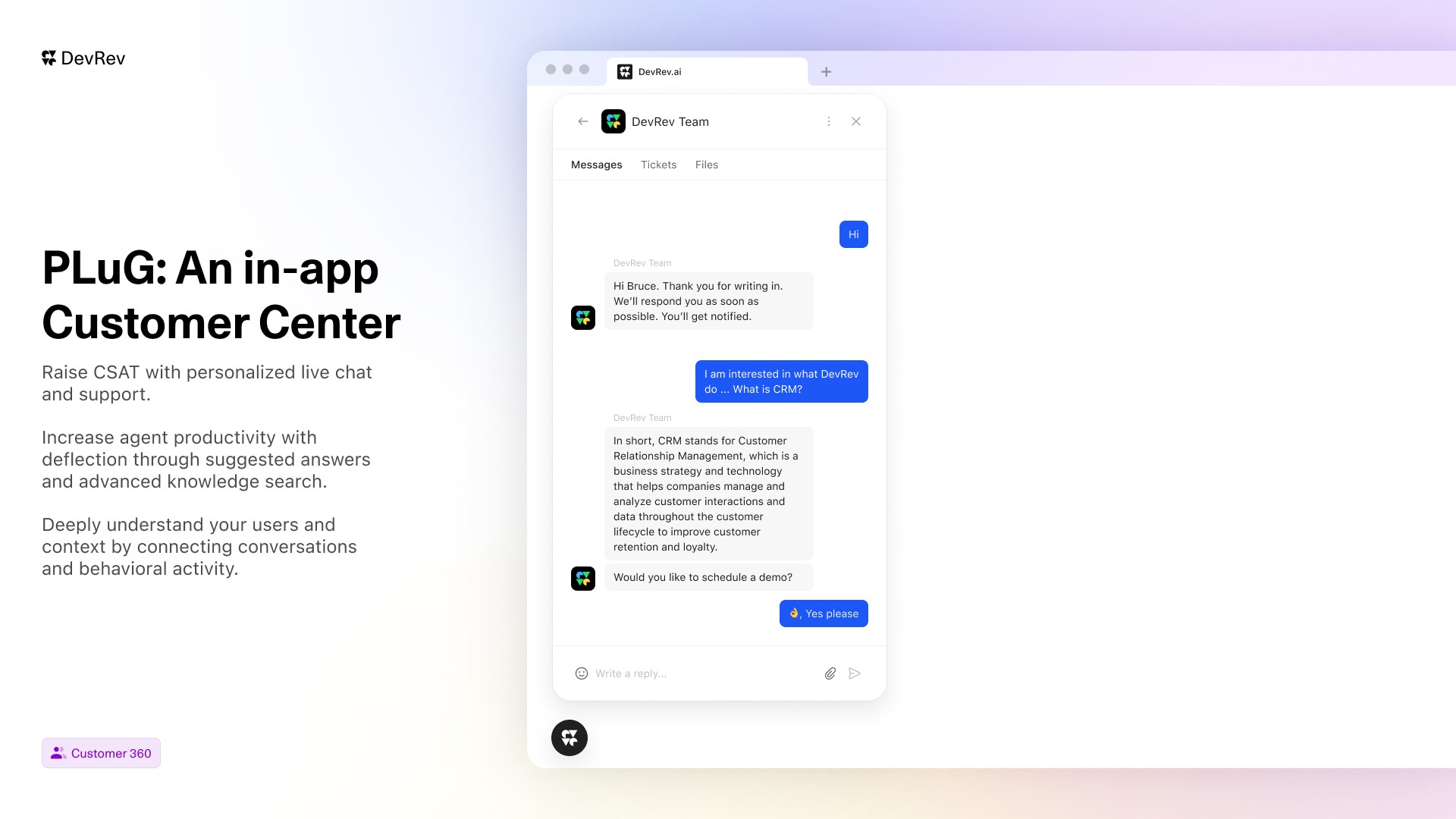
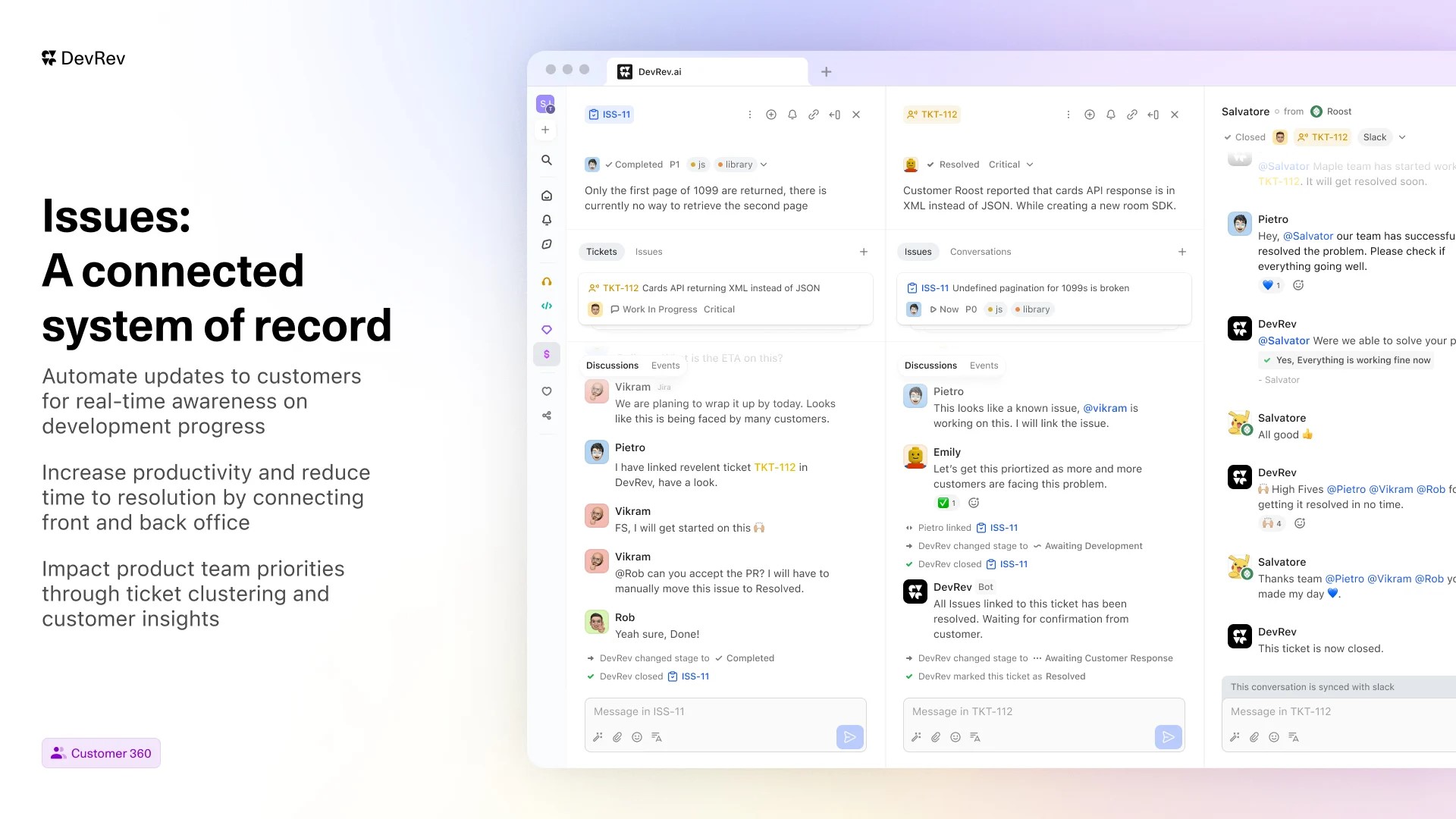
DevRev is a platform for SaaS and technology companies, helping back-office development match the rapid pace of front-office customer relationships. The vendor states its mission is to bring end users, support engineers, product managers, and developers together to create a company-wide culture of product and customer-centricity.
$9.99
per month per user
Salesforce Agentforce Service
Score 8.6 out of 10
N/A
Service Cloud is a customer service platform that helps businesses manage and resolve customer inquiries and issues. It provides tools for case management, knowledge base, omni-channel support, automation, and analytics, enabling companies to deliver exceptional customer service experiences.
DevRev knocks all of these other tools out of the water. From being able to migrate seamlessly in 2 weeks from Zendesk, to moving all of our bug and engineering tickets from Asana to DevRev via API in 1 day, and importing our customer information from Hubspot in a matter of …
DevRev is well suited for both multi-team and single-team environments, and teams can realize meaningful value even without having product, engineering, and support all onboarded at the same time. Its strength is clearest when used by customer-facing and delivery-adjacent teams that benefit from shared context and tighter feedback loops. However, DevRev is less appropriate out of the box for teams that sit outside those core functions, as the platform’s terminology and workflows are opinionated toward product, engineering, and support use cases. Without deeper custom object support and greater flexibility in redefining terms and processes, it has been challenging to demonstrate value to those teams and to help them move away from established tools and ways of working.
I think Service Cloud is best suited for medium to large operations that require both proactive and reactive service. It’s a great fit for post-sales support. However, I wouldn’t recommend it for very small companies because it can be quite costly, and many of the features may go unused. Salesforce also performs best when you have a capable team managing it, so it’s important to consider your organization’s size and readiness before starting. Once you do, I recommend exploring other parts of the Salesforce ecosystem—Service Cloud works even better when integrated with Sales Cloud, since it allows better visibility across teams.
Email to case is an interesting piece of it. The threading is very strong, sometimes too strong, but it does very well at handling the incoming emails.
The omnichannel routing, using skill-based routing is really effective.
Pathing. So making the workflow and helping the team understand what it is that they're trying to do, what they have to accomplish, those step-by-step pieces. That's really helpful.
The onboarding experience could be improved for teams that are not directly implementing DevRev, as they are often introduced to a powerful platform without enough guided context and can feel overwhelmed early on.
Creating and managing objects, dashboards, and other configurations would benefit from more robust desktop-based creation tools, as current workflows can feel constrained or unintuitive at scale. Use industry standard language and report building.
While regressions are rarely critical, the frequency of small UI issues, such as broken date selectors or text visibility problems caused by theming, creates unnecessary friction and frustration for users.
We had a principle initially to try and use Omni as much as we can from the user experience perspective, but have found that fairly restrictive. It was very difficult to actually get the right customer experience and customer engagement going. So we're actually on a journey at the moment to replace all of our Omni with Lightning web components that gives us that flexibility. That's probably one area where we've had some challenges in terms of how we've used the product out of the box.
Professional edition works best for a small company with lower call volumes and is very useful but as you grow exponetially I think it has limited ability to do all the things we want to - SLA management, defect, release management to name a few. Reports and dashboards being available in real time.
DevRev provides strong support through a dedicated key account manager and tech team, making the experience seamless. There might be hurdles, but they get resolved with team support. The tool is also very easy to use, with the user able to customize and use various features as needed.
I had Salesforce experience prior to using Service Cloud which made it a little easier to learn and navigate, but overall my team (some who had no Salesforce experience) caught on very quickly and found Service Cloud to be easy to use.
Working on an application that caters to customer needs requires a platform that acts as a mediator between the actual person and the client. This mediator handles the customer and resolves many of their doubts, helps them map through the entire process, and automates the processes. Such a platform is Salesforce Service Cloud. For queries that cannot be serviced by the platform, it creates a separate ServiceNow ticket for us, and it is assigned.
I have no functionality, reliability, or speed concerns with DevRev. In the past, we raised a few latency issues that were fixed within days by the engineering team. The DevRev team were incredibly thankful for these being raised.
The Salesforce Service Cloud generally has very good performance, however the overall new Lightning user experience can bring that down. For example, if you have too many tabs open, then it can take a while for the Lightning UI to load. This UI is probably not well equipped to handle loading of all of that information at once, but Users tend to leave their tabs open all day long. It can also be fickle depending on which browser you use, what extensions you have installed, and whether you've cleared your cache. This can be the downfall with any software as a service though, not just Salesforce
Salesforce offers support, although it generally gets routed to overseas support teams first, and once they are unable to help, it gets escalated up the chain to higher tiers. Frequently, the answer back from support is that there is no native solution, and we either have to turn to the AppExchange for some solution provided by another developer, or custom build our own solution.
Our in-person training was provided by our implementation partner and it was quite good. This was in part because we were already working with them and so it naturally leant itself to a good training relationship. And because they were building our customizations and configuring things, they could then provide training on those things naturally.
Trailheads are great but it was often unclear what actually applied to our organization. This made it difficult to get a whole lot out of it. Part of it is that because the basic Salesforce features didn't quite work for us, we had to add customizations, which then nullified a lot of the training.
I would go through an implementation very differently knowing what I know now. It was difficult coming from systems we liked in post-sales service and having to adapt to the clunky and underwhelming feature set in Salesforce. I would trim back our expectations
While Freshdesk and Kapture are great tools, they lack advanced features such as agent assist and AI summarisation. Dedicated support at these companies also becomes an issue, as no dedicated team is allotted due to frequent changes. Also, these tools are not DIY kind and require external help for use and excellence.
We selected this product because we already had some competencies in Salesforce. We own a Salesforce partner with expertise in this area, and on top of that, Salesforce purchased it — it was originally called Velocity. When Salesforce decided to acquire it, that finalized the decision for us.
DevRev is incredibly flexible - while we started with a support and product move to the tool - Engineering, Finance, People, and our Account Management team quickly followed. The best part about these teams being in DevRev is tying everything back to the customer and being able to build intuitive, flexible workflows for any need.
We have cut our service team in half over the past 5 years due to the efficiency of the tool
The amount of direct inquiries to our technical team is less than 10% compared to the number support tickets that get entered in the system for them to work in a more organized manner
Responses are 100% more timely because tickets can be responded to by any individual in the queue or on the team, as opposed to direct emails to just one person